167 Results for "

intercalation

" in MedChemExpress (MCE) Product Catalog:
Products (167)

167 Results for "intercalation" in MCE Product Catalog:

Cat. No.: HY-W004588
CAS No.: 72914-19-3
Research Areas:  

Others Cancer

tBu2bpy is a bidentate nitrogen ligand that coordinates with Pt (II) and Pt (IV) to form functional complexes. The tBu2bpy Pt (II) bis-crown ether complex selectively recognizes Mg 2+ and Zn 2+; both ions significantly enhance the fluorescence of the complex and cause a blue shift of the absorption peak. Its six-coordinate Pt (IV) complex [Pt (X)2Me2 ( tBu2bpy)] inhibits the proliferation of tumor cells. tBu2bpy Pt (IV) complexes bind to DNA through multiple interactions including partial intercalation, groove binding, and electrostatic interaction, and can competitively displace ethidium bromide and covalently bind to purine nucleotides. tBu2bpy can be used in relevant research in fields such as organic synthesis .
loading...
    loading...
Cat. No.: HY-W105310A
CAS No.: 14379-00-1
Synonyms: Nacr
Research Areas:  

Others

Croconic acid disodium (Nacr) is a lysine crotonylation (Kcr) activator and electroactive material. Croconic acid disodium reduces the expression of HDAC2, HDAC3, SIRT1, and SIRT3, and increases the expression of EP300, CITED1, ACSS2, DPF2, CDYL, MLLT3, and YEATS2. Croconic acid disodium elevates intracellular crotonyl-CoA content and global histone lysine crotonylation levels. Croconic acid disodium promotes the growth of bovine fibroblasts, regulates cell cycle progression, and inhibits bovine fibroblast apoptosis (apoptosis). Croconic acid disodium improves the blastocyst development efficiency of bovine somatic cell nuclear transfer embryos. Croconic acid disodium undergoes reversible lithium intercalation/deintercalation reactions via sodium-lithium ion exchange. Croconic acid disodium is applicable to research related to cell growth promotion .
loading...
    loading...
Cat. No.: HY-W800535
CAS No.: 480-26-2
Cryptolepine is an orally active multi-potent alkaloid with anti-cancer, anti-bacterial, anti-viral, anti-malarial, anti-inflammatory, anti-hyperglycemic, relieve pain and other properties. Cryptolepine acts as an inhibitor of c-Myc, mTOR, NF-κB, HIF-1, MAPK and an activator of AMPKα1/2. It intercalates into DNA, inhibits topoisomerase II (Top II), disrupts mitochondrial dynamics and induces apoptosis. Cryptolepine also exhibits anti-plasmodial and cholinesterase inhibitory activities. Cryptolepine can be used in research related to tumors (melanoma, hepatocellular carcinoma, mammary adenocarcinoma, etc.), malaria, inflammatory diseases and diabetes, particularly in studies focused on inhibiting tumor growth and anti-plasmodial infection .
loading...
    loading...
Cat. No.: HY-13551C
CAS No.: 80277-14-1
Synonyms: m-AMSA isethionate; Acridinyl anisidide isethionate
Amsacrine isethionate (m-AMSA isethionate) is a Topoisomerase II inhibitor. Amsacrine isethionate intercalates into DNA. Amsacrine isethionate induces Ca 2+-mediated inactivation of ERK, and also downregulates AKT, promoting MCL1 downregulation mediated by GSK3β via reducing the phosphorylation level of GSK3β. Amsacrine isethionate induces Apoptosis by activating Caspase-9 and Caspase-3. Amsacrine isethionate blocks HERG potassium channels in the open/inactivated state. Amsacrine isethionate induces chromosomal aberrations and sister chromatid exchanges, and inhibits the synthesis of RNA and DNA. Amsacrine isethionate exhibits anti-leukemic activity. Amsacrine isethionate causes cardiac repolarization disorders, QT interval prolongation, ventricular arrhythmias, and increases the risk of sudden cardiac death. Amsacrine isethionate can be used in research related to acute myeloid leukemia, lymphoma and progressive malignancies .
loading...
    loading...
Cat. No.: HY-13551D
CAS No.: 80277-11-8
Synonyms: m-AMSA lactate; Acridinyl anisidide lactate
Amsacrine lactate (m-AMSA lactate) is a Topoisomerase II inhibitor. Amsacrine lactate intercalates into DNA. Amsacrine lactate induces Ca 2+-mediated inactivation of ERK, and also downregulates AKT, promoting MCL1 downregulation mediated by GSK3β via reducing the phosphorylation level of GSK3β. Amsacrine lactate induces Apoptosis by activating Caspase-9 and Caspase-3. Amsacrine lactate blocks HERG potassium channels in the open/inactivated state. Amsacrine lactate induces chromosomal aberrations and sister chromatid exchanges, and inhibits the synthesis of RNA and DNA. Amsacrine lactate exhibits anti-leukemic activity. Amsacrine lactate causes cardiac repolarization disorders, QT interval prolongation, ventricular arrhythmias, and increases the risk of sudden cardiac death. Amsacrine lactate can be used in research related to acute myeloid leukemia, lymphoma and progressive malignancies .
loading...
    loading...
Cat. No.: HY-159122
CAS No.: 3009842-92-3
CA IX-IN-2 (Compound 9o) is an inhibitor for carbonic anhydrase (CA), that inhibits CA IX, CA XII and CA II with an IC50 of 5.6, 7.4 and 430 nM, respectively. CA IX-IN-2 inhibits the proliferation of cancer cell HCT-116, SW480, MDA-MB 231 and MCF-7, with IC50s of 14.63-29.33 μM. CA IX-IN-2 intercalates DNA, arrests cell cycle at G1/S phase, and induces apoptosis in MDA-MB-231. CA IX-IN-2 affects the mitochondrial membrane potential (MMP), increases the intracellular ROS levels, causes mitochondrial damage, and inhibits the cell migration of MDA-MB-231. CA IX-IN-2 exhibits antitumor efficacy in mouse models .
loading...
    loading...
Cat. No.: HY-D0917
CAS No.: 157199-59-2
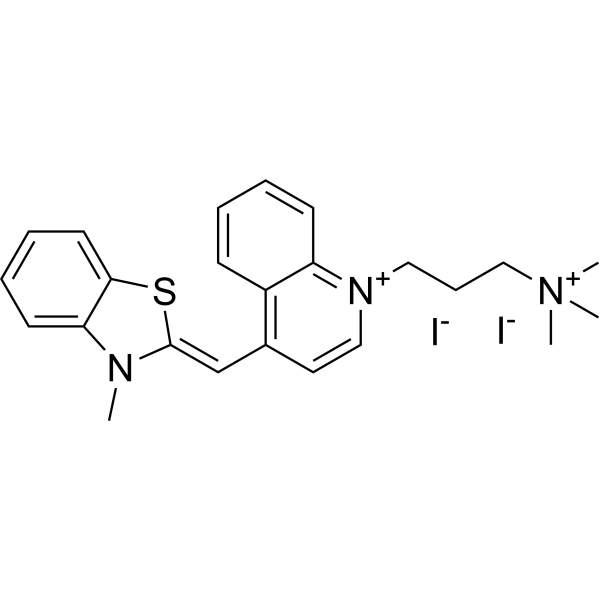
NIR-Red Dead Cell-1 Dye is a DNA-binding fluorescent dye for non-living cells (Ex/Em=515 nm/531 nm). NIR-Red Dead Cell-1 Dye can intercalate into base pairs of double-stranded DNA and produce stronger fluorescence. NIR-Red Dead Cell-1 Dye is suitable for necrotic cells or late apoptotic cells with damaged cell membranes, showing green fluorescence under fluorescence microscopy or flow cytometry. NIR-Red Dead Cell-1 Dye can be used to distinguish live cells from dead cells and distinguish cell membrane integrity. NIR-Red Dead Cell-1 Dye can be attached to the surface of Feraheme (FH) nanoparticles (NPs) to obtain fluorescent dye-functionalized NPs for drug delivery studies .
loading...
    loading...

