9 Results for "

CHO-K1 cell membranes

" in MedChemExpress (MCE) Product Catalog:
Products (9)

9 Results for "CHO-K1 cell membranes" in MCE Product Catalog:

2
2 Cited Publications
Cat. No.: HY-13242
CAS No.: 1258861-20-9
Purity:  99.92%
Synonyms: LY2940680
Target:  

Smo Gli

Research Areas:  

Cancer

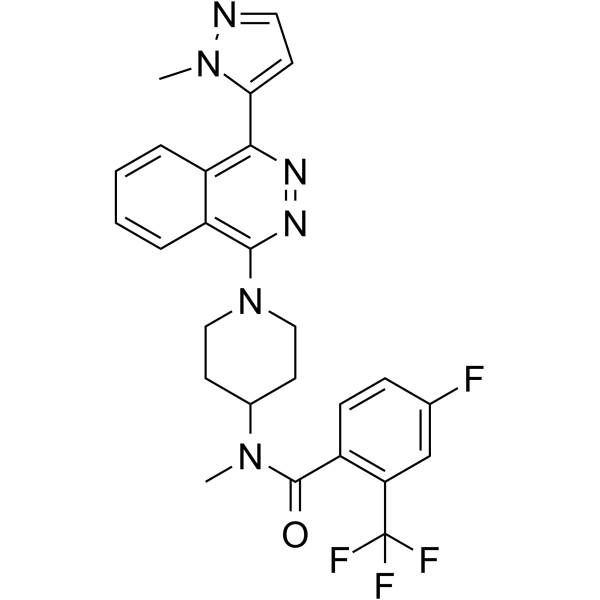
Taladegib is a Smoothened (SMO) antagonist. Taladegib hydrochloride inhibits the Hedgehog signaling pathway, with an IC50 of 5.5 nM for suppressing GLI1 mRNA expression in DAOY cells and an IC50 of 7.6 nM in CGNP cell proliferation assays. Taladegib binds to the extracellular loop region (site 1) of the transmembrane domain of the SMO receptor, competes with cyclopamine for SMO binding, and thereby inhibits Gli-dependent transcription. Taladegib can be used in studies of Hedgehog pathway-related cancers .
loading...
    loading...
2
2 Cited Publications
Cat. No.: HY-13242A
CAS No.: 1258861-21-0
Synonyms: LY2940680 hydrochloride
Target:  

Smo Gli

Research Areas:  

Cancer

Taladegib (LY2940680) hydrochloride is a Smoothened (SMO) antagonist. Taladegib hydrochloride inhibits the Hedgehog signaling pathway, with an IC50 of 5.5 nM for suppressing GLI1 mRNA expression in DAOY cells and an IC50 of 7.6 nM in CGNP cell proliferation assays. Taladegib hydrochloride binds to the extracellular loop region (site 1) of the transmembrane domain of the SMO receptor, competes with cyclopamine for SMO binding, and thereby inhibits Gli-dependent transcription. Taladegib hydrochloride can be used in studies of Hedgehog pathway-related cancers .
loading...
    loading...
1
1 Cited Publications
Cat. No.: HY-P1108
CAS No.: 681260-70-8
Target:  

CRFR

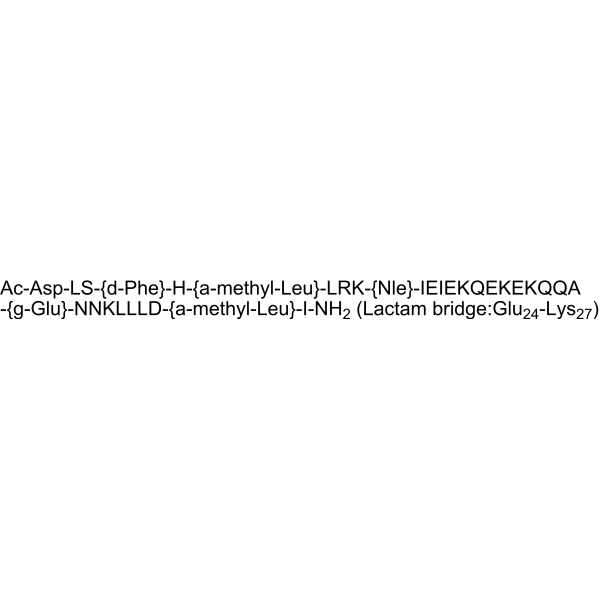
Astressin 2B is a blood-brain barrier-impermeable, highly selective CRFR2 antagonist (rCRFR2, IC50=0.57 nM). Astressin 2B blocks the protective effects mediated by CRFR2, thereby exacerbating indomethacin (HY-14397)-induced hemorrhagic intestinal injury in rats. Astressin 2B reverses the protective effects of Urocortin 1 against intestinal hypermotility, bacterial invasion and upregulation of inflammatory mediators. Astressin 2B also blocks the anxiogenic effect of Urocortin 2 and attenuates stress-induced anxiety-related behaviors. In the Clostridioides difficile toxin A (C. difficile toxin A)-mediated enteritis model, Astressin 2B mimics the phenotype of CRFR2-deficient mice, significantly exacerbating intestinal epithelial damage, edema, neutrophil migration and the expression of multiple proinflammatory cytokines. Astressin 2B is an important tool molecule for investigating the intestinal protective mechanisms of CRFR2 .
loading...
    loading...
Cat. No.: HY-182645
CAS No.: 441060-02-2
Target:  

CRFR

Research Areas:  

Neurological Disease

CRF1 receptor antagonist-2 is an orally active, blood-brain barrier permeable CRF1 receptor antagonist, with an IC50 of 4 nM in CHO-K1 cell membranes and an IC50 of 7 nM in rat brain cell membranes. CRF1 receptor antagonist-2 exerts anxiolytic effects in swim stress-loaded rats. CRF1 receptor antagonist-2 can be used in studies related to stress-induced anxiety .
loading...
    loading...
Cat. No.: HY-181682
Target:  

Neurokinin Receptor

Research Areas:  

Endocrinology

NK3R antagonist-1 is an orally active neurokinin-3 receptor (NK3R) antagonist with an IC50 of 53.61 nM. NK3R antagonist-1 reduces plasma luteinizing hormone (LH) levels in ovariectomized rat models. NK3R antagonist-1 is applicable to research related to menopausal hot flushes .
loading...
    loading...
Cat. No.: HY-183599
CAS No.: 2433765-51-4
Target:  

Adenosine Receptor

Research Areas:  

Cancer

MK-1088 is an orally active A2A/A2B adenosine receptor antagonist with human A2A Ki of 0.31 nM, human A2B Ki 5.3 nM. MK-1088 blocks receptor downstream signaling, inhibits CREB phosphorylation and reverses adenosine-mediated immunosuppression. MK-1088 restores TNF−α release and enhances tumor immune surveillance. MK-1088 can be used for the research of cancer[1].
loading...
    loading...
Cat. No.: HY-185699A
Target:  

Bacterial

Research Areas:  

Infection

Antibacterial agent 350 TFA is a membrane stabilizer/disruptor with antibacterial activity. Antibacterial agent 350 TFA reduces glucose-induced efflux efficiency and slightly impairs outer membrane stability. Antibacterial agent 350 TFA significantly decreases the bacteriostatic MIC50 of Ceftazidime (HY-B0593) or Ciprofloxacin (HY-B0356), but increases the MIC50 of Amikacin (HY-B0509A). Antibacterial agent 350 TFA can be used for the research of Pseudomonas aeruginosa infections .
loading...
    loading...
Cat. No.: HY-185699B
Target:  

Bacterial

Research Areas:  

Infection

Antibacterial agent 350 hydrochloride is a membrane stabilizer/disruptor with antibacterial activity. Antibacterial agent 350 hydrochloride reduces glucose-induced efflux efficiency and slightly impairs outer membrane stability. Antibacterial agent 350 hydrochloride significantly decreases the bacteriostatic MIC50 of Ceftazidime (HY-B0593) or Ciprofloxacin (HY-B0356), but increases the MIC50 of Amikacin (HY-B0509A). Antibacterial agent 350 hydrochloride can be used for the research of Pseudomonas aeruginosa infections .
loading...
    loading...
Cat. No.: HY-185699
CAS No.: 1394833-44-3
Target:  

Bacterial

Research Areas:  

Infection

Antibacterial agent 350 is a membrane stabilizer/disruptor with antibacterial activity. Antibacterial agent 350 reduces glucose-induced efflux efficiency and slightly impairs outer membrane stability. Antibacterial agent 350 significantly decreases the bacteriostatic MIC50 of Ceftazidime (HY-B0593) or Ciprofloxacin (HY-B0356), but increases the MIC50 of Amikacin (HY-B0509A). Antibacterial agent 350 can be used for the research of Pseudomonas aeruginosa infections .
loading...
    loading...

