16 Results for "

Daoy

" in MedChemExpress (MCE) Product Catalog:
Products (16)

16 Results for "Daoy" in MCE Product Catalog:

2
2 Cited Publications
Cat. No.: HY-13242
CAS No.: 1258861-20-9
Purity:  99.92%
Synonyms: LY2940680
Target:  

Smo Gli

Research Areas:  

Cancer

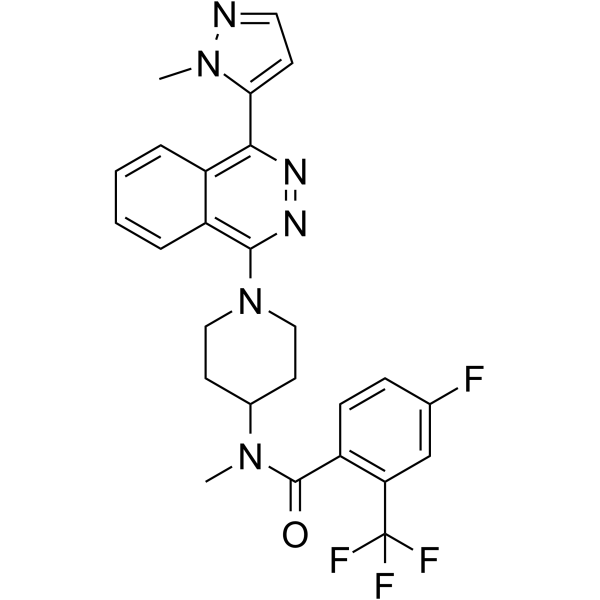
Taladegib is a Smoothened (SMO) antagonist. Taladegib hydrochloride inhibits the Hedgehog signaling pathway, with an IC50 of 5.5 nM for suppressing GLI1 mRNA expression in DAOY cells and an IC50 of 7.6 nM in CGNP cell proliferation assays. Taladegib binds to the extracellular loop region (site 1) of the transmembrane domain of the SMO receptor, competes with cyclopamine for SMO binding, and thereby inhibits Gli-dependent transcription. Taladegib can be used in studies of Hedgehog pathway-related cancers .
loading...
    loading...
Cat. No.: HY-179078
CAS No.: 1996636-69-1
Target:  

OLIG2 Apoptosis Caspase PARP

Research Areas:  

Neurological Disease Cancer

CT-179 is a brain-penetrant and orally active OLIG2 inhibitor with a human IC50 of 1250 nM. CT-179 disrupts OLIG2 dimerization, phosphorylation, and DNA binding, blocking OLIG2-driven transcription. CT-179 induces G2/M phase arrest and increases G0 population. CT-179 induces apoptosis by reducing anti-apoptotic proteins and increasing cleaved caspase-3 and cleaved PARP. CT-179 can be used for the research of subgroup medulloblastoma .
loading...
    loading...
Cat. No.: HY-169946
CAS No.: 3047737-15-2
Target:  

Wee1

Research Areas:  

Cancer

WEE1/PKMYT1-IN-1 (compound 75) is a potent and orally active WEE1 and PKMYT1 inhibitor. WEE1/PKMYT1-IN-1 shows antiproliferation activity .
loading...
    loading...
Cat. No.: HY-W587738
CAS No.: 552-02-3
Viridiflorol is an active natural molecule with anti-cancer effect. Viridiflorol induces anti-neoplastic effects on breast (MCF-7, IC50 = 10 µM), lung (A549, IC50 = 30 µM), and brain (Daoy, IC50 = 0.1 µM) cancer cells through apoptosis. Viridiflorol can be used for breast, lung, and brain cancer research .
loading...
    loading...
Cat. No.: HY-P6299
CAS No.: 944792-75-0
Research Areas:  

Neurological Disease Cancer

MAX8 is a synthetic β-hairpin peptide that folds rapidly and self-assembles into a β-sheet-rich fibrous hydrogel network via non-covalent crosslinking. MAX8 hydrogel exhibits excellent shear-thinning and self-healing properties, enabling precise delivery via syringe and maintaining local retention after implantation. MAX8 hydrogel can uniformly encapsulate cells while preserving their viability and morphology, and protect growth factors (e.g., NGF) and chemotherapeutic drugs from degradation. MAX8 is applicable for spinal cord injury repair, medulloblastoma treatment, and three-dimensional high-throughput drug screening .
loading...
    loading...
Cat. No.: HY-169946A
CAS No.: 3047759-59-8
Target:  

Wee1

Research Areas:  

Cancer

WEE1/PKMYT1-IN-2 is the axial chiral P configuration of WEE1/PKMYT1-IN-1 (HY-169946). WEE1/PKMYT1-IN-1 is a potent and orally active WEE1 and PKMYT1 inhibitor. WEE1/PKMYT1-IN-1 shows antiproliferation activity .
loading...
    loading...
Cat. No.: HY-169946B
CAS No.: 3047759-60-1
Target:  

Wee1

Research Areas:  

Cancer

WEE1/PKMYT1-IN-3 is the axial chiral M configuration of WEE1/PKMYT1-IN-1 (HY-169946). WEE1/PKMYT1-IN-1 is a potent and orally active WEE1 and PKMYT1 inhibitor. WEE1/PKMYT1-IN-1 shows antiproliferation activity .
loading...
    loading...
Cat. No.: HY-101761A
CAS No.: 2319722-53-5
Target:  

PAI-1 Apoptosis

Research Areas:  

Cardiovascular Disease Cancer

TM5441 is an orally bioavailable inhibitor of plasminogen activator inhibitor-1 (PAI-1), has IC50 values between 13.9 and 51.1 μM. TM5441 induces intrinsic apoptosis in several human cancer cell lines. TM5441 attenuates Nω-nitro-l-arginine methyl ester-induced cardiac hypertension and vascular senescence .
loading...
    loading...
Cat. No.: HY-P10699
CAS No.: 487036-63-5
Research Areas:  

Neurological Disease Cancer

MAX1 is a synthetic β-hairpin peptide that folds rapidly and self-assembles into a β-sheet-rich fibrous hydrogel network via non-covalent crosslinking. MAX1 hydrogel exhibits excellent shear-thinning and self-healing properties, enabling precise delivery via syringe and maintaining local retention after implantation. MAX1 hydrogel can uniformly encapsulate cells while preserving their viability and morphology, and protect growth factors (e.g., NGF) and chemotherapeutic drugs from degradation. MAX1 is applicable for spinal cord injury repair, medulloblastoma treatment, and three-dimensional high-throughput drug screening .
loading...
    loading...
Cat. No.: HY-150564
CAS No.: 1822355-27-0
Purity:  98.12%
Target:  

Smo Hedgehog

Research Areas:  

Cancer

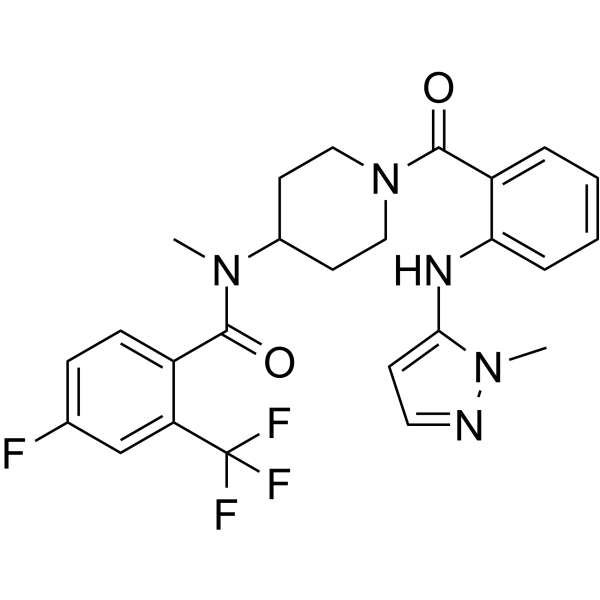
SMO-IN-2 is a potent smoothened (SMO) inhibitor with an IC50 value of 123.4 nM for hedgehog (Hh) signaling pathway. SMO-IN-2 has antiproliferative activity against human medulloblastoma cell line Daoy. Anticancer activity .
loading...
    loading...
Cat. No.: HY-150567
CAS No.: 2376914-71-3
Target:  

Smo Hedgehog

Research Areas:  

Cancer

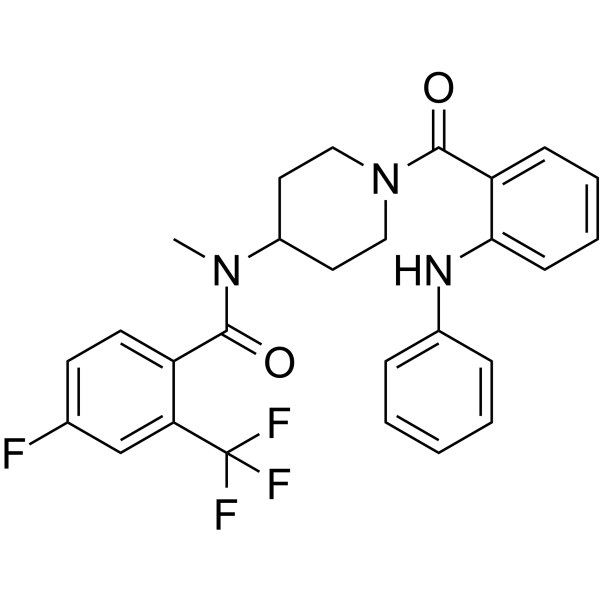
SMO-IN-3 (compound 12a) is a potent smoothened (SMO) inhibitor with an IC50 value of 34.09 nM for hedgehog (Hh) signaling pathway. SMO-IN-3 has antiproliferative activity against human medulloblastoma cell line Daoy. Anticancer activity .
loading...
    loading...
Cat. No.: HY-146209
CAS No.: 2426665-56-5
Research Areas:  

Cancer

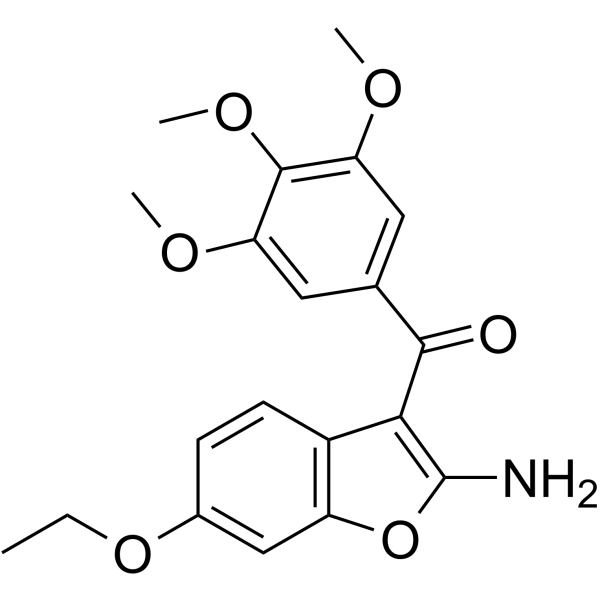
Tubulin polymerization-IN-13 (Compound 4f) is a tubulin polymerization inhibitor (IC50=0.37 μM). Tubulin polymerization-IN-13 shows anti-proliferative activity against cancer cells, induces apoptosis and potential antivascular activity .
loading...
    loading...
Cat. No.: HY-13242A
CAS No.: 1258861-21-0
Synonyms: LY2940680 hydrochloride
Target:  

Smo Gli

Research Areas:  

Cancer

Taladegib (LY2940680) hydrochloride is a Smoothened (SMO) antagonist. Taladegib hydrochloride inhibits the Hedgehog signaling pathway, with an IC50 of 5.5 nM for suppressing GLI1 mRNA expression in DAOY cells and an IC50 of 7.6 nM in CGNP cell proliferation assays. Taladegib hydrochloride binds to the extracellular loop region (site 1) of the transmembrane domain of the SMO receptor, competes with cyclopamine for SMO binding, and thereby inhibits Gli-dependent transcription. Taladegib hydrochloride can be used in studies of Hedgehog pathway-related cancers .
loading...
    loading...
Cat. No.: HY-181442
CAS No.: 313226-24-3
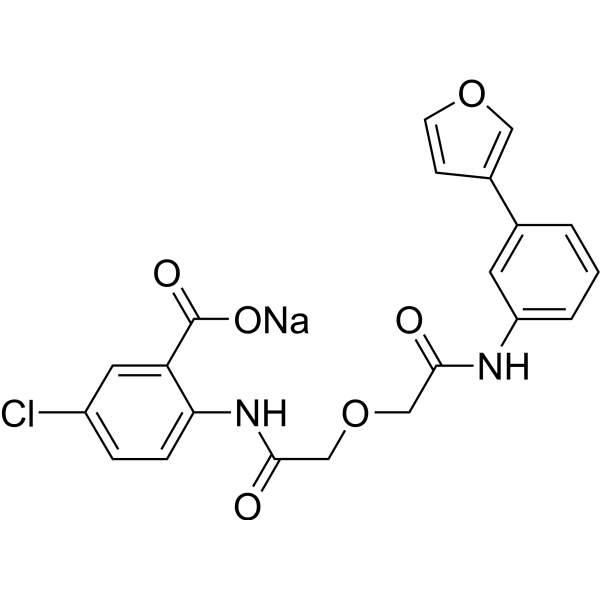
CK2-TN03 is an ATP-competitive casein kinase 2 (CK2) inhibitor, with an IC50 of 165 nM and a Ki of 20 nM. CK2-TN03 inhibits CK2-mediated survivin activation and reduces CK2-dependent phosphorylation levels of BRD4/MYCN and AKT1. CK2-TN03 exerts anti-neuroblastoma effects by inhibiting survivin, leading to mitotic catastrophe and apoptosis of cancer cells. CK2-TN03 can be used in studies related to neuroblastoma .
loading...
    loading...
Cat. No.: HY-181169
Research Areas:  

Cancer

GAK-IN-3 is a cyclin G-associated kinase (GAK) inhibitor with an IC50 of 207 nM and a Ki of 66 nM. GAK-IN-3 inhibits kinase activity in the nanomolar range by binding to GAK’s ATP-binding site. GAK-IN-3 acts as a cytotoxic agent that reduces viability of Ewing sarcoma cells. GAK-IN-3 can be used for the research of ewing sarcoma .
loading...
    loading...
Cat. No.: HY-129980A
CAS No.: 136449-85-9
Research Areas:  

Neurological Disease Cancer

NPC-15437 is a selective PKC inhibitor with an IC50 of 19 µM. NPC-15437 competitively inhibits phorbol ester- (Ki of 5 µM) and phosphatidylserine-induced (Ki of 12 µM) PKC activity. NPC-15437 does not inhibits cAMP-dependent or calcium/calmodulin-dependent protein kinases. NPC-15437 augments TRAIL-induced cell death in non-small cell lung cancer and medulloblastoma cells. NPC-15437 can be used for the research of non-small cell lung cancer, medulloblastoma, and neurological disease .
loading...
    loading...
  • 1

