

1. Search Result
Search Result
Results for "

EGFR Peptide

" in MedChemExpress (MCE) Product Catalog:

22

Inhibitors & Agonists

4

Biochemical Assay Reagents

15

Peptides

1

Click Chemistry

4

Oligonucleotides

Art. -Nr. Produktname Target Forschungsgebiete Chemical Structure
  • HY-P10408

    EGFR MMP Calcium Channel NOD-like Receptor (NLR) ERK p38 MAPK Infection Inflammation/Immunology
    Candidalysin is a cytolytic peptide toxin secreted by the fungus Candida albicans. Candidalysin drives epithelial immune responses by activating the EGFR-MAPK signaling pathway, inducing MMP expression and calcium influx, and regulating the c-Fos transcription factor and MKP1 via p38 MAPK and ERK1/2 respectively. Candidalysin is essential for mucosal and systemic infections, activating NLRP3 to promote inflammatory responses, neutrophil recruitment, and Th17 immunity. Candidalysin activates LDH causing membrane damage and exhibiting cytotoxicity
    Candidalysin
  • HY-W782083

    Biochemical Assay Reagents Radionuclide-Drug Conjugates (RDCs) Bombesin Receptor EGFR Cancer
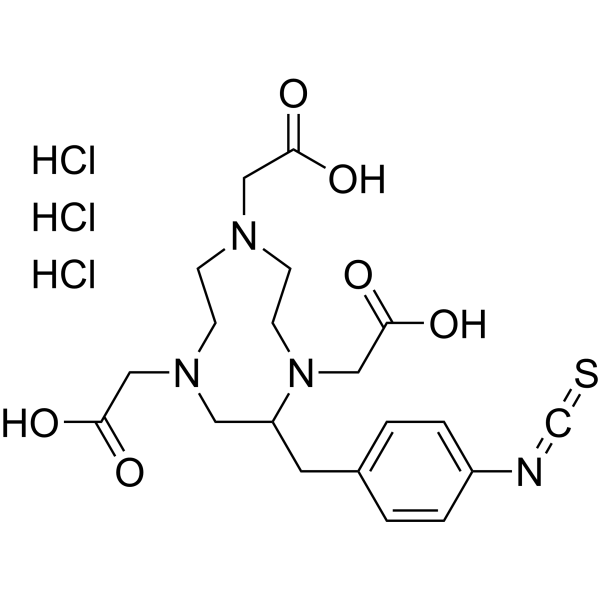
    p-SCN-Bn-NOTA trihydrochloride is a macrocyclic chelator. p-SCN-Bn-NOTA trihydrochloride can be covalently coupled to molecules such as peptides through the thiocyanate group to form hexacoordinate copper (such as 64Cu) complexes. p-SCN-Bn-NOTA trihydrochloride specifically binds to GRPR or EGFR highly expressed on the surface of tumor cells, mediating tumor enrichment of radioactive probes. p-SCN-Bn-NOTA trihydrochloride can be used to study malignant tumors expressing GRPR or EGFR, such as prostate cancer and colorectal cancer .
    p-SCN-Bn-NOTA trihydrochloride
  • HY-172470

    Liposome EGFR Cancer
    DSPE-PEG2000-GE11 is a nanocarrier component composed of DSPE and the EGFR-targeting peptide (GE11). DSPE-PEG2000-GE11 specifically binds to EGFR and mediates receptor-mediated endocytosis of micellar drug carriers. DSPE-PEG2000-GE11 can be used for drug delivery .
    DSPE-PEG2000-GE11
  • HY-W062835

    Src Cancer
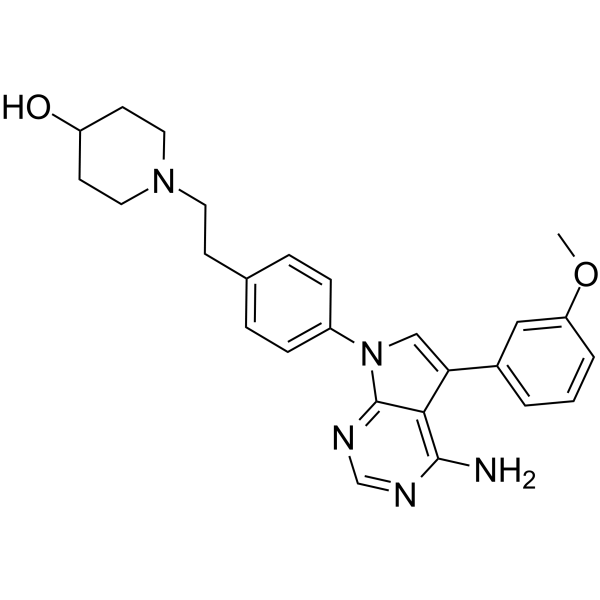
    CGP77675 is an orally active and potent inhibitor of Src family kinases. CGP77675 inhibits phosphorylation of peptide substrates and autophosphorylation of purified Src (IC50s of 5-20 and 40 nM, respectively), and also inhibits Src, EGFR, KDR, v-Abl, and Lck with IC50s of 5-20, 40, 20, 150, 1000, 310, and 290 nM, respectively. Anticancer activity .
    CGP77675
  • HY-P11308

    EGFR Cancer
    Cys-GE11 is an N-terminal modified GE11 (HY-P10128) with cysteine ​​(Cys) added. Cys-GE11 can be coupled through the thiol group of Cys. Cys-GE11 can be linked to PEG-P (TMC-DTC) through the N-terminus of cysteine to form a targeted polymer. Cys-GE11 can target cells with high EGFR expression (such as SMMC-7721 cells). Cys-GE11 can significantly enhance drug enrichment at the tumor site and exhibit low toxicity .
    Cys-GE11
  • HY-P11078A

    EGFR Cancer
    LARLLT TFA is an EGFR-binding peptide. LARLLT has the potential for research of EGFR overexpressing cancers, such as lung, ovarian and colorectal cancer .
    LARLLT TFA
  • HY-P11078

    EGFR Cancer
    LARLLT (D4) is an EGFR-binding peptide. LARLLT has the potential for research of EGFR overexpressing cancers, such as lung, ovarian and colorectal cancer .
    LARLLT
  • HY-P1085

    EGFR Cancer
    Epidermal Growth Factor Receptor Peptide (985-996) is an amino acid peptide fragment derived from positions 985-996 in epidermal growth factor receptor (EGFR) .
    Epidermal Growth Factor Receptor Peptide (985-996)
  • HY-P10994

    Eps8(327-335)

    EGFR IFNAR Interleukin Related TNF Receptor Complement System Apoptosis Inflammation/Immunology Cancer
    Eps8 peptide 327 is an HLA-A*2402-restricted peptide antigen derived from Eps8 protein. Eps8 peptide 327 has potent antitumor activity with significant cytotoxicity. Eps8 peptide 327 effectively inhibits cancer cells proliferation, induces apoptosis and disrupts EGFR signal pathway by inhibiting downstream signals (such as IL-2, TNF-α and IFN-γ) expression and the Eps8/EGFR interaction. Eps8 peptide 327 significantly inhibits tumor growth in HT-29 xenograft mcie models .
    Eps8 peptide 327
  • HY-P10967

    PKC Metabolic Disease
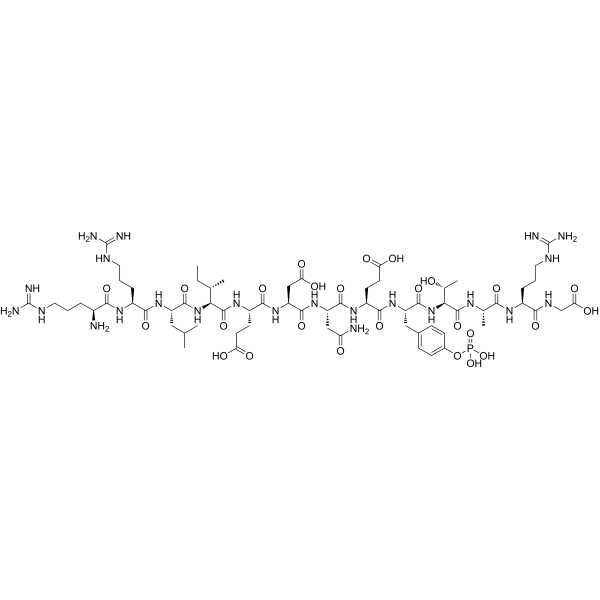
    EGFR Peptide is a selective substrate peptide for PKC. EGFR Peptide can used to measure PKC activity .
    EGFR Peptide
  • HY-P3918

    p38 MAPK Others
    EGF-R (661-681) T669 Peptide is a MAPK substrate that can used to measure MAPK catalytic activity .
    EGF-R (661-681) T669 Peptide
  • HY-P2548

    EGFR Others
    pp60 (v-SRC) Autophosphorylation Site, Phosphorylated is the phosphorylated peptide of an EGFR substrate. pp60 (v-SRC) Autophosphorylation Site, Phosphorylated can be used for the screening of EGFR Kinase inhibitors via phosphorylated-substrate quantification .
    pp60 (v-SRC) Autophosphorylation Site, Phosphorylated
  • HY-172470A

    Liposome EGFR Cancer
    DSPE-PEG3400-GE11 is a PEG compound which composed of DSPE and an EGFR targeting peptide (GE11). GE11 can be used for EGFR overexpressed cancer cells. DSPE-PEG3400-GE11 can be used for drug delivery .
    DSPE-PEG3400-GE11
  • HY-P10659

    EGFR Cancer
    Self-assembling peptide pY1 is a peptide that assemblies around cancer cells and targets EGFR. When co-cultured with Ovalbumin (OVA), pY1 can effectively block the endocytosis of OVA .
    Self-assembling peptide pY1
  • HY-172471

    Liposome EGFR Cancer
    DSPE-PEG5000-GE11 is a PEG compound which composed of DSPE and an EGFR targeting peptide (GE11). GE11 can be used for EGFR overexpressed cancer cells. DSPE-PEG5000-GE11 can be used for drug delivery .
    DSPE-PEG5000-GE11
  • HY-172469

    Liposome EGFR Cancer
    DSPE-PEG1000-GE11 is a PEG compound which composed of DSPE and an EGFR targeting peptide (GE11). GE11 can be used for EGFR overexpressed cancer cells. DSPE-PEG1000-GE11 can be used for drug delivery .
    DSPE-PEG1000-GE11
  • HY-P10995

    EGFR IFNAR Interleukin Related TNF Receptor Complement System Apoptosis Inflammation/Immunology Cancer
    TAT-327 is cell-penetrating peptide. TAT-327 selectively inserts into cancer cell membranes and shows potent antitumor activity. TAT-327 effectively inhibits cancer cells proliferation, induces apoptosis and disrupts EGFR signal pathway by inhibiting downstream signals (such as IL-2, TNF-α and IFN-γ) expression and the Eps8/EGFR interaction. TAT-327 significantly inhibits tumor growth in HT-29 xenograft mcie models .
    TAT-327
  • HY-W062835A

    Src Cancer
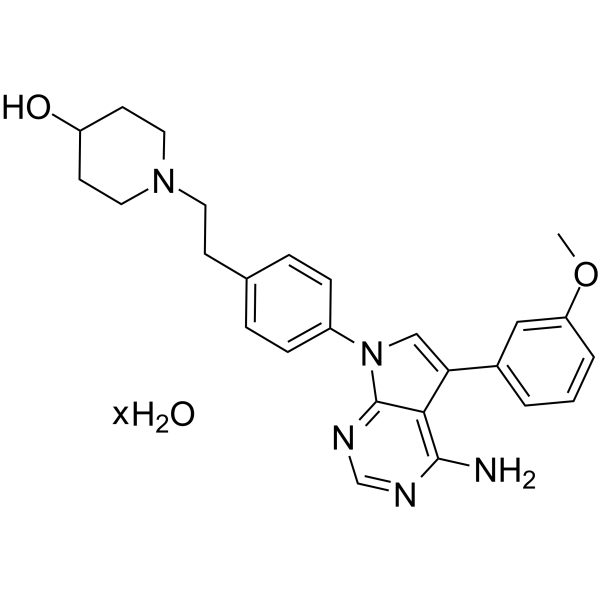
    CGP77675 hydrate is an orally active and potent inhibitor of Src family kinases. CGP77675 hydrate inhibits phosphorylation of peptide substrates and autophosphorylation of purified Src (IC50s of 5-20 and 40 nM, respectively),and also inhibits Src, EGFR, KDR, v-Abl, and Lck with IC50s of 0.02, 0.15, 1.0, 0.31, and 0.29 μM, respectively. Anticancer activity .
    CGP77675 hydrate
  • HY-P11781

    EGFR Cancer
    HW12 is a scrambled peptide control with no EGFR ligand activity. HW12 shows low cellular uptake levels in EGFR-positive cells. HW12 exerts weak growth inhibitory effects on pancreatic cancer. HW12 serves as a scrambled peptide control for EGFR-targeted GE11 (HY-P10128)-conjugated mixed micelles. HW12 can be used in pancreatic cancer research .
    HW12
  • HY-P11757

    EGFR Cancer
    Cyclo[K(N3)larllt] is a seven-membered cyclic peptide targeting EGFR, with a Kd value of 5.09 μM, and exhibits binding selectivity toward homologous proteins HER2 and HER3. Cyclo[K(N3)larllt] has no cytotoxicity and shows no growth inhibitory effect on cancer cells overexpressing EGFR. Cyclo[K(N3)larllt] can serve as a ligand for EGFR-targeted fluorescent conjugates, which is applicable to the detection of cancers with EGFR overexpression. Cyclo[K(N3)larllt] can be used in the research of colorectal cancer .
    Cyclo[K(N3)larllt]
  • HY-P11781A

    Drug Derivative Cancer
    Cys-HW12 is a random peptide containing an N-terminal cysteine. Cys-HW12 can be coupled via the thiol group of Cys. Cys-HW12 can serve as a control for GE11 (HY-P10128)-conjugated mixed micelles targeting EGFR, and also functions as a cytotoxic agent, cellular uptake inhibitor, and tumor growth inhibitor. Cys-HW12 is applicable to pancreatic cancer-related research .
    Cys-HW12
  • HY-P11781B

    Drug Derivative Cancer
    Cys-HW12 TFA is a random peptide containing an N-terminal cysteine and derivative of HW12 (HY-P11781). Cys-HW12 TFA can be coupled via the thiol group of Cys. Cys-HW12 TFA can serve as a control for GE11 (HY-P10128)-conjugated mixed micelles targeting EGFR, and also functions as a cytotoxic agent, cellular uptake inhibitor, and tumor growth inhibitor. Cys-HW12 TFA is applicable to pancreatic cancer-related research .
    Cys-HW12 TFA

Online-Anfrage

Your information is safe with us. * Required Fields.

Anrede


Country or Region *

Name des Antragstellers *


Name der Organisation *

Department *


E-Mail-Addresse *


Produktname *

Art. -Nr.


Requested quantity *

Telefonnummer *


Bemerkungen

Online-Anfrage

Inquiry Information

Produktname:
Art. -Nr.:
Menge:
MCE Japan Authorized Agent:

