9 Results for "

IAP family

" in MedChemExpress (MCE) Product Catalog:
Products (9)

9 Results for "IAP family" in MCE Product Catalog:

23
23 Publications Verification
Cat. No.: HY-16701
CAS No.: 1001600-56-1
Target:  

IAP

Research Areas:  

Cancer

BV6 is an antagonist of cIAP1 and XIAP, members of the inhibitors of apoptosis (IAP) family. BV6 shows an IC50 of 7.2 μM in MTS assays in HCC193 cells. BV6 can be used in the research of endometrial cancer and endometriosis .
loading...
    loading...
23
23 Publications Verification
Cat. No.: HY-16701A
Target:  

IAP

Research Areas:  

Cancer

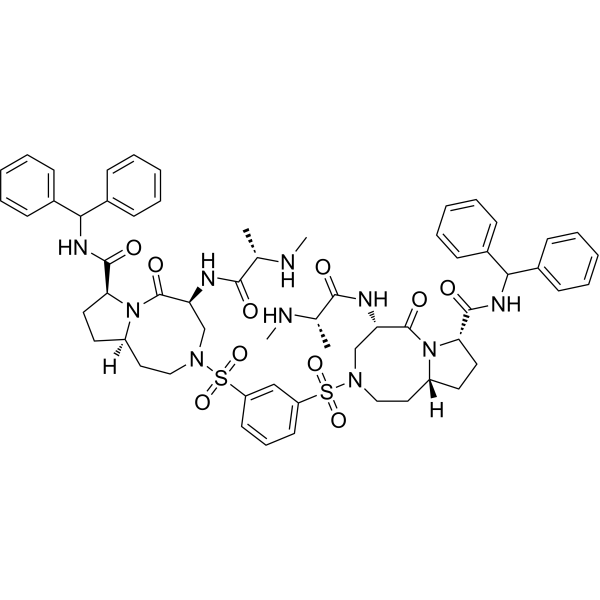
BV6 TFA is an antagonist of cIAP1 and XIAP, members of the inhibitors of apoptosis (IAP) family. BV6 TFA shows an IC50 of 7.2 μM in MTS assays in HCC193 cells. BV6 TFA can be used in the research of endometrial cancer and endometriosis .
loading...
    loading...
3
3 Cited Publications
Cat. No.: HY-N6064
CAS No.: 66663-91-0
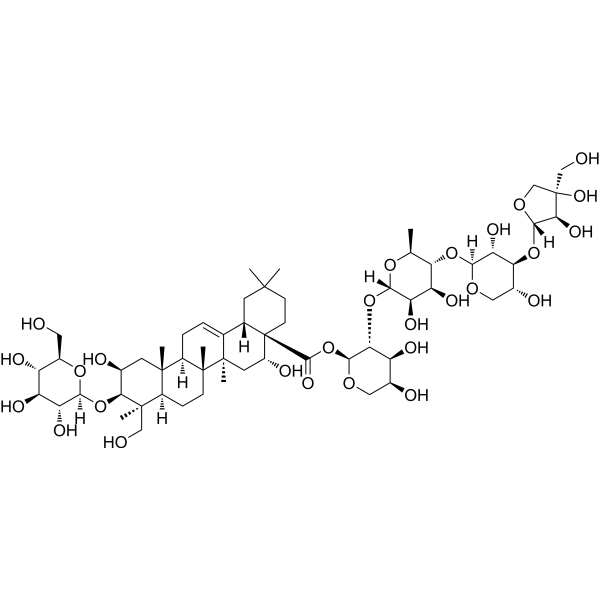
Polygalacin D (PGD) is a bioactive compound isolated from Platycodon grandiflorum with anticancer and anti-proliferative properties. PGD suppresses the expression of the IAP family of proteins including survivin, cIAP-1 and cIAP-2 and blocks the PI3K/Akt pathway by inhibiting the phosphorylation of GSK3β, Akt and the expression of PI3K. Polygalacin D induces apoptosis
loading...
    loading...
Cat. No.: HY-125593
CAS No.: 1570231-89-8
Purity:  99.36%
Synonyms: APG-1387
Target:  

IAP Apoptosis

Research Areas:  

Cancer

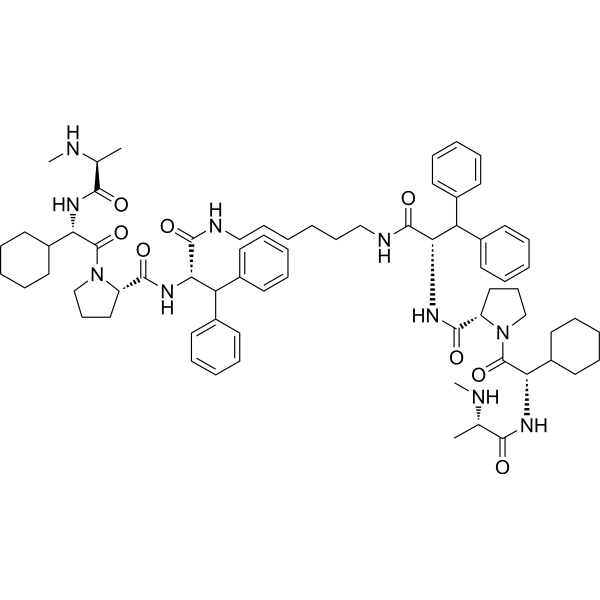
Dasminapant (APG-1387), a bivalent SMAC mimetic and an IAP antagonist, blocks the activity of IAPs family proteins (XIAP, cIAP-1, cIAP-2, and ML-IAP). Dasminapant induces degradation of cIAP-1 and XIAP proteins, as well as caspase-3 activation and PARP cleavage, which leads to apoptosis. Dasminapant can be used for the research of hepatocellular carcinoma, ovarian cancer, and nasopharyngeal carcinoma .
loading...
    loading...
Cat. No.: HY-111875
CAS No.: 2095244-54-3
Purity:  99.68%
Research Areas:  

Cancer

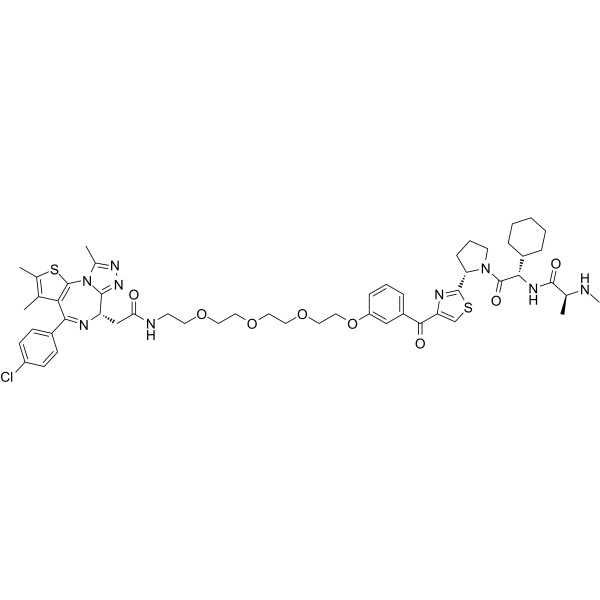
SNIPER (BRD)-1 is a BRD2/3/4 SNIPER degrader. SNIPER (BRD)-1 induces ubiquitin-proteasome-dependent degradation of the epigenetic regulatory proteins BRD2/3/4 as well as the IAP family E3 ligase itself with its IC50 values for cIAP1, cIAP2 and XIAP of 6.8 nM, 17 nM and 49 nM, respectively. SNIPER (BRD)-1 can be used in the research of prostate cancer .
loading...
    loading...
Cat. No.: HY-131188
CAS No.: 2450351-07-0
Target:  

PROTACs Bcl-2 Family

Research Areas:  

Cancer

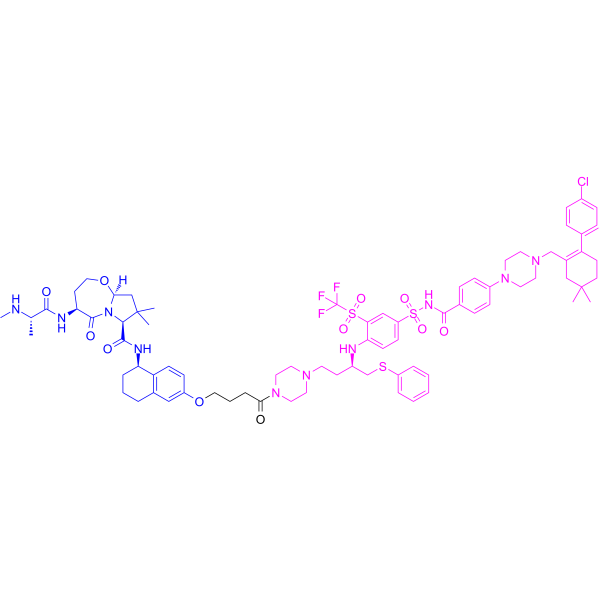
PROTAC Bcl-xL degrader-1 is a PROTAC that comprises a Bcl-xL (Bcl-2 family member) ligand binding group, a linker and an IAP E3 ligases binding group. PROTAC Bcl-xL degrader-1 is a potent Bcl-xL degrader, and shows toxicity for human platelets and MyLa 1929 cells with IC50 values of 62 nM and 8.5 μM, respectively .
loading...
    loading...
Cat. No.: HY-181532
Research Areas:  

Cancer

IAP ligand 8 is an ASX-series, non-peptidic SMAC mimetic and IAP binder with high cell permeability. IAP ligand 8 selectively targets cIAP1-BIR3, XIAP-BIR2 (with a KD of 15.8 nM for both). IAP ligand 8 serves as an IAP ligand moiety to synthesize IAP-recruiting protein degrader (IPD) (HY-181590). This IPD simultaneously forms two ternary complexes, cIAP1-A538-TEAD1 and XIAP-A538-TEAD1, and efficiently degrades TEAD1 via a dual E3 recruitment mechanism, while inducing the autodegradation of cIAP1. IAP ligand 8 and its series of degraders are applicable to targeted research on Hippo pathway-dysregulated cancers such as NF2-mutant mesothelioma .
loading...
    loading...
Cat. No.: HY-P11828
Target:  

Survivin Caspase Apoptosis

Research Areas:  

Cancer

Anticancer agent 324 is a Survivin inhibitor. Anticancer agent 324 competitively binds to Survivin’s linker region and triggers proteasomal IAP degradation. Anticancer agent 324 blocks Borealin binding and chromosomal passenger complex formation, and inhibits Survivin-CRM1 nuclear-cytoplasmic transport. Anticancer agent 324 activates extrinsic (caspase-8) and intrinsic (caspase-9) apoptotic pathways, activates executioner caspases-3 and caspases-7, and arrests cell cycle. Anticancer agent 324 can be used for the research of breast cancer .
loading...
    loading...
Cat. No.: HY-L003
3,650 compounds

Apoptosis is an ordered and orchestrated cellular process that occurs in physiological and pathological conditions, which is also called programmed cell death (PCD). Apoptosis plays a crucial role in developing and maintaining the health of the body by eliminating old cells, unhealthy cells and unnecessary cells. Too little or too much apoptosis contribute to many diseases. When apoptosis does not work correctly, cells that should be eliminated may persist and become immortal, for example, in cancer and leukemia. When apoptosis works overly well, it kills too many cells and inflicts grave tissue damage. This is the case in strokes and neurodegenerative disorders such as Alzheimer's, Huntington's, and Parkinson's disease.

MCE designs a unique collection of 3,650 apoptosis-related compounds mainly focusing on the key targets in the apoptosis signaling pathway and can be used in the research of apoptosis signal pathway and related diseases.

