12 Results for "

Petasites japonicus

" in MedChemExpress (MCE) Product Catalog:
Products (12)

12 Results for "Petasites japonicus" in MCE Product Catalog:

Cat. No.: HY-N7293
CAS No.: 18456-03-6
Bakkenolide D is a sesquiterpene lactone. Bakkenolide D is the major component of Bakkenolides in Petasites tricholobus. Bakkenolide D exhibits anti-allergic and antihistamine activities, and can be used in studies related to allergic rhinitis .
loading...
    loading...
Cat. No.: HY-N10612
CAS No.: 26577-85-5
Petasin is an orally active, potent inhibitor of mitochondrial electron transport chain complex I (ETCC1) with an IC50 of 3.55 μM. Petasin functionally activates AMPK by inhibiting mitochondrial respiration and increasing the intracellular AMP/ATP ratio. Petasin inhibits leukotriene production and eosinophil effector responses, as well as tumor cell proliferation, migration, invasion, and in vivo tumor growth and metastasis. Petasin is also a natural sesquiterpene ester that can be found in plants of the Petasites genus, such as Petasites japonicus and Petasites hybridus. Petasin can be used in studies related to cancer metabolism, glucose and lipid metabolism, and inflammation .
loading...
    loading...
Cat. No.: HY-N14021
CAS No.: 91845-41-9
Petasites japonicus extract is the extract from Petasites japonicus with antioxidant, anti-inflammatory, anti-obesity, neuroprotective and anti-cancer effects. Petasites japonicus extract promotes osteoblast differentiation via up-regulation of Runx2 and Osterix in MC3T3-E1 cells .
loading...
    loading...
Cat. No.: HY-142063
CAS No.: 60102-37-6
Synonyms: Fukinotoxin
Target:  

Endogenous Metabolite

Research Areas:  

Others

Petasitenine (Fukinotoxin) is a pyrrolizidine alkaloid that can be found in the plant Petasites japonicus, which is a carcinogenic metabolite of neopetasitenine. Petasitenine causes lactate dehydrogenase leakage, and exhibits hepatotoxicity .
loading...
    loading...
Cat. No.: HY-N21376
Petasites japonicus polysaccharide is a polysaccharide derived from Petasites japonicus.
loading...
    loading...
Cat. No.: HY-N19748
CAS No.: 70474-33-8
Petasinine is an alkaloid. Petasinine can be isolated from Petasites japonicus Maxim .
loading...
    loading...
Cat. No.: HY-N21764
CAS No.: 41059-95-4
Dihydrofukinolide is a sesquiterpene lactone. Dihydrofukinolide can be isolated from the flower stalks of Petasites japonicus Maxim .
loading...
    loading...
Cat. No.: HY-N7292A
CAS No.: 21807-96-5
Bakkenolide E is a sesquiterpene lactone bearing a spiro-γ-lactone moiety. Bakkenolide E is isolated from the buds of Petasites japonicus subsp. giganteus .
loading...
    loading...
Cat. No.: HY-N21776
CAS No.: 2569624-21-9
Petasitesterpene IV is an eremophilane-type sesquiterpenoid found in the aerial parts of Petasites japonicus. Petasitesterpene IV shows no activity against both non-cancer stem cells and cancer stem cells of U-251 MG and MDA-MB-231 .
loading...
    loading...
Cat. No.: HY-N21769
CAS No.: 1448439-91-5
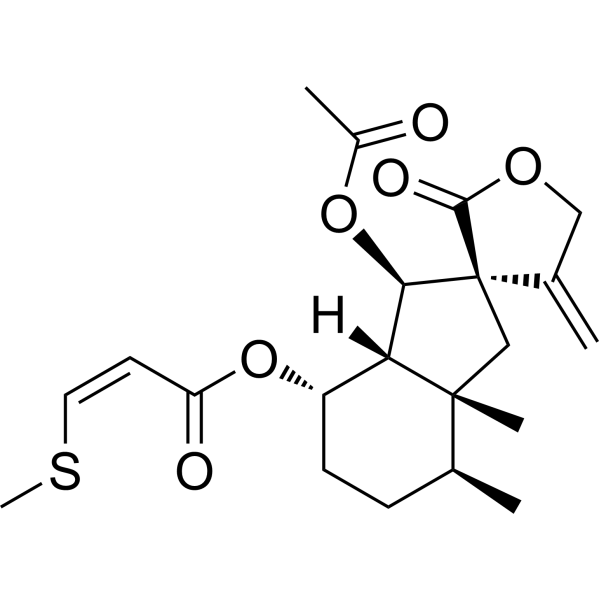
Japonipene C is a bakkenolide-type sesquiterpene. Japonipene C can be isolated from Petasites japonicus. Japonipene C exhibits neuroprotective activity. Japonipene C can be used for research on Parkinson's disease .
loading...
    loading...
Cat. No.: HY-N21777
CAS No.: 145904-50-3
Petasiphenol is a phenolic natural product found in Petasites japonicus, possessing selective inhibitory activity against DNA polymerase λ. Petasiphenol binds to the N-terminal BRCT domain of DNA polymerase λ, with an IC50 of 7.8 μM against DNA polymerase λ . Petasiphenol induces cell growth inhibition, G1 phase cell cycle arrest in human cancer cell lines, and exhibits anti-inflammatory activity against TPA-induced mouse ear inflammation. Petasiphenol can be used for research on cancer and inflammation-related diseases .
loading...
    loading...
Cat. No.: HY-N21783
CAS No.: 1448439-95-9
Japonipene G is a bisabolane-type sesquiterpene that exhibits no significant cytotoxicity toward neuronal cells at the tested concentrations, but shows no inhibitory activity against cobalt CoCl2-induced neuronal cell death. Japonipene G can serve as a negative control or a mechanistic research tool for neuroprotection-related studies .
loading...
    loading...
  • 1

