



Bakkenolide D

Based on 1 Customer Validation
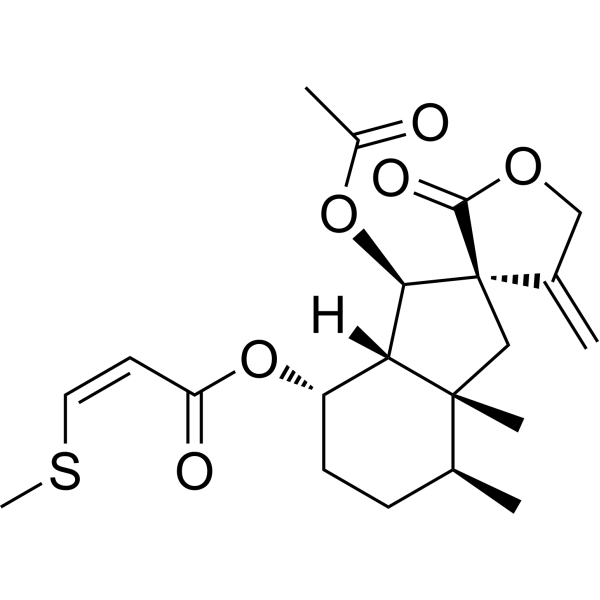
Bakkenolide D is a sesquiterpene lactone. Bakkenolide D is the major component of Bakkenolides in Petasites tricholobus. Bakkenolide D exhibits anti-allergic and antihistamine activities, and can be used in studies related to allergic rhinitis.
For research use only. We do not sell to patients.
- Purity : 99.92%
- CAS No.: 18456-03-6
- Formula: C21H28O6S
- Molecular Weight:408.51
-
Storage:Powder -20°C, 3 years ; In solvent -80°C, 6 months , -20°C, 1 month

To place orders, for customer services and technical support, please contact: MedChemExpress USA
Tel: 609-228-6898 E-mail: [email protected] [email protected]


-
 Biological Activity
-
Chemical Information
- Purity & Documentation
- References
-
 Help & FAQs


All Histamine Receptor Isoforms
More

Biological Activity
Description
Parmacokinetics
In Vivo
MedChemExpress (MCE) has not independently confirmed the accuracy of these methods. They are for reference only.


Chemical Information
-
CAS No. 18456-03-6
-
Appearance Solid
-
Molecular Weight 408.51
-
Formula C21H28O6S
-
Color White to off-white
-
SMILES
O=C(O[C@@H]1[C@]2([H])[C@@H](OC(C)=O)[C@]3(C[C@]2(C)[C@@H](C)CC1)C(OCC3=C)=O)/C=C\SC
-
Structure Classification
-
Initial Source
-
Shipping
Room temperature in continental US; may vary elsewhere.
-
Storage
Powder -20°C 3 years In solvent -80°C 6 months -20°C 1 month


Purity & Documentation
-
Data Sheet (274 KB)
-
SDS (252 KB)
- English - EN (252 KB)
- Français - FR (252 KB)
- Deutsch - DE (252 KB)
- Norwegian - NO (252 KB)
- Español - ES (252 KB)
- Swedish - SV (252 KB)
- Italian - IT (252 KB)
- Korean - KR (252 KB)
- Portuguese - PT (252 KB)
-
Handling Instructions (2659 KB)
References
[1]. Zhang FJ, et al. Anti-allergic effects of total bakkenolides from Petasites tricholobus in ovalbumin-sensitized rats. Phytother Res. 2011;25(1):116-121. [Content Brief]
[2]. Dai D, et al. LC-MS/MS determination of bakkenolide D in rats plasma and its application in pharmacokinetic studies. Biomed Chromatogr. 2013;27(9):1200-1207. [Content Brief]

Calculators
Concentration (start) × Volume (start) = Concentration (final) × Volume (final)


Bakkenolide D Related Classifications
HY-N7293 Related Classifications
 Powered by Bioz