13 Results for "

acute pancreatitis model

" in MedChemExpress (MCE) Product Catalog:
Products (13)

13 Results for "acute pancreatitis model" in MCE Product Catalog:

9
9 Publications Verification
Cat. No.: HY-N0469
CAS No.: 56-87-1
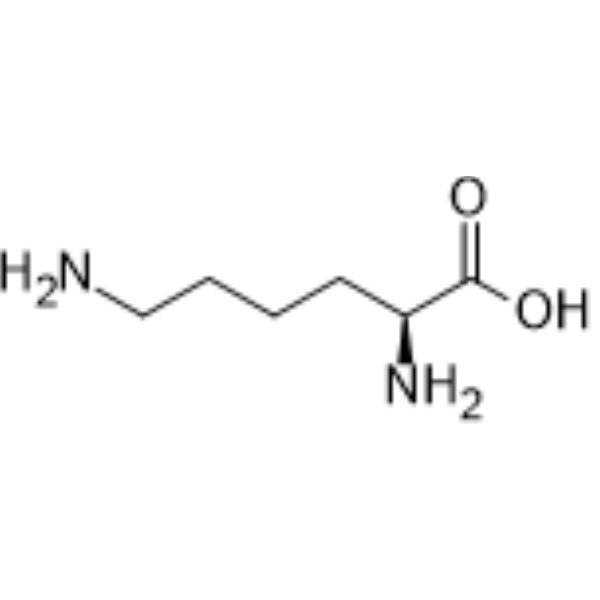
L-lysine is an essential amino acid for humans with orally activity. L-lysine can inhibit the occurrence of HSV infections and is used in herpes research. L-lysine increases calcium absorption, reduces diabetes-related diseases, improves gut health, and alleviates pancreatic inflammation. L-lysine can be used in research on metabolism, infection, and inflammation .
loading...
    loading...
4
4 Cited Publications
Cat. No.: HY-B2123
CAS No.: 63-42-3
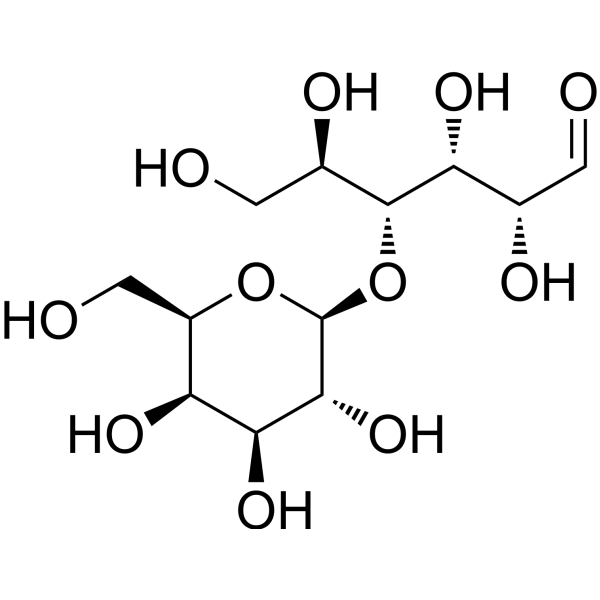
Lactose is a β-galactoside consisting of galactose and glucose residues, the main carbohydrate in mammalian breast milk. Lactose, a macronutrient and an inducer of host innate immune responses, possesses immune modulatory functions .
loading...
    loading...
Cat. No.: HY-N0469R
CAS No.: 56-87-1
L-Lysine (Standard) is the analytical standard of L-Lysine. This product is intended for research and analytical applications. L-lysine is an essential amino acid for humans with orally activity. L-lysine can inhibit the occurrence of HSV infections and is used in herpes research. L-lysine increases calcium absorption, reduces diabetes-related diseases, improves gut health, and alleviates pancreatic inflammation. L-lysine can be used in research on metabolism, infection, and inflammation . IC50 & Target:L-lysine (150 mg/kg) promotes, but not initiates, bladder cancer. The administration of L-lysine to rats submitted to colovesical cystoplasty accelerates the development of transitional metaplasia of the intestinal epithelium .
L-lysine (10 mg/kg) treatment attenuates pancreatic tissue injury induced by L-arginine by inhibiting the release of the inflammatory cytokine IL-6 and enhance antioxidant activity . In Vivo:L-lysine (10?mg/kg, p.o., pre-treated or post-treated, administration duration 15 days) treatment attenuates pancreatic tissue injury induced by L-arginine by inhibiting the release of the inflammatory cytokine IL-6 and enhance antioxidant activity in acute pancreatitis mice model . L-lysine (5 or 10?mg/kg, p.o., 45 days) ameliorates sepsis-induced acute lung injury in a lipopolysaccharide (HY-D1056)-induced mouse model .
loading...
    loading...
Cat. No.: HY-174802
CAS No.: 3117797-77-7
XL-3158 is a selective and cross-species Cyclic GMP-AMP synthase (cGAS) inhibitor (IC50: 11.1 μM for human cGAS, 2.19 μM for mouse cGAS). XL-3158 simultaneously occupy allosteric and orthosteric sites, stabilizing the activation loop in a closed, inactive conformation and thereby attenuating the cGAS-DNA interactions. XL-3158 inhibits cGAS by targeting phase separation. XL-3158 efficiently penetrates cells by inhibiting aggregate formation, effectively reducing the local concentration of cGAS within cells. XL-3158 can be used for the study of cGAS-dependent inflammatory diseases.
loading...
    loading...
Cat. No.: HY-12733
CAS No.: 1254318-44-9
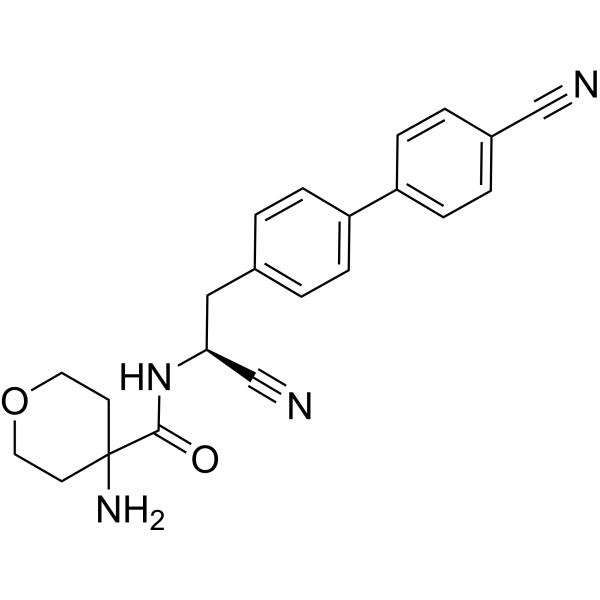
AZD5248 is an orally active, selective dipeptidyl peptidase 1 (cathepsin C) inhibitor, with IC50 values of 1 nM and 17 nM against human CatC, 44 nM against human DPP1, and 67 nM against rat DPP1. It exhibits low clearance and high bioavailability in animal models. AZD5248 forms an irreversible covalent bond with the catalytic Cys234 residue of CatC, exerts reversible inhibition via its nitrile moiety, blocks CatC-dependent amyloid formation, and reduces the activation levels of neutrophil serine proteases in bone marrow and blood. AZD5248 reacts with aortic elastin aldehydes to form stable 4-imidazolinones, induces ultrastructural changes in aortic tissue, and has an α-amino acid-based backbone. AZD5248 reduces the severity of acute pancreatitis in mouse models. AZD5248 can be used in research on chronic obstructive pulmonary disease, acute pancreatitis, neurodegenerative diseases, lysosomal storage disorders, acute lung injury, cystic fibrosis, and neutrophil-mediated inflammatory diseases .
loading...
    loading...
Cat. No.: HY-P10966A
Target:  

IKK NF-κB

Research Areas:  

Inflammation/Immunology

Tat-IKIP (46-60) TFA is the trifluoroacetic acid of Tat-IKIP (46-60) (HY-P10966). Tat-IKIP (46-60) is a IκB kinase (IKK)-targeting membrane-penetrating peptide. Tat-IKIP (46-60) inhibits IKK activation and NF-κB targeted gene expression by disrupting the IKKβ/NEMO complex. Tat-IKIP (46-60) significantly reduces DSS (HY-116282)-induced acute inflammation in inflammatory bowel disease (IBD) mice model and attenuates Zymosan-induced acute arthritis in acute arthritis model (AAM). Tat-IKIP (46-60) can be used for inflammatory diseases research, such as IBD, pancreatitis and rheumatoid arthritis .
loading...
    loading...
Cat. No.: HY-19106
CAS No.: 132197-26-3
Target:  

Secretin Receptor

MCI-727 free base is an orally active anti-ulcer agent. MCI-727 free base can increase the plasma secretin concentration in rats and dogs. MCI-727 free base can also stimulate the exocrine function of the pancreas in rats by promoting the release of endogenous secretin, and exert preventive and therapeutic effects on mild acute pancreatitis. MCI-727 free base can be used in the research of ulcer-related diseases .
loading...
    loading...
Cat. No.: HY-N0469A
CAS No.: 53411-64-6
L-lysine sulfite is an essential amino acid for humans , offers numerous benefits and can be used in herpes research. Additionally, L-lysine sulfite enhances calcium absorption, reduces diabetes-related complications, improves gut health, and alleviates pancreatitis inflammation .
loading...
    loading...
Cat. No.: HY-168211
Target:  

Epoxide Hydrolase

Research Areas:  

Inflammation/Immunology

LQ-38 is an orally active inhibitor for soluble epoxide hydrolase (sEH) with an IC50 of 5.2 nM. LQ-38 exhibits anti-inflammatory activity in rat foot edema model and mouse acute pancreatitis model, exhibits analgesic effect in Acetic acid (HY-Y0319)-induced writhing mouse model .
loading...
    loading...
Cat. No.: HY-P10966
Target:  

IKK NF-κB

Research Areas:  

Inflammation/Immunology

Tat-IKIP (46-60) is a IκB kinase (IKK)-targeting membrane-penetrating peptide. Tat-IKIP (46-60) inhibits IKK activation and NF-κB targeted gene expression by disrupting the IKKβ/NEMO complex. Tat-IKIP (46-60) significantly reduces DSS (HY-116282)-induced acute inflammation in inflammatory bowel disease (IBD) mice model and attenuates Zymosan-induced acute arthritis in acute arthritis model (AAM). Tat-IKIP (46-60) can be used for inflammatory diseases research, such as IBD, pancreatitis and rheumatoid arthritis .
loading...
    loading...
Cat. No.: HY-170492
CAS No.: 3107483-12-2
sEH inhibitor-19 (Compound (R)-14i) is an orally active inhibitor for soluble epoxide hydrolase (sEH) with an IC50 of 1.2 nM. sEH inhibitor-19 inhibits the expression of TNF-α and IL-6, exhibits anti-inflammatory activity in mouse acute pancreatitis or Carrageenan (HY-125474)-induced edema models .
loading...
    loading...
Cat. No.: HY-122692
CAS No.: 1532515-60-8
Target:  

TRP Channel

TRPV4/TRPA1-IN-1 is a TRPV4/TRPA1 inhibitor that suppresses TRPV4/TRPA1-mediated calcium influx. TRPV4/TRPA1-IN-1 alleviates pain behaviors in a mouse trigeminal stimulation pain model and inhibits inflammation and pain-related behaviors in a mouse acute pancreatitis model. TRPV4/TRPA1-IN-1 can be used in research on acute pancreatitis .
loading...
    loading...
Cat. No.: HY-181526
CAS No.: 3099101-40-0
Target:  

IFNAR STING

Research Areas:  

Inflammation/Immunology

Sim-9 is a covalent allosteric inhibitor of interferon regulatory factor 3 (IRF3). Sim-9 binds covalently to the Cys222 residue of IRF3, induces its conformational change, blocks its interactions with TRIF, MAVS and STING, and inhibits IRF3 homodimerization and type I interferon response. Sim-9 exhibits significant anti-inflammatory, organ-protective and survival benefits in mouse models of sepsis and acute pancreatitis. Sim-9 can be used for research related to inflammatory diseases .
loading...
    loading...
  • 1

