



12 Results for "

anti-VEGF

" in MedChemExpress (MCE) Product Catalog:
Products (12)

12 Results for "anti-VEGF" in MCE Product Catalog:

2
2 Cited Publications
Cat. No.: HY-P9951A
CAS No.: 347396-82-1
Synonyms: RG-6321 (anti-VEGF)

Target:  

VEGFR

Research Areas:  

Cardiovascular Disease

Ranibizumab (RG-6321) (anti-VEGF) is a humanized anti-VEGF monoclonal antibody fragment and can recognize all VEGF-A isoforms (VEGF110, VEGF121, and VEGF165) . Ranibizumab (anti-VEGF) slows vision loss in vivo and is used for wet age-related macular degeneration (AMD) research .
loading...
    loading...
1
1 Cited Publications
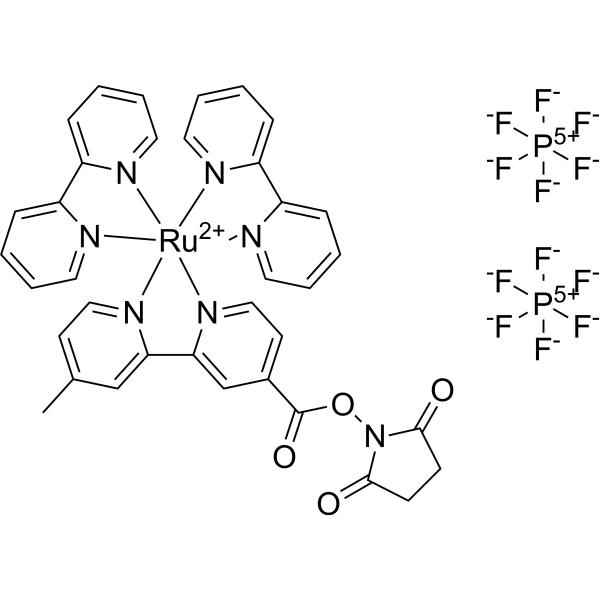
Cat. No.: HY-W127716
CAS No.: 136724-73-7
Ru(bpy)2(mcbpy-O-Su-ester)(PF6)2 is a potent ruthenium-based dye. Ru(bpy)2(mcbpy-O-Su-ester)(PF6)2 can bu used as an effective quencher of quantum dots (QDs) fluorescence and the capture probe of virus antigen EV71. Ru(bpy)2(mcbpy-O-Su-ester)(PF6)2 can be used sensitive electrogenerated chemiluminescence (ECL) labels for detection of matrix metalloproteinases (MMPs) .
loading...
    loading...
1
1 Cited Publications
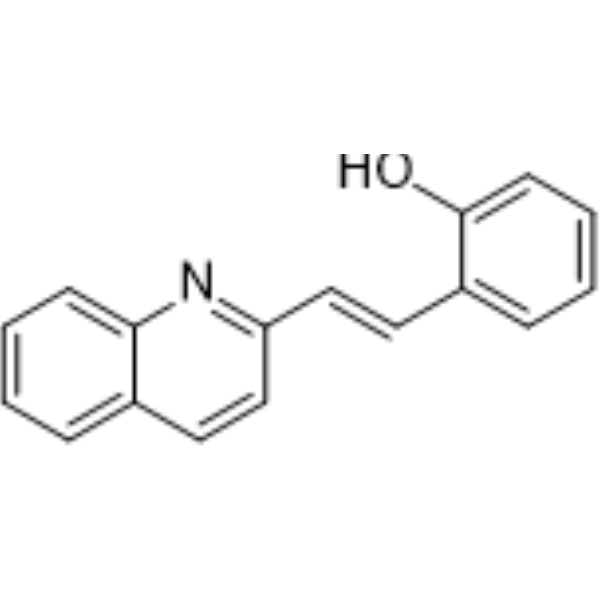
Cat. No.: HY-119442
CAS No.: 143816-42-6
Target:  

Leukotriene Receptor

Research Areas:  

Cardiovascular Disease

Quininib is a cysteinyl leukotriene 1 and 2 receptor antagonist with IC50s of 1.2 and 52 μM for CysLT1R and CysLT2R, respectively. Quininib is a potent inhibitor of developmental angiogenesis in the zebrafish eye. Quininib can be used for the research of ocular neovascular pathologies and may complement current anti-VEGF biological agents .
loading...
    loading...
Cat. No.: HY-P99377
CAS No.: 1638338-43-8
Synonyms: OMP-305B83; anti-DLL4 Reference antibody (navicixizumab)

Target:  

Notch

Research Areas:  

Cancer

Navicixizumab (OMP-305B83) is a bispecific anti-VEGF and anti-DLL4 inhibitory antibody. Navicixizumab can combine with Paclitaxel (HY-B0015) for cancer research. Navicixizumab can be used in the research of ovarian, primary peritoneal, or fallopian tube cancer .
loading...
    loading...
Cat. No.: HY-P9973
CAS No.: 1531589-13-5
Synonyms: DLX1008; ESBA 1008; RTH258

Target:  

VEGFR

Research Areas:  

Cancer

Brolucizumab (DLX1008) is a single-chain anti-VEGF-A antibody fragment with low picomolar affinity (KD=1.05 pM). Brolucizumab can be used for the research of cancer .
loading...
    loading...
Cat. No.: HY-P991415
Synonyms: AM712

Target:  

VEGFR Tie

Research Areas:  

Others

ASKG-712 (AM712) is a recombinant anti-VEGF humanized monoclonal antibody and Ang-2 antagonist peptide fusion protein. ASKG-712 can be used in Wet age-related macular degeneration and Diabetic macular oedema research .
loading...
    loading...
Cat. No.: HY-P991738
Target:  

PD-1/PD-L1 VEGFR

Research Areas:  

Cancer

LM-299 is a bispecific antibody targeting PD-1 and VEGF with anti-tumor activity. The dual binding activity of LM-299 is achieved through the effective binding of its Fab-terminal anti-VEGF-A antibody to human VEGF-A, as well as the blocking effect of its Fc-terminal anti-PD-1 antibody on the PD-1/PD-L1 pathway. LM-299 binds to and modulates PD-1 and VEGF. LM-299 can be used in studies related to advanced malignant tumors, advanced solid tumors, and advanced non-small cell lung cancer .
loading...
    loading...
Cat. No.: HY-W888515
Research Areas:  

Neurological Disease

mPEG-PCL is an amphiphilic biodegradable block copolymer composed of hydrophilic methoxy poly (ethylene glycol) (mPEG) and hydrophobic poly (ε-caprolactone) (PCL). mPEG-PCL possesses excellent biocompatibility and can form delivery carriers such as micelles and nanoparticles. Through its amphiphilic block structure, mPEG-PCL forms nanocarriers and encapsulates hydrophobic molecules, thereby enhancing the loading capacity of hydrophobic molecules, reducing burst release, and achieving sustained release. mPEG-PCL can be used in research on nanodelivery, tissue engineering, and ocular delivery systems related to age-related macular degeneration (AMD) .
loading...
    loading...
Cat. No.: HY-P990082
CAS No.: 1610010-57-5
Synonyms: APX-003; BD-0801

Target:  

VEGFR

Research Areas:  

Cardiovascular Disease Cancer

Suvemcitug (APX-003) is a selective humanized rabbit monoclonal IgG1 (κ) anti-VEGF antibody. Suvemcitug inhibits the binding of VEGF to purified VEGFR1 (IC50 = 21.0 ng/mL) and VEGFR2 (IC50 = 275.4 ng/mL). Suvemcitug suppresses tumor angiogenesis, tumor growth and metastasis. Suvemcitug is applicable to research related to epithelial ovarian cancer, fallopian tube cancer and primary peritoneal cancer .
loading...
    loading...
Cat. No.: HY-125059
CAS No.: 865531-74-4
Target:  

Endogenous Metabolite

Research Areas:  

Cancer

PTC-510 Free base is a compound that selectively inhibits hypoxia-induced VEGF expression in tumor cells. PTC-510 Free base demonstrates potent activity in reducing endogenous VEGF production under hypoxic conditions. PTC-510 Free base has been shown to control tumor growth effectively while minimizing toxicity. PTC-510 Free base represents a novel therapeutic strategy to address the limitations of current anti-VEGF therapies.
loading...
    loading...
Cat. No.: HY-182372
CAS No.: 1638153-78-2
Target:  

Epoxide Hydrolase

Research Areas:  

Neurological Disease

SH-11037 is a potent inhibitor of soluble epoxide hydrolase (sEH) and docks to the substrate binding cleft in the sEH hydrolase domain. SH-11037 dose-dependently suppresses angiogenesis in the choroidal sprouting assay ex vivo and inhibited ocular developmental angiogenesis in zebrafish larvae. SH-11037 reduces choroidal neovascularisation lesion volume in the laser-induced CNV mouse model. SH-11037 synergises with anti-VEGF treatments in vitro and in vivo. SH-11037 induces G2/M phase blockade and retains retinal endothelial cell viability at active concentrations without overt toxicity. SH-11037 can be used for the research of retinal neovascularization and ocular neovascularization .
loading...
    loading...
Cat. No.: HY-P991911

Research Areas:  

Cancer

PLT012 is a humanized IgG4 antibody targeting CD36. PLT012 inhibits the lipid-binding domain of CD36. PLT012 blocks CD36-mediated metabolic adaptation in regulatory T cells (Tregs) and CD8 + tumor-infiltrating lymphocytes (TILs), thereby inhibiting tumor growth and shifting the tumor microenvironment from immunosuppressive to immunosupportive. PLT012 reduces intratumoral Tregs, enhances CD8 + T cell infiltration and cytotoxic function, and increases the abundance of progenitor-exhausted T cells. PLT012 exerts robust antitumor activity and synergizes with anti-PD-L1 or standard-of-care regimens (anti-VEGF + anti-PD-L1). PLT012 can be used for hepatocellular carcinoma, colorectal cancer and solid tumor research .
loading...
    loading...
  • 1

