12 Results for "

cytotoxicity evaluation

" in MedChemExpress (MCE) Product Catalog:
Products (12)

12 Results for "cytotoxicity evaluation" in MCE Product Catalog:

1
1 Cited Publications
Cat. No.: HY-D0300
CAS No.: 129-73-7
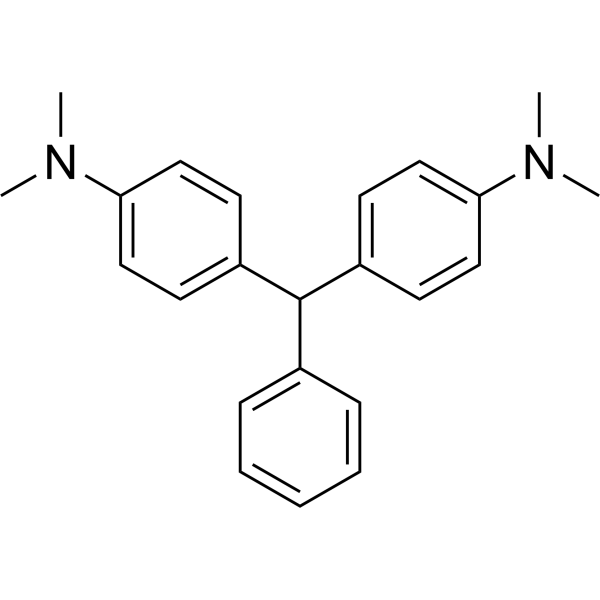
Leucomalachite green is the major reduced metabolite of malachite green (MG) and has lower cytotoxicity (such as HEp-2 and Caco-2) than malachite green. Leucomalachite green may be involved in interfering with cell metabolism or redox balance and can be used to evaluate its potential harm to human cells as a food contaminant .
loading...
    loading...
Cat. No.: HY-141452
CAS No.: 542-78-9
Synonyms: Malondialdehyde
Target:  

Endogenous Metabolite

Research Areas:  

Neurological Disease

Propanedial (Malondialdehyde) (13.88 mM in water) is one of the final products of lipid peroxidation. Propanedial causes protein inactivation, DNA damage and cross-linking by forming stable covalent adducts with biological macromolecules, which is the main mechanism for its cytotoxicity and genotoxicity. Propanedial production increases with the elevation of free radicals. Propanedial is a key biomarker for evaluating the level of cellular oxidative stress [1][2][3].
loading...
    loading...
Cat. No.: HY-146819
CAS No.: 2439165-37-2
Target:  

Carbonic Anhydrase

Research Areas:  

Cancer

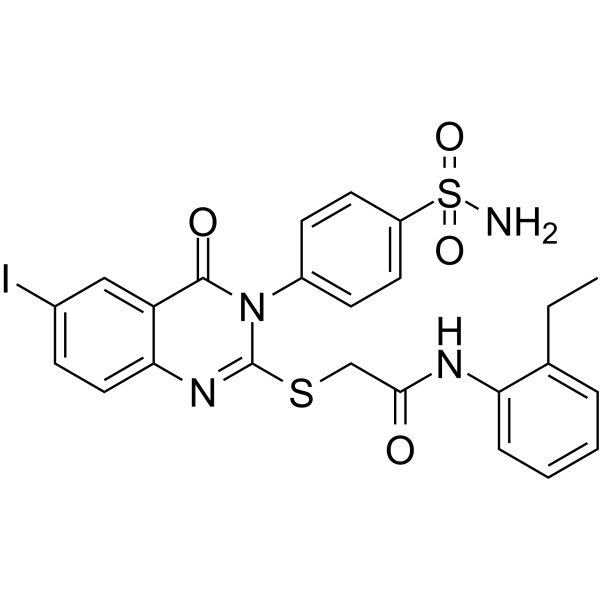
Compound 9 is the most effective against tumor specific Ca ix/ca XII (ki=29.1 and 8.8 nm), so it is possible to evaluate its cytotoxicity and selectivity to HepG-2, HCT-116 and MCF-7 cancer cell lines in vitro, and its IC50 values to tumor cells are 1.78, 1.94 and 3.07, respectively μ M. It showed that it had obvious cytotoxicity.
loading...
    loading...
Cat. No.: HY-D0300S1
CAS No.: 1173021-13-0
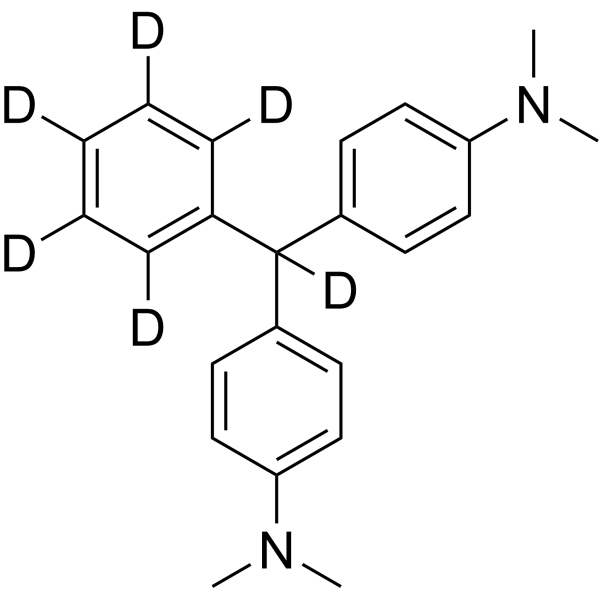
Leucomalachite green-d6 is the deuterated derivative of Leucomalachite green (HY-D0300). Leucomalachite green is the major reduced metabolite of malachite green (MG) and has lower cytotoxicity (such as HEp-2 and Caco-2) than malachite green. Leucomalachite green may be involved in interfering with cell metabolism or redox balance and can be used to evaluate its potential harm to human cells as a food contaminant .
loading...
    loading...
Cat. No.: HY-N11988
CAS No.: 858127-39-6
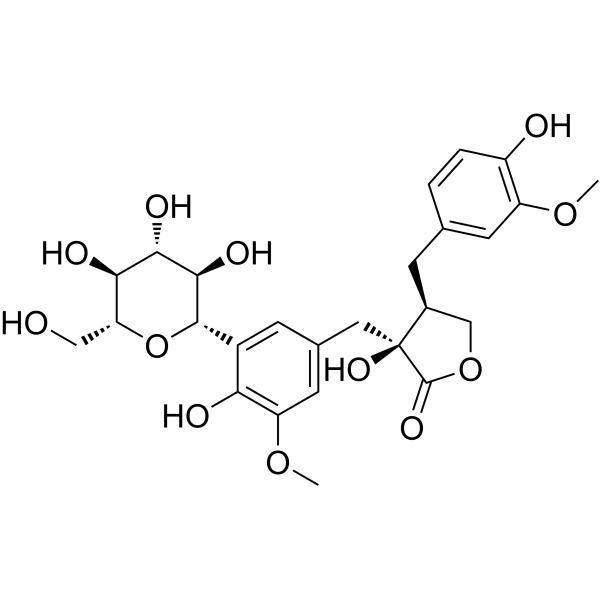
Nortrachelogenin 5'-C-β-glucopyranoside (compound 3) is a glycoside compound that can be isolated from the aerial parts of Trachelospermia vine .
loading...
    loading...
Cat. No.: HY-D0300S
CAS No.: 947601-82-3
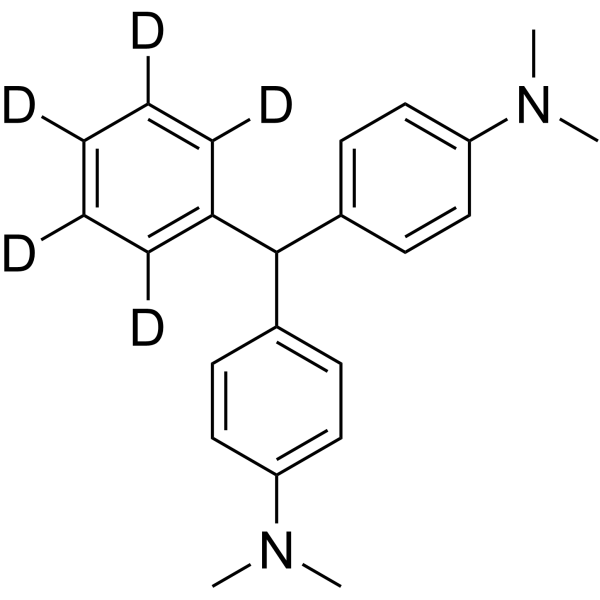
Leucomalachite green-d5 is the deuterated derivative of Leucomalachite green (HY-D0300). Leucomalachite green is the major reduced metabolite of malachite green (MG) and has lower cytotoxicity (such as HEp-2 and Caco-2) than malachite green. Leucomalachite green may be involved in interfering with cell metabolism or redox balance and can be used to evaluate its potential harm to human cells as a food contaminant .
loading...
    loading...
Cat. No.: HY-D0300R
CAS No.: 129-73-7
Leucomalachite green (Standard) is the analytical standard of Leucomalachite green (HY-D0300). This product is intended for research and analytical applications. Leucomalachite green is the major reduced metabolite of malachite green (MG) and has lower cytotoxicity (such as HEp-2 and Caco-2) than malachite green. Leucomalachite green may be involved in interfering with cell metabolism or redox balance and can be used to evaluate its potential harm to human cells as a food contaminant .
loading...
    loading...
Cat. No.: HY-N21531
CAS No.: 2841395-79-5
Trolliusditerpenoside I is a labdane-type diterpenoid glycoside identified in the flowers of Trollius chinensis Bunge. Trolliusditerpenoside I exerts weak inhibitory effects on LPS (HY-D1056)-induced NO production in RAW 264.7 macrophages, with an IC50 > 50 μM, and shows no significant cytotoxicity within the effective concentration range used for NO inhibition evaluation. Trolliusditerpenoside I can be used in studies on the structure of diterpenoid glycosides and LPS-induced inflammation-related NO production .
loading...
    loading...
loading...
    loading...
Cat. No.: HY-D3181
CyGbPF is a granzyme B-specific near-infrared fluorescent probe. CyGbPF can be cleaved by granzyme B to remove the peptide cage group, restoring near-infrared fluorescence. CyGbPF passively accumulates in mouse tumors, and its activated fluorescence correlates with granzyme B expression, CD8 + cytotoxic T lymphocyte populations, and CD4 + helper T lymphocyte populations in tumor tissues. CyGbPF is efficiently cleared by the kidneys, enabling the assessment of immune activation via optical urine analysis. CyGbPF allows real-time non-invasive evaluation of cancer immunotherapeutic efficacy in living animals. CyGbPF can be used in research on cancers such as breast cancer. Excitation wavelength/emission wavelength: approximately 658 nm/approximately 717 nm .
loading...
    loading...
Cat. No.: HY-D3104
CAS No.: 2767443-23-0
Target:  

Fluorescent Dye

Research Areas:  

Others

ERNT is a fluorescent probe for monitoring endoplasmic reticulum (ER) polarity and detecting endoplasmic reticulum stress (ERS) during the progression of dynamic liver injury. ERNT functions based on a donor-π-acceptor (D-π-A) structure with an intramolecular charge transfer (ICT) effect. ERNT has multiple excitation/emission pairs: for in vitro cell imaging, the green channel has Ex/Em = 488/500-550 nm, and the red channel has Ex/Em = 488/570-620 nm; for in vivo liver imaging, Ex/Em = 520/620 nm; for solvent optical tests, Ex = 470 nm, with the maximum emission peak at 548 nm in low-polarity toluene and 668 nm in high-polarity DMSO. ERNT can evaluate the efficacy of hepatoprotective interventions by detecting changes in ER polarity, and also exhibits excellent photostability and low cytotoxicity .
loading...
    loading...
Cat. No.: HY-P11590
Target:  

EGFR

Research Areas:  

Cancer

WGYRGFYC (WC8) is a selective HER2-targeting peptide that binds specifically to HER2 by mimicking the antigen-binding site of trastuzumab. The DOTA precursor of WGYRGFYC has a KD of 61.20 nM for HER2. WGYRGFYC enables specific and highly sensitive detection of HER2 expression in HER2-positive breast cancer cells and tumor tissues, and monitors the dynamic downregulation of HER2 expression. WGYRGFYC rapidly distributes to target tissues and is efficiently cleared from non-target tissues via the kidneys, generating an ideal tumor-to-background ratio in imaging; it is a component of the PET radiotracer Ga-DOTA-WC8. WGYRGFYC exhibits no significant cytotoxicity in breast cancer cells, and can be used for non-invasive imaging diagnosis and therapeutic efficacy evaluation of HER2-positive breast cancer .
loading...
    loading...
  • 1

