3 Results for "

dendritic 2.4 cells

" in MedChemExpress (MCE) Product Catalog:
Products (3)

3 Results for "dendritic 2.4 cells" in MCE Product Catalog:

Cat. No.: HY-124237A
CAS No.: 147852-84-4
Purity:  99.58%
Synonyms: C8-HSL
Target:  

Bacterial

Research Areas:  

Infection Inflammation/Immunology

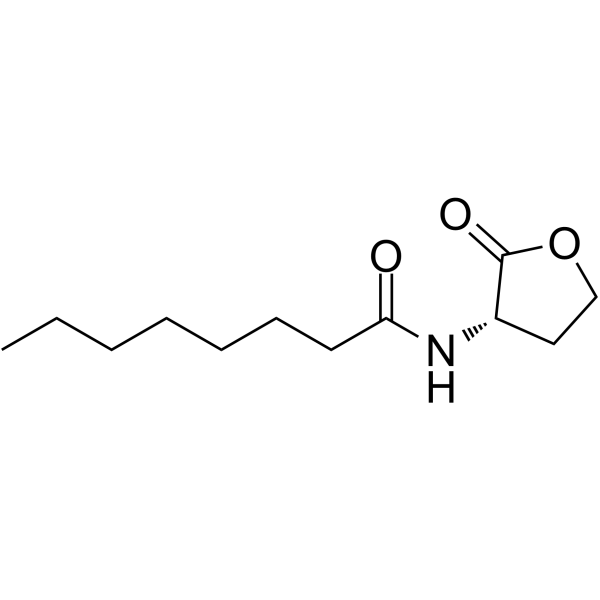
N-Octanoyl-L-homoserine lactone (C8-HSL) is an autoinducer. It mainly serves as a key inter- and intra-species communication medium or "signal molecule" in Gram-negative bacteria. N-Octanoyl-L-homoserine lactone microparticles exhibit adjuvant potential when used in combination with various particulate vaccines .
loading...
    loading...
Cat. No.: HY-124237AR
CAS No.: 147852-84-4
Synonyms: C8-HSL (Standard)
N-Octanoyl-L-homoserine lactone (Standard) (C8-HSL (Standard)) is the analytical standard of N-Octanoyl-L-homoserine lactone (HY-124237A). This product is intended for research and analytical applications. N-Octanoyl-L-homoserine lactone (C8-HSL) is an autoinducer. It mainly serves as a key inter- and intra-species communication medium or "signal molecule" in Gram-negative bacteria. N-Octanoyl-L-homoserine lactone microparticles exhibit adjuvant potential when used in combination with various particulate vaccines .
loading...
    loading...
Cat. No.: HY-117573
CAS No.: 1438280-73-9
1Z105 is an orally active TLR4/MD2 agonist, immunostimulant and vaccine adjuvant. 1Z105 activates NF-κB via the MyD88/TRIF pathway in a CD14-independent manner, with EC50 values of 0.63 µM and 0.77 µM for inducing IL-6 and IL-12 in mBMDCs, respectively. 1Z105 promotes dendritic cell maturation, antigen uptake and cross-presentation; when used alone, it induces Th2-IgG1, while combined with the TLR7 agonist 1V270, it synergistically induces balanced Th1/Th2 responses and provides low-reactogenic protection against homologous, heterologous and heterosubtypic influenza. 1Z105 prevents LPS (HY-D1056A1)- and galactosamine-induced liver injury as well as autoantibody-driven arthritis in mice. 1Z105 can be used in studies related to influenza virus infection, inflammation, and LPS/galactosamine-induced liver injury .
loading...
    loading...

