


1. Search Result
Search Result
Isoforms Recommended: μ Opioid Receptor/MOR
Results for "

human μ-opioid receptor

" in MedChemExpress (MCE) Product Catalog:

15

Inhibitors & Agonists

6

Peptides

2

Natural
Products

1

Recombinant Proteins

Cat. No. Product Name Target Research Areas Chemical Structure
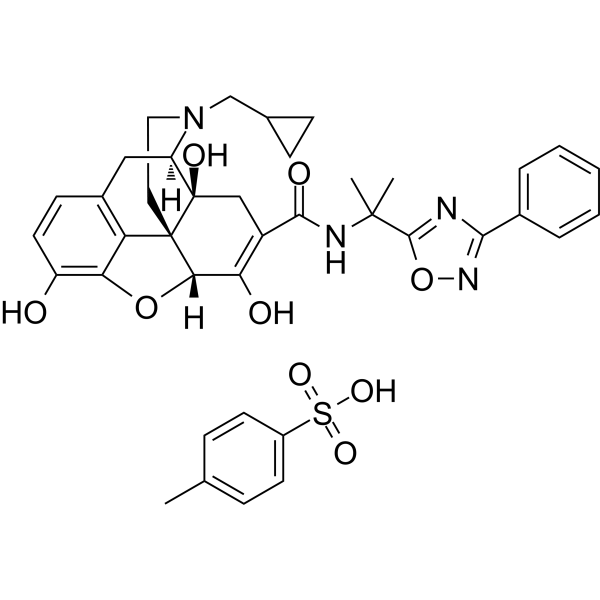
  • HY-19627A
    Naldemedine tosylate
    1 Publications Verification

    S-297995 tosylate

    Opioid Receptor Neurological Disease Metabolic Disease
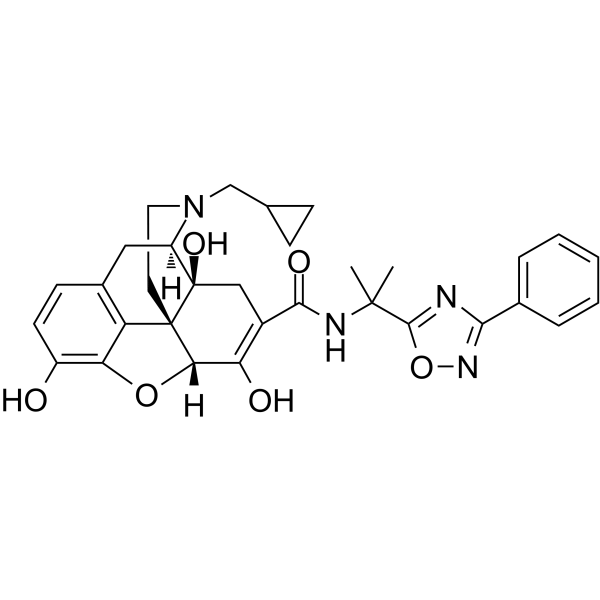
    Naldemedine (S-297995) tosylate is an orally active μ-opioid receptor antagonist (PAMORA) . Naldemedine tosylate shows potent binding affinities (Ki=0.34, 0.43, 0.94 nM, respectively) and antagonist activities (IC50=25.57, 7.09, 16.1 nM, respectively) for recombinant human μ-, δ-, and κ- opioid receptors . Naldemedine can be used in opioid-induced constipation (OIC) research . Naldemedine tosylate is predicted to bind to 3CL pro encoded by SARS-CoV2 genome .
    Naldemedine tosylate
  • HY-P1502
    β-Endorphin, human
    1 Publications Verification

    Opioid Receptor Neurological Disease
    β-Endorphin, human, a prominent endogenous peptide, existing in the hypophysis cerebri and hypothalamus, is an agonist of opioid receptor, with preferred affinity for μ-opioid receptor and δ-opioid receptor; β-Endorphin, human exhibits antinociception activity.
    β-Endorphin, human
  • HY-N2392
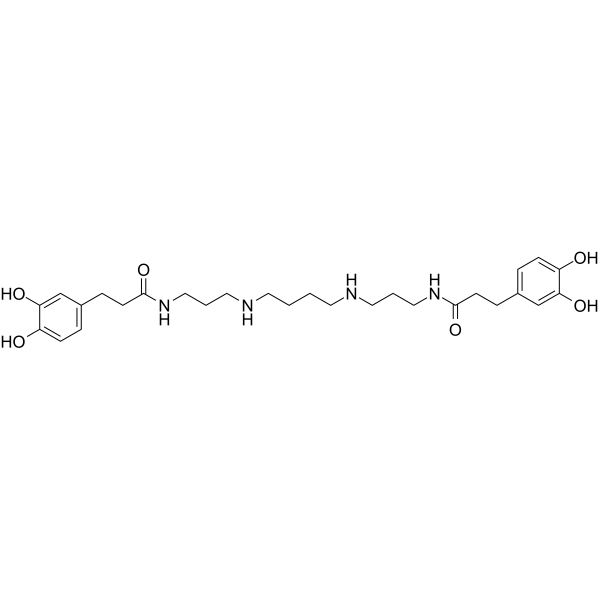
    Kukoamine A
    1 Publications Verification

    Parasite Lipoxygenase Opioid Receptor Apoptosis Autophagy Reactive Oxygen Species (ROS) Interleukin Related TNF Receptor PGE synthase COX Infection Neurological Disease Metabolic Disease Inflammation/Immunology Cancer
    Kukoamine A, a spermine alkaloid, is an orally active and brain-penetrant component found in the root barks of Lycium chinense (L. chinense) Miller. Kukoamine A inhibits purified Crithidia fasciculata trypanothione reductase and soybean lipoxygenase, activates μ-opioid receptor. Kukoamine A can inhibt cancer cell proliferation, migration and invasion, cause G0/G1 phase cell cycle arrest and induce apoptosis. Kukoamine A exerts neuroprotective effect and can induce autophagy . Kukoamine A inhibits LPS (HY-D1056)-induced NO, ROS, PGE2, TNF-α, IL-1β, IL-6 production and COX-2 activity. Kukoamine A reverses palmitic acid-induced insulin resistance, lipid accumulation, and oxidative stress via downregulation of Srebp-1c. Kukoamine A can be used for the research of cancer, infection, inflammation, metabolic and neurological disease, such as glioblastoma and Parkinson's disease .
    Kukoamine A
  • HY-P1626

    Opioid Receptor Neurological Disease
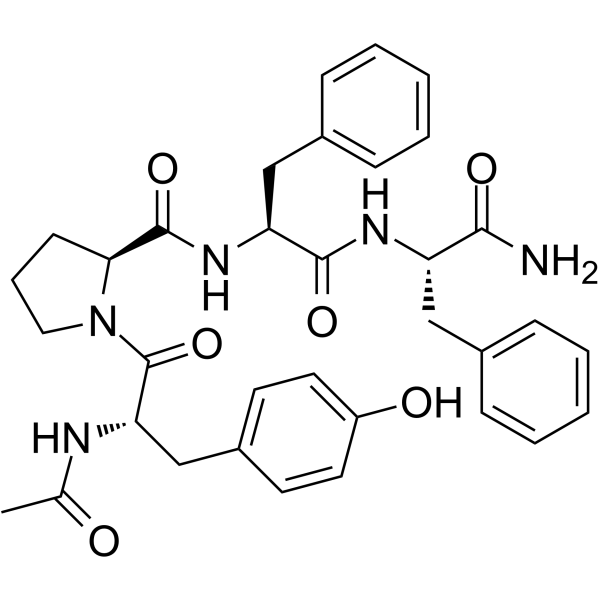
    Acetyl tetrapeptide-15 is a synthetic peptide. Acetyl tetrapeptide-15 is derived from endomorphin-2 (Tyr-Pro-Phe-Phe-NH2), a human μ-opioid agonist with selective anti-nociceptive effect. Acetyl tetrapeptide-15 reduces skin hyperreactivity producing inflammatory, chronic and neuropathic pain, by increasing the threshold of neuronal excitability in μ-opioid receptor via an endorphin-like pathway. Acetyl tetrapeptide-15 is used in the cosmetics for sensitive skin .
    Acetyl tetrapeptide-15
  • HY-N2571

    Reverse Transcriptase HIV Opioid Receptor Infection Neurological Disease Cancer
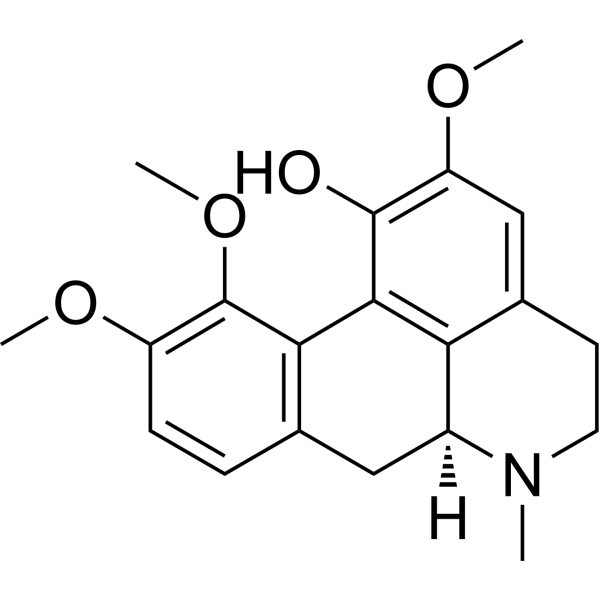
    Corydine is a HIV-1 reverse transcriptase inhibitor and μ-opioid receptor (MOR) agonist, with an IC50 of 356.7 μg/mL against HIV-1 reverse transcriptase, an EC50 of 0.51 μM for MOR, and a Ki of 2.82 μM for MOR. Corydine produces antinociceptive effects by inhibiting acetic acid-induced writhing behavior in a MOR-dependent manner. Corydine inhibits the proliferation of cancer cells, mitogen-stimulated lymphocytes and IL-2-dependent cells. Corydine can be used in studies related to human immunodeficiency virus infection, visceral pain, leukemia, melanoma, bladder cancer and colon adenocarcinoma .
    Corydine
  • HY-19627

    S-297995

    Opioid Receptor Neurological Disease Metabolic Disease
    Naldemedine (S-297995) is an orally active μ-opioid receptor antagonist (PAMORA) . Naldemedine shows potent binding affinities (Ki=0.34, 0.43, 0.94 nM, respectively) and antagonist activities (IC50=25.57, 7.09, 16.1 nM, respectively) for recombinant human μ-, δ-, and κ- opioid receptors . Naldemedine can be used in opioid-induced constipation (OIC) research . Naldemedine is predicted to bind to 3CL pro encoded by SARS-CoV2 genome .
    Naldemedine
  • HY-121854A

    Opioid Receptor Inflammation/Immunology
    Bromadoline maleate is an opioid analgesic selective for the μ-opioid receptor, exhibiting analgesic activity in various biological fluids. Bromadoline maleate has been successfully quantified alongside its N-demethylated metabolites in human and canine samples.
    Bromadoline maleate
  • HY-P11642A

    Enteropeptidase Aminopeptidase Opioid Receptor ERK mTOR Androgen Receptor Inflammation/Immunology
    Sialorphin TFA is a neutral endopeptidase (NEP) and aminopeptidase N (APN) inhibitor that responds to androgen signals. Sialorphin TFA blocks the degradation of endogenous opioid peptides and interacts with μ-, δ-, κ-opioid receptors. Sialorphin TFA regulates the ERK/mTOR signaling pathway by inducing cell cycle arrest, enhancing ERK1/2 activity, and reducing the phosphorylation levels of mTOR, 4E-BP1, p70S6K; accordingly, Sialorphin TFA exhibits antiproliferative activity against colorectal cancer, glioma and prostate cancer cells without cytotoxicity. In addition, Sialorphin TFA also produces antinociceptive responses, regulates sexual behavior, relaxes corpus cavernosum smooth muscle, and alleviates experimental colitis. Sialorphin TFA is also a copper (II) ion-binding ligand. Sialorphin TFA has been used in mechanistic studies related to cancer, pain management and inflammatory bowel disease .
    Sialorphin TFA
  • HY-P1253

    Opioid Receptor Neurological Disease
    α-Endorphin (human) is a neuropeptide, that acts on the central nervous system (CNS) and peripheral nervous system (PNS). α-Endorphin (human) binds μ-opioid receptor, and exhibits analgesic efficacy. α-Endorphin (human) regulates sexual behaviors and pleasure felling .
    α-Endorphin (human)
  • HY-P1502F

    Opioid Receptor Neurological Disease
    Biocytin-β-endorphin, human is abiotinylated β-Endorphin, human (HY-P1502). β-Endorphin, human, a prominent endogenous peptide, existing in the hypophysis cerebri and hypothalamus, is an agonist of opioid receptor, with preferred affinity for μ-opioid receptor and δ-opioid receptor; β-Endorphin, human exhibits antinociception activity.
    Biocytin-β-endorphin, human
  • HY-122286

    Neurokinin Receptor Neurological Disease
    SB 414240 is a selective neurokinin-2 receptor (NK-2R) antagonist with Kis of 1 nM and 193 nM for human NK-3R and human NK-2R, respectively. SB 414240 does not bind the human μ-opioid receptor (hMOR). SB 414240 can be used for the study of neurological disease .
    SB 414240
  • HY-P3517

    β-EP (6-31), human

    Opioid Receptor Neurological Disease Endocrinology
    β-Endorphin, an endogenous opioid neuropeptide, is an opioid receptor agonist. β-Endorphin binds preferentially to μ-opioid receptors and is produced in certain neurons of the central and peripheral nervous system and is one of three endorphins produced in humans. β-Endorphin can be used to reduce stress and maintain homeostasis in the body and is involved in neurological pain perception regulation .
    β-Endorphin (6-31), human
  • HY-W414109

    Opioid Receptor Arrestin Neurological Disease
    ID110460002 possesses both full agonist activity at the μ-opioid receptor (OPRM) and agonist activity at the δ-opioid receptor (OPRD). ID110460002 acts as a potent agonist for the G protein pathways of both receptors, but exhibits only very weak partial agonist activity towards the β-arrestin-2 pathway. The agonistic potency of ID110460002 at OPRM has extremely high intrinsic activity and is unaffected by reduced receptor expression levels, while its potency at OPRD depends on receptor expression levels. ID110460002 displays tissue- or organ-dependent properties, and serves as a critical compound for investigating pain mechanisms and analgesia .
    ID110460002
  • HY-181103

    Opioid Receptor Potassium Channel Neurological Disease
    ERG-IN-6 (compound (+)-(S)-5a) is a μ-opioid receptor activator with an EC50 of 0.12 nM. ERG-IN-6 also is a hERG (Kv11.1) potassium channel inhibitor with an IC50 of 0.681 μM. ERG-IN-6 can be used for the research of pain .
    ERG-IN-6
  • HY-W099633

    Amino Acid Derivatives Neurological Disease
    2-Aminodecanoic acid is a lipophilic α-amino acid with an aliphatic side chain of 10 carbon atoms. 2-Aminodecanoic acid modifies the N-terminus of endogenous opioid peptide endomorphin-1 to enhance metabolic stability and membrane permeability. 2-Aminodecanoic acid can be used for the research of neuropathic pain .
    2-Aminodecanoic acid

Inquiry Online

Your information is safe with us. * Required Fields.

Salutation


Country or Region *

Applicant Name *


Organization Name *

Department *


Email Address *


Product Name *

Cat. No.


Requested quantity *

Phone Number *


Remarks

Inquiry Online

Inquiry Information

Product Name:
Cat. No.:
Quantity:
MCE Japan Authorized Agent:

