5 Results for "

human dermal papilla cells

" in MedChemExpress (MCE) Product Catalog:
Products (5)

5 Results for "human dermal papilla cells" in MCE Product Catalog:

Cat. No.: HY-P5243
CAS No.: 767286-83-9
Synonyms: AHK-Cu
Research Areas:  

Others

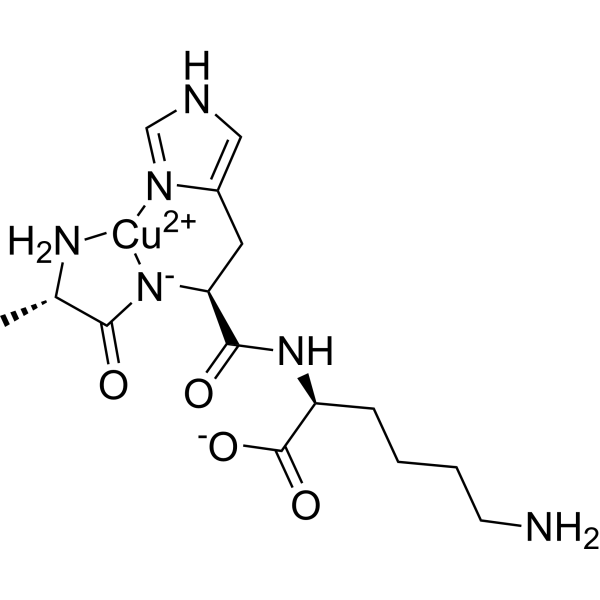
Copper tripeptide-3 (AHK-Cu) is a bioactive peptide with promotion of hair growth effect. Copper tripeptide-3 increases dermal cell proliferation and viability while increasing the deposition of collagen to renew the extracellular matrix. Copper tripeptide-3 stimulates the elongation of human hair follicles and proliferation of dermal papilla cells .
loading...
    loading...
Cat. No.: HY-170448
PROTAC AR Degrader-9 is a topically applicable androgen receptor (AR) PROTAC degrader. PROTAC AR Degrader-9 recruits Cereblon (CRBN) E3 ubiquitin ligase to induce AR ubiquitination and proteasomal degradation in human dermal papilla cells (HDPCs) with a DC50 of 262.38 nM. PROTAC AR Degrader-9 possesses excellent skin retention, modulates androgenetic alopecia (AGA)-related downstream paracrine factors including TGF-β1 and β-catenin, promotes hair regeneration in mice. and exhibits favorable skin pharmacokinetics profiles with minimal systemic exposure. PROTAC AR Degrader-9 can be used for the study of androgenetic alopecia (AGA) .
loading...
    loading...
Cat. No.: HY-184195
PROTAC AR Degrader-13 is a proteolysis-targeting chimera (PROTACs) that targets the androgen receptor (AR). PROTAC AR Degrader-13 has a DC50 of 0.90 nM in LNCaP cells and a DC50 of 0.23 nM in hDPC cells. PROTAC AR Degrader-13 induces AR degradation, downregulates TGF-β1 expression, upregulates β-catenin levels, and restores the Wnt/β-catenin pro-proliferation signaling in hair follicles. In a testosterone-induced androgenetic alopecia mouse model, PROTAC AR Degrader-13 accelerates hair regeneration rate, increases hair density and hair diameter. PROTAC AR Degrader-13 can be used for the research of androgenetic alopecia .
loading...
    loading...
Cat. No.: HY-P11890
CAS No.: 1154403-54-9
Research Areas:  

Inflammation/Immunology

GPVGPS is a low-molecular-weight fish collagen peptide. GPVGPS upregulates the expression of vascular endothelial growth factor (VEGF), PCNA, hepatocyte growth factor, epidermal growth factor (EGF) , and insulin-like growth factor 1 (IGF-1), and downregulates the expression of negative regulatory proteins associated with hair health. GPVGPS inhibits MMP-1, MMP-2, and MMP-9, increases skin water content, reduces wrinkles, and improves oxidative stress status and pro-inflammatory cytokine levels. GPVGPS can be used in studies related to hair loss and UVB-induced skin photoaging .
loading...
    loading...
Cat. No.: HY-B0356G
CAS No.: 85721-33-1
Synonyms: Bay-09867 (GMP)
Ciprofloxacin GMP is Ciprofloxacin (HY-B0356) produced by using GMP guidelines. GMP small molecules works appropriately as an auxiliary reagent for cell therapy manufacture. Ciprofloxacin (Bay-09867) is an orally active, blood-brain barrier permeable fluoroquinolone antibacterial agent. Ciprofloxacin exerts bactericidal effects primarily by inhibiting topoisomerase II and IV. Ciprofloxacin inhibits the proliferation of human dental pulp stem cells and chondrocytes from young rats, and also activates the Akt signaling pathway and upregulates markers such as β-catenin and Nanog to maintain the morphological characteristics of stem cells. Ciprofloxacin induces significant neurotoxicity and tissue damage, including reducing serotonin and glutathione levels in the brain, inducing oxidative stress and depression-like behaviors, and causing articular cartilage damage. Ciprofloxacin can be applied to research related to infections of necrotic young permanent teeth and neurotoxicity .
loading...
    loading...

