14 Results for "

intramolecular rotation

" in MedChemExpress (MCE) Product Catalog:
Products (14)

14 Results for "intramolecular rotation" in MCE Product Catalog:

Cat. No.: HY-W012725
CAS No.: 367-27-1
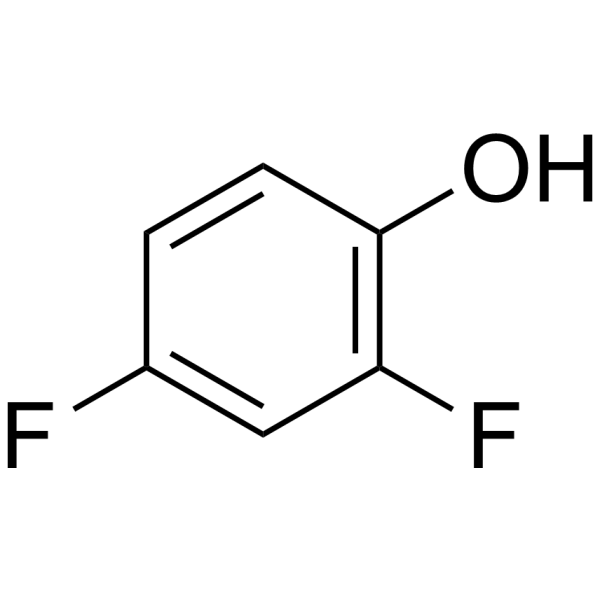
2,4-Difluorophenol is a difluoro-substituted phenol that serves as a starting material for the synthesis of 4,6-difluoro-5,7-dihydroxytryptamine .
loading...
    loading...
Cat. No.: HY-Y0661
CAS No.: 2947-61-7
Research Areas:  

Others

4-Methylbenzyl cyanide is an organic chemical probe used to study intramolecular rotation properties. 4-Methylbenzyl cyanide is promising for research of NMR spectroscopy and physical chemistry research on molecular dynamics .
loading...
    loading...
Cat. No.: HY-D2639
CAS No.: 3032077-04-3
TPE-PY is a fluorescent dye targeting mitochondria, which has cationic and lipophilic characteristics, enabling specific targeting of mitochondria. TPE-PY functions through the aggregation-induced emission (AIE) mechanism. TPE-PY mechanism of action is based on the restriction of intramolecular rotation (RIR), which enhances fluorescence in the aggregated state. TPE-PY is mainly used in the field of biological imaging, especially for the specific staining of mitochondria in living cells, facilitating the observation of the location, morphology, and quantity of mitochondria .
loading...
    loading...
Cat. No.: HY-D3097
Target:  

Fluorescent Dye

Research Areas:  

Others

Lyso-VR1 is a fluorescent probe for lysosomal viscosity detection. The detection mechanism of Lyso-VR1 relies on intramolecular rotation restriction. Due to the protonation of its indole moiety in lysosomes, this probe can specifically target lysosomes, thereby localizing to this suborganelle for viscosity monitoring. Its excitation wavelength ranges from 400-500 nm, and its emission peak under excitation at 488 nm is located at ~550 nm to ~560 nm .
loading...
    loading...
Cat. No.: HY-P12218
CAS No.: 2559743-70-1
Research Areas:  

Cancer

CVNTANST is a fluorescent peptide that targets vimentin. CVNTANST binds to vimentin and restricts the ethylene bond rotation of tetraphenylethylene, triggering fluorescence turn-on via the restriction of intramolecular motion mechanism. CVNTANST enables wash-free fluorescence detection and imaging of vimentin-positive epithelial-mesenchymal transition (EMT)-type cancer cells and tumor tissues. CVNTANST can be used for research on EMT-type cancers .
loading...
    loading...
Cat. No.: HY-D3082
CAS No.: 2222720-58-1
Target:  

Fluorescent Dye

Research Areas:  

Others

Probe L is an AIE-based dual-sensing fluorescent probe for the detection of Zn 2+ and single-stranded DNA (ssDNA). Coordination of Probe L with Zn 2+ restricts intramolecular rotation and triggers ESIPT, turning on fluorescence at 490 nm. Upon further binding of the Probe L-Zn 2+ complex to ssDNA, enhanced emission is generated at 550 nm. Ex/Em = 365/490 nm (Zn 2+); Ex/Em = 365/550 nm (ssDNA) .
loading...
    loading...
Cat. No.: HY-D2962
CAQ is a near-infrared fluorescent probe based on a curcumin scaffold (Ex/Em = 565/635). CAQ exhibits high affinity for Aβ1-42 aggregates (Kd = 78.89 nM) and excellent selectivity toward common biomolecules. CAQ’s emission wavelength shows significant solvent dependence. CAQ, by incorporating intramolecular rotation donors and quinoline functional groups, can be used for the specific detection and imaging of Aβ aggregates in Alzheimer's disease .
loading...
    loading...
Cat. No.: HY-D3430
PTPA-QM is a low-cytotoxicity protein probe that can be used for live-cell imaging and tissue section staining (Lys. Ex/Em = 385/615 nm). PTPA-QM can intercalate into the β-sheet layered structure of β-amyloid fibrils, form intermolecular interactions with amino acid residues, restrict intramolecular rotation and trigger fluorescence activation for imaging purposes. PTPA-QM is applicable to Alzheimer's disease-related research. Maximum excitation/emission wavelength: 448/605 nm .
loading...
    loading...
Cat. No.: HY-D3364
Research Areas:  

Others

RL480 is a green-emitting RNA fluorescent dye used for selective RNA labeling and imaging. RL480 contains an acylimidazole reactive group that undergoes selective acylation with the 2′-OH group of RNA ribose, and restricts intramolecular rotation through covalent binding to relieve the TICT quenching effect, thereby generating a fluorescence enhancement signal. RL480 enables selective fluorescent labeling of RNA over DNA, and is applicable to RNA gel detection, real-time RNA synthesis monitoring and live-cell RNA imaging. The detection wavelengths are Ex/Em = 480 nm/514 nm .
loading...
    loading...
Cat. No.: HY-D3119
CAS No.: 2246946-49-4
Research Areas:  

Others

MitoAIE1 is a Fluorescent probe for mitochondrial viscosity detection. MitoAIE1 contains a pyridinium structural unit, which endows it with mitochondria-targeting specificity. The detection mechanism of this probe is based on aggregation-induced emission (AIE): in low-viscosity media such as PBS buffer, intramolecular rotation leads to non-radiative energy dissipation, resulting in only weak fluorescence; however, in high-viscosity environments such as the mitochondrial matrix or the vicinity of the inner mitochondrial membrane, such intramolecular motion is restricted, thereby significantly enhancing its fluorescent signal; in addition, this probe is not interfered by changes in microenvironment polarity and pH. Its emission wavelength is 625 nm, with absorption peaks at 325 nm and 450 nm; when transferred from low-viscosity PBS to high-viscosity 99% glycerol, its fluorescence intensity at 625 nm can be increased by 38-fold. It can be used to monitor changes in mitochondrial viscosity during processes such as Stauroporine (HY-15141)-induced apoptosis and starvation-induced mitophagy in live cells, and has good biocompatibility .
loading...
    loading...
Cat. No.: HY-D3118
CAS No.: 2989973-69-3
Target:  

Fluorescent Dye

Research Areas:  

Others

Biotin-V is a fluorescent probe targeting the biotin receptor (BiR), which can be used to detect changes in intracellular viscosity in cancer cells and tumor tissues. Biotin-V consists of a viscosity-responsive TICT (twisted internal charge transfer) fluorophore and a biotin-targeting moiety. In a high-viscosity environment, intramolecular rotation is restricted, which reduces non-radiative transitions and enhances fluorescence intensity and fluorescence lifetime. Biotin-V enters BiR-positive cancer cells via biotin receptor-mediated uptake, and mainly localizes to mitochondria, enabling dual-modal viscosity imaging (fluorescence intensity imaging and fluorescence lifetime imaging) (Ex/Em = 540/608 nm; cell imaging Ex/Em = 561/570-620 nm) .
loading...
    loading...
Cat. No.: HY-D3108
CAS No.: 2569032-08-0
Target:  

Fluorescent Dye

Research Areas:  

Others

BV-1 is a fluorescent probe for viscosity detection and imaging in living cells. BV-1 can be used to detect changes in intracellular viscosity and mitochondrial viscosity in living cells. BV-1 responds to environmental viscosity via a molecular rotor mechanism. In a low-viscosity environment, the centrally located unsaturated structure induces a twisted intramolecular charge transfer (TICT) state and promotes non-radiative transitions, resulting in fluorescence quenching; when viscosity increases, molecular rotation is restricted, the TICT state is attenuated, and fluorescence is enhanced with a red shift. BV-1 can be used for real-time monitoring of changes in cytoplasmic viscosity and the viscosity increase during cell apoptosis. Ex/Em = 480/570 nm .
loading...
    loading...
Cat. No.: HY-D3148
CAS No.: 1804107-88-7
Target:  

Fluorescent Dye

Research Areas:  

Others

TPE-Ph-In is a mitochondria-targeted voltage-sensitive probe that can be used for mitochondrial membrane potential detection, mitochondrial imaging of animal and plant cells and tissues, mouse sperm activity indication, and detection of mitochondrial membrane potential changes associated with early apoptosis. TPE-Ph-In is non-fluorescent in solution, but emits strong fluorescence when aggregated via restriction of intramolecular rotation/movement, and its fluorescence intensity is directly correlated with local probe concentration or mitochondrial membrane potential level. TPE-Ph-In can penetrate cell membranes, target mitochondria through charge-dependent accumulation, has low cytotoxicity and high photostability, and enables super-resolution imaging of plant mitochondrial fission, fusion and cristae structures. The excitation wavelengths of TPE-Ph-In include 450 nm, 488 nm, and 489 nm, while its emission wavelengths include 551-661 nm, 660 nm, and 694 nm. TPE-Ph-In can be used for studies on mitochondrial dysfunction associated with early apoptosis .
loading...
    loading...
Cat. No.: HY-D3117
CAS No.: 2146114-18-1
Target:  

Fluorescent Dye

Research Areas:  

Others

MBCB is a two-photon Fluorescent probe for dual-detection of mitochondrial SO₂ derivatives and viscosity. For SO₂ derivatives detection, the probe utilizes a Michael addition mechanism: nucleophilic addition of SO₂ derivatives to the C=C bond between the carbazole skeleton and 3-methylbenzothiazolium moiety destroys the strong intramolecular charge transfer (ICT) system between these groups, while enhancing the weak ICT system between the benzothiazole group and carbazole framework; this causes the red emission at 600 nm to decrease and the blue emission at 434 nm to increase, creating a ratiometric response based on the I₄₃₄ₙₘ/I₆₀₀ₙₘ intensity ratio. For viscosity detection, in low-viscosity environments, steric hindrance creates a twisted ICT (TICT) system with weak fluorescence, while in high-viscosity environments, intramolecular rotation is blocked, the TICT state is disrupted, and the strong ICT system is recovered, leading to a strong red emission at 567 nm with negligible change to the short-wavelength emission at 415 nm, creating a ratiometric response based on the I₅₆₇ₙₘ/I₄₁₅ₙₘ intensity ratio that has a logarithmic linear relationship with viscosity. The probe has excitation/emission wavelengths of Ex/Em = 351/434, 600 nm for SO₂ derivatives detection and Ex/Em = 351/567 nm for viscosity detection, with two-photon excitation at 740 nm for bioimaging; it also exhibits good mitochondrial targeting ability with a Pearson's colocalization coefficient of 0.93 when paired with Mito-Tracker Green. The probe shows high sensitivity and selectivity for SO₂ derivatives, has low cell cytotoxicity, and can be applied to detect exogenous/endogenous HSO₃⁻ in living cells and in vivo, as well as visualize mitochondrial viscosity changes induced by nystatin[1].
loading...
    loading...
  • 1

