14 Results for "

leukocyte proliferation

" in MedChemExpress (MCE) Product Catalog:
Products (14)

14 Results for "leukocyte proliferation" in MCE Product Catalog:

Cat. No.: HY-P5351A
Hyaluronan-binding peptide, biotin labeled TFA is a biological active peptide. (This peptide is a hyaluronan-binding peptide biotinylated through a C-terminal GGGSK linker. Hyaluronan (HA) is a nonsulfated glycosaminoglycan expressed in the extracellular matrix and on cell surfaces. HA plays a role in fertilization, embryonic development, wound healing, angiogenesis, leukocyte trafficking to inflamed tissues, and cancer metastasis. This peptide has been shown to block HA binding to CD44 receptors and inhibit T cell proliferation.) .
loading...
    loading...
Cat. No.: HY-W009632
CAS No.: 70700-30-0
Synonyms: 6-Aminopurine phosphate
Adenine phosphate (6-Aminopurine phosphate) can stimulate leukocyte proliferation. Adenine phosphate is a kind of biological materials or organic compounds that are widely used in life science research .
loading...
    loading...
Cat. No.: HY-153085
Target:  

CD19

Research Areas:  

Inflammation/Immunology Cancer

CD19 CAR circRNA will express CD19 car protein, and can be used in chimeric antigen receptor T cell immunotherapy (CAR-CD19). The CD19 car is a chimeric antigen receptor. Among them, CD19 is a CD molecule expressed by B cells (i.e. leukocyte differentiation antigen), an important membrane antigen involved in B cell proliferation, differentiation, activation and antibody production, and can also promote BCR signal transduction.
loading...
    loading...
Cat. No.: HY-118028
CAS No.: 1950-36-3
Purity:  99.99%
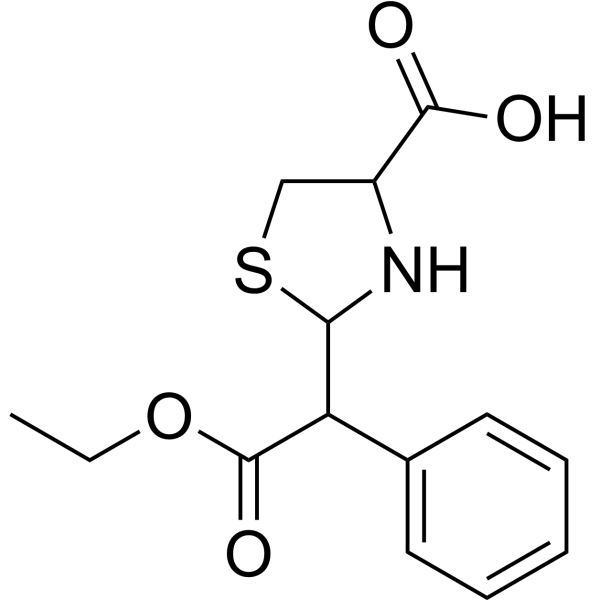
Leyk is an orally active Cysteine derivative. Leyk stimulates bone marrow hematopoiesis. Leyk exerts a significant protective effect against cyclophosphamide-induced leukopenia. Leyk can be used in studies related to thrombocytopenia and leukopenia .
loading...
    loading...
Cat. No.: HY-P5351
Target:  

Inhibitory Antibodies

Research Areas:  

Others

Hyaluronan-binding peptide, biotin labeled is a biological active peptide. (This peptide is a hyaluronan-binding peptide biotinylated through a C-terminal GGGSK linker. Hyaluronan (HA) is a nonsulfated glycosaminoglycan expressed in the extracellular matrix and on cell surfaces. HA plays a role in fertilization, embryonic development, wound healing, angiogenesis, leukocyte trafficking to inflamed tissues, and cancer metastasis. This peptide has been shown to block HA binding to CD44 receptors and inhibit T cell proliferation.)
loading...
    loading...
Cat. No.: HY-P10692
CAS No.: 135154-02-8
Target:  

Interleukin Related

Research Areas:  

Inflammation/Immunology

HB-107 is a peptide with wound healing properties. HB-107 promotes the proliferation of keratinocytes and increased leukocyte infiltration at the wound site, and it also stimulates cultured endothelial cells to secrete interleukin 8 (IL-8). HB-107 holds potential for research in the fields of wound healing and inflammation .
loading...
    loading...
Cat. No.: HY-W339834
CAS No.: 325465-92-7
Research Areas:  

Others

1-Stearoyl-sn-glycerol 3-phosphate sodium is a bioactive phospholipid that plays a crucial role in modulating cellular processes such as motility, proliferation, invasion, survival, and growth factor production, primarily through its interaction with G protein-coupled receptors (GPCRs). Typically found at low concentrations in plasma (~100nM), this compound is synthesized during the formation of membrane phospholipids and is derived from various cell types, including activated platelets, epithelial cells, leukocytes, neuronal cells, and tumor cells. Its unique structure includes stearic acid at the sn-1 position alongside a hydroxyl group at the sn-2 position.
loading...
    loading...
Cat. No.: HY-19108
CAS No.: 104795-68-8
Target:  

Calcium Channel Actin

Research Areas:  

Inflammation/Immunology Cancer

CI-959 is an orally active cell activation inhibitor. CI-959 selectively suppresses inflammatory cell activation post-receptor signaling via inhibiting calcium influx and weak calmodulin antagonism, without targeting PLC, PKC or NADPH oxidase. CI-959 blocks lung allergic mediator release, anti-IgE bronchial contraction, neutrophil function, T-cell proliferation and DC marker expression while sparing monocytes. CI-959 provides gastric cytoprotection by inhibiting leukocyte adhesion and suppresses tumor motility through F-actin reduction. CI-959 can be used for research on allergies, inflammation, autoimmune diseases, gastric injury, and tumor metastasis .
loading...
    loading...
Cat. No.: HY-N19464
CAS No.: 16408-78-9
Dicentrinone is an orally active PDI inhibitor with an IC50 value of 43.95 μM. Dicentrinone directly binds to PDI and suppresses cell proliferation and reduces cancer cell viability. Dicentrinone elicits anti-inflammatory and antioxidant effects by suppressing leukocyte migration, plasma leakage and paw edema, and scavenging free radicals. Dicentrinone can be used in the research of hepatoma, rheumatism and arthritis .
loading...
    loading...
Cat. No.: HY-P991530
YH004 is an anti-CD137 agonistic monoclonal antibody, with immunostimulating and antineoplastic activities. YH004 activates CD137 expressed on a variety of leukocyte subsets including activated T lymphocytes and natural killer cells. YH004 enhances CD137-mediated signaling and induces cytotoxic T-lymphocyte (CTL) proliferation, cytokine production and promotes anti-tumor response mediated by CTL. YH004 induces NK-mediated tumor cell killing and suppresses the immunosuppressive activity of regulatory T cells. YH004 can be studied in anticancer research .
loading...
    loading...
Cat. No.: HY-113886
CAS No.: 104795-66-6
Target:  

Calcium Channel Actin

Research Areas:  

Inflammation/Immunology Cancer

CI-959 free acid is an orally active cell activation inhibitor. CI-959 free acid selectively suppresses inflammatory cell activation post-receptor signaling via inhibiting calcium influx and weak calmodulin antagonism, without targeting PLC, PKC or NADPH oxidase. CI-959 free acid blocks lung allergic mediator release, anti-IgE bronchial contraction, neutrophil function, T-cell proliferation and DC marker expression while sparing monocytes. CI-959 free acid provides gastric cytoprotection by inhibiting leukocyte adhesion and suppresses tumor motility through F-actin reduction. CI-959 free acid can be used for research on allergies, inflammation, autoimmune diseases, gastric injury, and tumor metastasis .
loading...
    loading...
Cat. No.: HY-P700016AF
Purity:  ≥ 95%, as determined by reducing SDS-PAGE.
Synonyms: TNFSF13; ZTNF2; TNF Superfamily Member 13; Tumor Necrosis Factor Ligand Superfamily Member 13 Epsilon; APRIL; Tumor Necrosis Factor-Related Death Ligand-1; Tumor Necrosis Factor Ligand Superfamily Member 13; Tumor Necrosis Factor Superfamily Member 13; A proliferation-Inducing Ligand; Tumor Necrosis Factor-Like Protein ZTNF2; CD256; Tumor Necrosis Factor Ligand 7B; Tumor Necrosis Factor (Ligand) Superfamily, Member 13; TNF-Related Death Ligand 1; TNF- And APOL-Related leukocyte Expressed Ligand 2; UNQ383/PRO715; TALL-2; CD256 Antigen; TRDL-1; TNLG7B; TALL2
Species:  
Human
Source:  
E. coli
loading...
    loading...
Cat. No.: HY-P70733A
Purity:  ≥ 95%, as determined by reducing SDS-PAGE.
Synonyms: TNFSF13; ZTNF2; TNF Superfamily Member 13; Tumor Necrosis Factor Ligand Superfamily Member 13 Epsilon; APRIL; Tumor Necrosis Factor-Related Death Ligand-1; Tumor Necrosis Factor Ligand Superfamily Member 13; Tumor Necrosis Factor Superfamily Member 13; A proliferation-Inducing Ligand; Tumor Necrosis Factor-Like Protein ZTNF2; CD256; Tumor Necrosis Factor Ligand 7B; Tumor Necrosis Factor (Ligand) Superfamily, Member 13; TNF-Related Death Ligand 1; TNF- And APOL-Related leukocyte Expressed Ligand 2; UNQ383/PRO715; TALL-2; CD256 Antigen; TRDL-1; TNLG7B; TALL2
Species:  
Human
Source:  
HEK293
loading...
    loading...
Cat. No.: HY-P704361
Purity:  ≥ 90%, as determined by reducing SDS-PAGE.
Synonyms: TNFSF13; ZTNF2; TNF Superfamily Member 13; Tumor Necrosis Factor Ligand Superfamily Member 13 Epsilon; APRIL; Tumor Necrosis Factor-Related Death Ligand-1; Tumor Necrosis Factor Ligand Superfamily Member 13; Tumor Necrosis Factor Superfamily Member 13; A proliferation-Inducing Ligand; Tumor Necrosis Factor-Like Protein ZTNF2; CD256; Tumor Necrosis Factor Ligand 7B; Tumor Necrosis Factor (Ligand) Superfamily, Member 13; TNF-Related Death Ligand 1; TNF- And APOL-Related leukocyte Expressed Ligand 2; UNQ383/PRO715; TALL-2; CD256 Antigen; TRDL-1; TNLG7B; TALL2
Species:  
Human
Source:  
HEK293
loading...
    loading...
  • 1

