1. Search Result
Search Result
Pathways Recommended: Metabolic Enzyme/Protease
Results for "

metabolic dysfunction-associated steatohepatitis mice

" in MedChemExpress (MCE) Product Catalog:

13

Inhibitors & Agonists

2

Peptides

1

Natural
Products

Cat. No. Product Name Target Research Areas Chemical Structure
  • HY-N8599
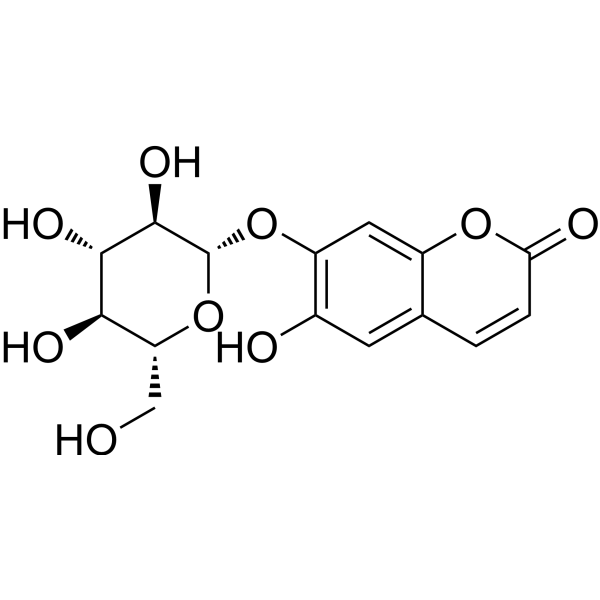
    Cichoriin
    2 Publications Verification

    Amylases Glycosidase Lipase Dipeptidyl Peptidase p38 MAPK PPAR P2Y Receptor NOD-like Receptor (NLR) SARS-CoV Pyroptosis GLUT Angiotensin-converting Enzyme (ACE) NF-κB Infection Metabolic Disease Inflammation/Immunology
    Cichoriin is an orally active coumarin glycoside with broad biological activities. Cichoriin exhibits inhibitory activities against α-amylase, α-glucosidase, pancreatic lipase and DPP-IV, with IC50 values of 5.76, 2.94, 16.83 and 9.16 μg/mL, respectively. Cichoriin significantly improves metabolic dysfunction-associated steatohepatitis (MASH) in mice by activating the AMPK signaling pathway. Cichoriin upregulates PPAR-γ in adipose tissue and alleviates obesity and associated cardiorenal injury in rats. Cichoriin blocks monosodium urate crystal-induced activation of the NLRP3 inflammasome and cell pyroptosis by inhibiting P2Y14R (IC50 = 8.47 nM). In silico virtual screening reveals that Cichoriin has a strong binding affinity for SARS-CoV-2 .
    Cichoriin
  • HY-177704

    ACSL Family Drug Derivative Metabolic Disease Cancer
    ACSL5-IN-1 (Compound A) is an ACSL5 inhibitor with body weight-reducing activity. ACSL5-IN-1 inhibits ACSL5, an enzyme linked to fatty acid metabolism. ACSL5-IN-1 reduces body weight in diet-induced obesity mice. ACSL5-IN-1 can be used for the research of obesity, metabolic dysfunction-associated steatohepatitis, metabolic syndrome, non-alcoholic fatty liver disease, type 2 diabetes, acute myeloid leukemia, colorectal cancer, and breast cancer .
    ACSL5-IN-1
  • HY-P11208C

    GABA Receptor Inflammation/Immunology
    mNLS-CPP-WSTF TFA is the trifluoroacetate salt of mNLS-CPP-WSTF (HY-P11208). mNLS-CPP-WSTF is a nuclear localization signal (NLS)-cell-penetrating peptide based on the mouse WSTF sequence. mNLS-CPP-WSTF significantly inhibits the GABARAP-WSTF interaction, WSTF degradation and inflammatory gene expression. mNLS-CPP-WSTF effectively attenuates chronic inflammation, liver fibrosis and cartilage damage in metabolic-dysfunction-associated steatohepatitis (MASH) and osteoarthritis (OA) mice model. mNLS-CPP-WSTF is promising for research of chronic inflammatory diseases such as MASH and OA .
    mNLS-CPP-WSTF TFA
  • HY-178015

    Thyroid Hormone Receptor Metabolic Disease Inflammation/Immunology
    THR-β agonist 11 is an orally active and selective thyroid hormone receptor (THR-β) agonist. THR-β agonist 11 shows potent cholesterol-lowering activity in cholesterol-fed rats. THR-β agonist 11 significantly reduces serum total TG, LDL-cholesterol, liver total TC and TG levels, and alleviates hepatic steatosis, inflammation and fibrosis in HFD-CCl4-induced Metabolic dysfunction-associated steatohepatitis (MASH) model mice. THR-β agonist 11 can be used for the study of metabolic dysfunction-associated steatohepatitis (MASH) and other fibrotic diseases .
    THR-β agonist 11
  • HY-P11208

    GABA Receptor Inflammation/Immunology
    mNLS-CPP-WSTF is a nuclear localization signal (NLS)-cell-penetrating peptide based on the mouse WSTF sequence. mNLS-CPP-WSTF significantly inhibits the GABARAP-WSTF interaction, WSTF degradation and inflammatory gene expression. mNLS-CPP-WSTF effectively attenuates chronic inflammation, liver fibrosis and cartilage damage in metabolic-dysfunction-associated steatohepatitis (MASH) and osteoarthritis (OA) mice model. mNLS-CPP-WSTF is promising for research of chronic inflammatory diseases such as MASH and OA .
    mNLS-CPP-WSTF
  • HY-168629

    FXR Metabolic Disease
    FXR agonist 9 (compound 26) is an oral active and selectivity FXR partial agonist with the EC50 of 0.09 µM (75.13 % maximum efficacy). FXR agonist 9 ameliorates pathological features in HFD and CCl4(HY-Y0298)-induced metabolic dysfunction-associated steatohepatitis mice .
    FXR agonist 9
  • HY-168713

    FXR Metabolic Disease
    LZ-007 is an agonist for farnesoid X receptor (FXR) with an EC50 of 51 nM measuring by TR-FRET assay, or an EC50 of 76 nM in HepG2 cell. LZ-007 exhibits good pharmacokinetic characheristics in SD rats. LZ-007 ameliorates western diet and CCl4 (HY-Y0298)-induced mice metabolic dysfunction-associated steatohepatitis
    LZ-007
  • HY-172883

    FABP PPAR Metabolic Disease Inflammation/Immunology
    ABP/PPAR modulator 1 is an orally active FABP and PPAR multiple modulator (IC50s of 0.65  μM and 1.08  μM for FABP1 and FABP4, EC50 s of 9.19  μM, 2.20  μM and 1.58 μM for PPARα, PPARγ and PPARδ). ABP/PPAR modulator 1 has potent anti-metabolic dysfunction-associated steatohepatitis (MASH) activity. ABP/PPAR modulator 1 dose-dependently ameliorates multiple pathological characteristics of fatty liver in WD + Carbon tetrachloride-induced MASH mice model .
    ABP/PPAR modulator 1
  • HY-172883A

    FABP PPAR Metabolic Disease Inflammation/Immunology
    (E/Z)-ABP/PPAR modulator 1 is a mixture of the E and Z isomers of ABP/PPAR modulator 1 (HY-172883). ABP/PPAR modulator 1 is an orally active FABP and PPAR multiple modulator (IC50s of 0.65  μM and 1.08  μM for FABP1 and FABP4, EC50 s of 9.19  μM, 2.20  μM and 1.58 μM for PPARα, PPARγ and PPARδ). ABP/PPAR modulator 1 has potent anti-metabolic dysfunction-associated steatohepatitis (MASH) activity. ABP/PPAR modulator 1 dose-dependently ameliorates multiple pathological characteristics of fatty liver in WD + Carbon tetrachloride-induced MASH mice model .
    (E/Z)-ABP/PPAR modulator 1
  • HY-183692

    FXR G protein-coupled Bile Acid Receptor 1 TNF Receptor Heme Oxygenase (HO) Quinone Reductase Keap1-Nrf2 Cardiovascular Disease Inflammation/Immunology
    FXR agonist 18 is an orally active FXR agonist, with an EC50 of 10 nM against human FXR and an EC50 of 1360 nM against human TGR5. FXR agonist 18 inhibits inflammatory responses by reducing nitrite production, downregulating the expression of pro-inflammatory genes (Tnf, Adgre1, Cyp8b1, upregulating the expression of FXR, Hmox1, Nqo1, Nrf2, and enhancing antioxidant responses. FXR agonist 18 ameliorates liver fibrosis in mice, exhibits protective effects in mice with cholestatic liver injury, and shows anti-MASH efficacy. FXR agonist 18 can be used in studies of metabolic dysfunction-associated steatohepatitis .
    FXR agonist 18
  • HY-179591

    326E

    ATP Citrate Lyase PPAR Metabolic Disease
    BGT-002 (326E) is an orally active dual ACLY inhibitor and PPARα agonist. BGT-002 reduces lipogenesis by inhibiting synthesis and promoting efflux. BGT-002 demonstrates efficacy in ameliorating metabolic dysfunction-associated steatohepatitis (MASH) and improving hyperlipidemia in vivo. BGT-002 can be used for hypercholesterolemia and MASH research .
    BGT-002
  • HY-182026

    FXR G protein-coupled Bile Acid Receptor 1 TNF Receptor Reactive Oxygen Species (ROS) Inflammation/Immunology
    FXR agonist 17 is an orally active, steroidal FXR agonist with EC50 values of 42.2 nM (TR-FRET) and 176.4 nM (luciferase reporter assay), respectively. FXR agonist 17 activates TGR5 (EC50 = 2.6 μM) but does not activate hMRGPRX4. FXR agonist 17 exerts anti-inflammatory, hepatoprotective and antifibrotic effects, improves the non-alcoholic steatohepatitis (NAFLD) activity score and reduces the severity of liver fibrosis. FXR agonist 17 can be used for the research of NAFLD, cholestatic liver disease and liver fibrosis .
    FXR agonist 17
  • HY-183279

    FXR AMPK Metabolic Disease
    FXR antagonist 4 (Compound 4l) is an orally active, selective FXR antagonist with an IC50 of 0.70 μM. FXR antagonist 4 binds to FXR, differentially regulates bile acid and lipid transporter genes, and exerts no effect on gluconeogenesis-related genes. FXR modulator 1 activates the AMPK signaling pathway to inhibit fatty acid synthesis. FXR modulator 1 alleviates hepatic steatosis, ballooning degeneration and fibrosis, and improves dyslipidemia. FXR modulator 1 can be used for research on metabolic dysfunction-associated steatohepatitis .
    FXR antagonist 4

Inquiry Online

Your information is safe with us. * Required Fields.

Salutation


Country or Region *

Applicant Name *


Organization Name *

Department *


Email Address *


Product Name *

Cat. No.


Requested quantity *

Phone Number *


Remarks

Inquiry Online

Inquiry Information

Product Name:
Cat. No.:
Quantity:
MCE Japan Authorized Agent:

