1. Search Result
Search Result
Pathways Recommended: Membrane Transporter/Ion Channel
Results for "

mitochondrial membrane potential depolarization

" in MedChemExpress (MCE) Product Catalog:

16

Inhibitors & Agonists

1

Fluorescent Dyes

1

Peptides

1

Natural
Products

Cat. No. Product Name Target Research Areas Chemical Structure
  • HY-137371

    Bacterial Apoptosis Antibiotic Infection Cancer
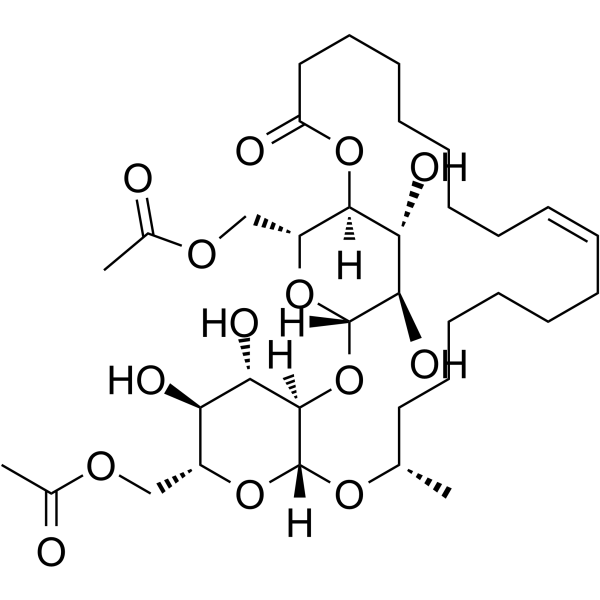
    Lactonic sophorolipid is an apoptosis inducer and antimicrobial surfactant with antitumor activity. Lactonic sophorolipid regulates Bax/Bcl-gene expression through caspase-3/9 and induces apoptosis in tumor cells. Lactonic sophorolipid can disrupt cell membrane permeability and exert antibacterial effects (MIC for oral pathogens is 100-400 μg/mL). Lactonic sophorolipid promotes mitochondrial membrane potential depolarization, activates the intrinsic apoptotic pathway, and can synergize with antibiotics to enhance the antibacterial effect. Lactonic sophorolipid can be used in liver cancer research and the development of oral hygiene antibacterial agents[1][2][3].
    Lactonic sophorolipid
  • HY-126220

    Fluorescent Dye Others
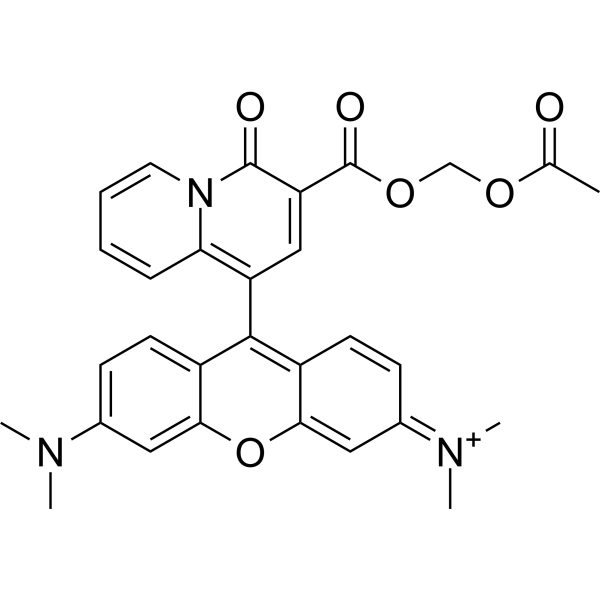
    KMG-301AM is the acetoxy methyl esterified form of KMG-301. KMG-301AM successfully accumulates in mitochondria and then it is hydrolyzed to KMG-301. KMG-301 is an Mg 2+-selective fluorescent probe functional in mitochondria in intact cells. Since the mitochondrial membrane is impermeable to KMG-301, it is not released upon depolarization of the mitochondrial membrane potential. KMG-301 can indicate changes in mitochondrial Mg2+ concentration and shows Mg 2+ transport across the mitochondrial membrane in the early phases of a cellular model .
    KMG-301AM
  • HY-126220A

    Fluorescent Dye Others
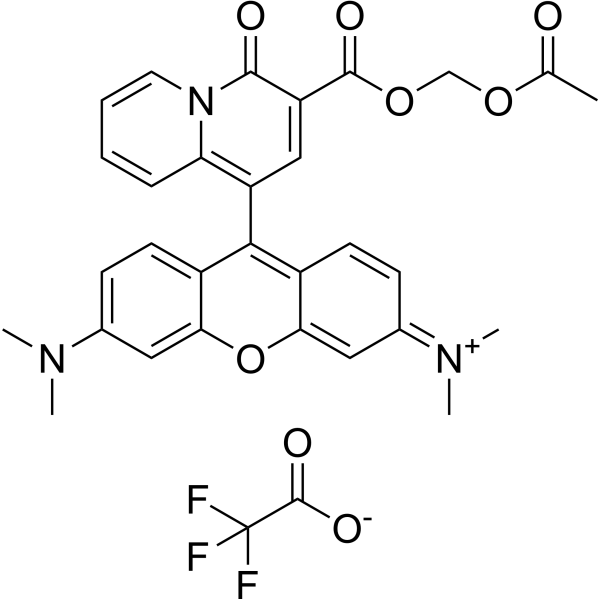
    KMG-301AM TFA is the acetoxy methyl esterified form of KMG-301. KMG-301AM TFA successfully accumulates in mitochondria and then it is hydrolyzed to KMG-301. KMG-301 is an Mg 2+-selective fluorescent probe functional in mitochondria in intact cells. Since the mitochondrial membrane is impermeable to KMG-301, it is not released upon depolarization of the mitochondrial membrane potential. KMG-301 can indicate changes in mitochondrial Mg2+ concentration and shows Mg 2+ transport across the mitochondrial membrane in the early phases of a cellular model .
    KMG-301AM TFA
  • HY-114372

    Lipoxygenase Caspase Apoptosis Cancer
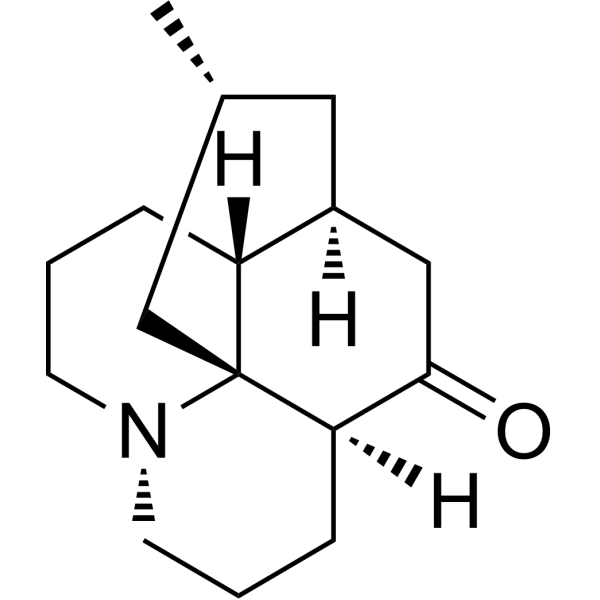
    Lycopodine, a pharmacologically important bioactive component derived from Lycopodium clavatumspores, triggers apoptosis by modulating 5-lipoxygenase, and depolarizing mitochondrial membrane potential in refractory prostate cancer cells without modulating p53 activity . Lycopodine inhibits proliferation of HeLa cells through induction of apoptosis via caspase-3 activation .
    Lycopodine
  • HY-14764

    SPI 8811

    Chloride Channel Mitochondrial Metabolism Inflammation/Immunology
    Cobiprostone (SPI 8811) is a type-2 chloride channel activator. Cobiprostone protects against Indomethacin (HY-14397)-induced depolarization of mitochondrial membrane potential and reverses the loss of mitochondrial membrane potential. Cobiprostone protects against NSAID-induced cellular damage .
    Cobiprostone
  • HY-W587938

    (+)-γ-Eudesmol

    Apoptosis Cancer
    γ-Eudesmol ((+)-γ-Eudesmol) is a mitochondrial-mediated apoptosis inducer. γ-Eudesmol binds mitochondrial membrane proteins, triggering depolarization of mitochondrial membrane potential and activating caspase cascades. γ-Eudesmol demonstrates cytotoxicity against multiple tumor cell lines (e.g., HepG2, B16-F10) with IC50 values ranging from 8.86-15.15 μg/mL. γ-Eudesmol is promising for research of cancers, such as hepatocellular carcinoma and melanoma .
    γ-Eudesmol
  • HY-172116

    Mitochondrial Metabolism Apoptosis Reactive Oxygen Species (ROS) Cancer
    Mitochondria modulator-2 (Compound Ir1) induces the depolarization of mitochondrial membrane potential, induces ROS generation, inhibits cell migration of A549, arrests the cell cycle at G2/M phase, and induces apoptosis in A549 .
    Mitochondria modulator-2
  • HY-170559

    EGFR Apoptosis Cancer
    EGFR-IN-141 (Compound 8I) is the inhibitor for EGFR with an IC50 of 2.67 nM. EGFR-IN-141 exhibits cytotoxicity in cancer cell A549 with an IC50 of 13.75 μM. EGFR-IN-141 induces apoptosis and mitochondrial membrane depolarization, and exhibits potential antitumor efficacy .
    EGFR-IN-141
  • HY-P10402

    Bacterial Infection Cancer
    BMAP 28, bovine is an antibacterial peptide. BMAP 28, bovine exhibits antimicrobial activity against gram-positive and gram-negative bacteria, by increasing cell membrane permeability, and causing leakage of cell contents. BMAP 28, bovine exhibits cytotoxicity to cancer cells and activated human lymphocytes. BMAP 28, bovine induces apoptosis through depolarization of mitochondrial membrane potential .
    BMAP 28 (bovine)
  • HY-167255

    Fluorescent Dye Others
    JC-10 is a lipophilic mitochondrial membrane potential indicator and is a fluorescent dye. JC-10 accumulates and aggregates in healthy mitochondria to emit red fluorescence; exists as a monomer emitting green fluorescence in the cytosol or apoptotic cells with collapsed mitochondrial membrane potential, enabling measurement of mitochondrial depolarization via the green/red fluorescence ratio .
    JC-10
  • HY-175567

    Apoptosis Reactive Oxygen Species (ROS) Cancer
    Apoptosis inducer 41 is an apoptosis inducer that induces apoptosis through the mitochondrial pathway. Apoptosis inducer 41 exhibits remarkable inhibitory effects against MCF-7 cells (IC50 = 6.2 μM). Apoptosis inducer 41 significantly arrests MCF-7 cells in the G2/M phase, increases ROS accumulation, induces mitochondrial membrane potential depolarization. Apoptosis inducer 41 can used for the study of breast cancer .
    Apoptosis inducer 41
  • HY-172100

    Apoptosis Reactive Oxygen Species (ROS) p38 MAPK Cancer
    p38-α MAPK-IN-8 (Compound 13) is a lipophilic cationic derivative. p38-α MAPK-IN-8 is cytotoxic to various tumor cells, and can induce cell cycle arrest, apoptosis, increase reactive oxygen species (ROS) production, and induce mitochondrial membrane potential depolarization. The antitumor activity of p38-α MAPK-IN-8 may be related to p38α MAPK pathway, which can be used in the study of cancer .
    p38-α MAPK-IN-8
  • HY-179018

    Topoisomerase Reactive Oxygen Species (ROS) Apoptosis Cancer
    Topoisomerase II-IN-25 (Compound 6a) is a selective inhibitor of topoisomerase II and has no inhibitory activity on topoisomerase I. Topoisomerase II-IN-25 exhibits significant anti-PC-3 cell activity. Topoisomerase II-IN-25 significantly increases intracellular ROS levels, inducing oxidative stress. Topoisomerase II-IN-25 causes depolarization of mitochondrial membrane potential and promotes cell apoptosis. Topoisomerase II-IN-25 blocks PC-3 cells in the G2/M phase. Topoisomerase II-IN-25 can be used for the study of prostate cancer .
    Topoisomerase II-IN-25
  • HY-173007

    Akt PI3K Anaplastic lymphoma kinase (ALK) CDK Apoptosis Mitochondrial Metabolism Cancer
    ALK/PI3K/AKT-IN-1 (Compound 45) inhibits the proliferation of cancer cell A549, H1975 and PC9 with an IC50 of 0.44, 0.83 and 1.51 μM. ALK/PI3K/AKT-IN-1 increases the expression of p21 and p27, inhibits the activity of CDK2 and p-Rb, arrests the cell cycle at G1 phase. ALK/PI3K/AKT-IN-1 inhibits the ALK/PI3K/AKT signaling pathway, promotes the depolarization of mitochondrial membrane potential, and inducing apoptosis in A549 cell. ALK/PI3K/AKT-IN-1 inhibits the formation and growth of A549 cell spheroids .
    ALK/PI3K/AKT-IN-1
  • HY-183364

    Methylenetetrahydrofolate Dehydrogenase (MTHFD) Reactive Oxygen Species (ROS) Apoptosis Mitochondrial Metabolism Cancer
    MTHFD2-IN-8 is a selective MTHFD2 inhibitor with an IC50 of 0.066 μM. MTHFD2-IN-8 directly binds to intracellular mitochondrially localized protein MTHFD2 and accumulates selectively in tumor mitochondria. MTHFD2-IN-8 increases intracellular ROS levels, induces mitochondrial membrane potential depolarization, arrests cell cycle at G0/G1 phase, promotes apoptosis in cancer cells. MTHFD2-IN-8 inhibits tumor growth in a mouse colon cancer graft model .
    MTHFD2-IN-8
  • HY-181746

    Bcl-2 Family Apoptosis Caspase PARP Cancer
    Bcl-2/Mcl-1-IN-5 (Compound S6) is a Bcl-2 and Mcl-1 inhibitor. Bcl-2/Mcl-1-IN-5 promotes Apoptosis, downregulates anti-apoptotic proteins Bcl-2 and Mcl-1, induces mitochondrial membrane potential depolarization, and activates the Caspase-dependent apoptotic cascade, as evidenced by Caspase-3 activation and PARP1 cleavage. Bcl-2/Mcl-1-IN-5 has anti-hepatocellular carcinoma activity .
    Bcl-2/Mcl-1-IN-5

Inquiry Online

Your information is safe with us. * Required Fields.

Salutation


Country or Region *

Applicant Name *


Organization Name *

Department *


Email Address *


Product Name *

Cat. No.


Requested quantity *

Phone Number *


Remarks

Inquiry Online

Inquiry Information

Product Name:
Cat. No.:
Quantity:
MCE Japan Authorized Agent:

