10 Results for "

normal mammary epithelial cells

" in MedChemExpress (MCE) Product Catalog:
Products (10)

10 Results for "normal mammary epithelial cells" in MCE Product Catalog:

1
1 Cited Publications
Cat. No.: HY-N3009
CAS No.: 58822-47-2
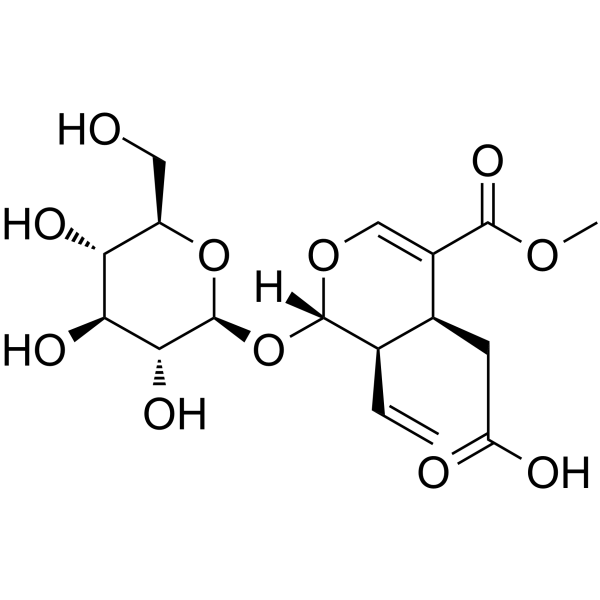
Secoxyloganin is an orally effective iridoid derivative. Secoxyloganin can be isolated from the flower buds of L. japonica. Secoxyloganin induces Apoptosis by inhibiting the expression of Bcl-2. Secoxyloganin potently inhibits the proliferation of breast cancer cells, while exerting weak activity against normal mammary epithelial cells. Secoxyloganin inhibits the decrease in tail vein blood flow associated with allergic reactions .
loading...
    loading...
Cat. No.: HY-100395
CAS No.: 36098-33-6
Purity:  99.94%
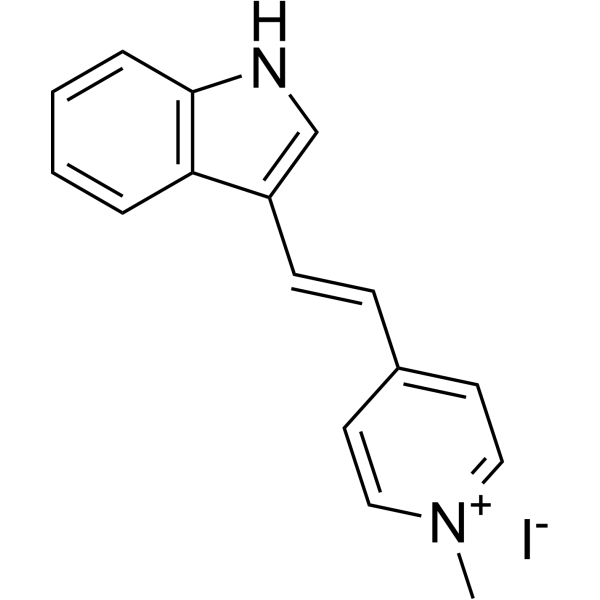
F16 is a mitochondrial permeability transition pore (PTP) modulator with an EC50 of 30 μM in mice. F16 promotes PTP opening, accumulates in cancer cell mitochondria, and induces mitochondrial depolarization, swelling, cristae disruption, outer membrane rupture, ATP depletion, reactive oxygen species (ROS) production, cytochrome c release and mitochondrial uncoupling. F16 induces cell cycle arrest at the G1 (occasionally G2) phase, reduces the phosphotyrosine content of Neu, as well as the levels of phosphorylated PKB/Akt and phosphorylated MAP kinase, downregulates the protein expression levels of Neu and PKB, triggers apoptosis in cells with moderate Bcl-2 expression, and induces necrosis in cells with overexpressed Bcl-2. F16 can be used in research related to breast cancer and gastric cancer .
loading...
    loading...
Cat. No.: HY-174779
Target:  

mRNA

Research Areas:  

Cancer

Human AREG mRNA encodes the human amphiregulin (AREG) protein, a member of the epidermal growth factor family. AREG interacts with the EGF/TGF-alpha receptor to promote the growth of normal epithelial cells, and inhibits the growth of certain aggressive carcinoma cell lines. It also functions in mammary gland, oocyte and bone tissue development.
loading...
    loading...
Cat. No.: HY-100395R
CAS No.: 36098-33-6
F16 (Standard) is the analytical standard of F16 (HY-100395). This product is intended for research and analytical applications. F16 is a mitochondrial permeability transition pore (PTP) modulator with an EC50 of 30 μM in mice. F16 promotes PTP opening, accumulates in cancer cell mitochondria, and induces mitochondrial depolarization, swelling, cristae disruption, outer membrane rupture, ATP depletion, reactive oxygen species (ROS) production, cytochrome c release and mitochondrial uncoupling. F16 induces cell cycle arrest at the G1 (occasionally G2) phase, reduces the phosphotyrosine content of Neu, as well as the levels of phosphorylated PKB/Akt and phosphorylated MAP kinase, downregulates the protein expression levels of Neu and PKB, triggers apoptosis in cells with moderate Bcl-2 expression, and induces necrosis in cells with overexpressed Bcl-2. F16 can be used in research related to breast cancer and gastric cancer .
loading...
    loading...
Cat. No.: HY-182054
Research Areas:  

Cancer

Topoisomerase ll/ME-1-IN-1 (Compound 7a) is a Topoisomerase ll and ME-1 inhibitor with an IC50 of 5.03 μM against Topoisomerase ll. Topoisomerase ll/ME-1-IN-1 functionally inhibits the activity of Topoisomerase II and functionally blocks the activity of ME-1. Topoisomerase ll/ME-1-IN-1 induces Autophagy by upregulating the expression of Beclin-1 and LC3-II. Topoisomerase ll/ME-1-IN-1 promotes Apoptosis. Topoisomerase ll/ME-1-IN-1 exhibits antiproliferative activity against breast cancer cells and shows no toxicity to normal mammary epithelial cells. Topoisomerase ll/ME-1-IN-1 can be used in studies related to breast cancer (including triple-negative breast cancer) .
loading...
    loading...
Cat. No.: HY-184665
CAS No.: 1638811-35-4
Target:  

Drug Derivative

Research Areas:  

Cancer

Dedimethyl MitoCur-1 is a mitochondria-targeted curcuminoid derived from MitoCur-1 (HY-150228) with anticancer activity. MitoCur-1 induces massive reactive oxygen species production in cancer cells, reduces mitochondrial membrane potential, and triggers cell cycle arrest and apoptosis. Meanwhile, MitoCur-1 inhibits the phosphorylation of Akt and STAT3, enhances ERK phosphorylation, and upregulates the expression of the pro-apoptotic protein BNIP3. Dedimethyl MitoCur-1 can be used in research related to breast cancer, cervical cancer, prostate cancer, and neuroblastoma .
loading...
    loading...
Cat. No.: HY-183294
CAS No.: 2834106-56-6
GPX4-IN-24 is an orally active glutathione peroxidase 4 (GPX4) inhibitor with a human IC50 of 10.90 μM, human Kd of 10.04 μM. GPX4-IN-24 suppresses GPX4 enzymatic activity, disrupts redox homeostasis, drives lipid peroxidation, promotes lipid peroxidation, and induces ferroptosis. GPX4-IN-24 can be used for the research of triple-negative breast cancer .
loading...
    loading...
Cat. No.: HY-182547
CAS No.: 476475-07-7
Research Areas:  

Cancer

LY580276 is an ATP-competitive ALK5 inhibitor with an IC50 of 175 nM. LY580276 inhibits transforming growth factor-β-induced epithelial-mesenchymal transition. LY580276 can be used for cancer research .
loading...
    loading...
Cat. No.: HY-181413
CAS No.: 3093642-25-9
PROTAC EZH2 Degrader-44 (compound 60) is a highly efficient PROTAC degrader targeting the EZH2-PRC2 complex. By recruiting the CRBN E3 ligase and relying on the proteasome system, PROTAC EZH2 Degrader-44 simultaneously induces the degradation of core components EZH2, SUZ12 and EED, thereby significantly reducing the levels of H3K27me3 and CARM1. PROTAC EZH2 Degrader-44 exerts antiproliferative effects through a dual mechanism: on the one hand, it triggers mitochondrial dysfunction leading to decreased membrane potential; on the other hand, it strongly promotes apoptosis by regulating Bcl-2 family proteins (upregulating Bax, Caspase-3 and PARP, and downregulating Bcl-2). PROTAC EZH2 Degrader-44 exhibits only extremely low cytotoxicity in human normal mammary epithelial, liver and kidney cells, showing a favorable safety window. PROTAC EZH2 Degrader-44 is an ideal tool molecule for exploring the mechanisms of targeted therapy for triple-negative breast cancer .
loading...
    loading...
Cat. No.: HY-183700
Research Areas:  

Infection

DNA gyrase/Topo IV-IN-3 is an inhibitor of Escherichia coli DNA gyrase and Topoisomerase IV, with IC50 values of 1.75 μM and 3.47 μM, respectively. DNA gyrase/Topo IV-IN-3 acts as a biofilm inhibitor and exhibits antibacterial activity against both Gram-negative and Gram-positive bacteria. DNA gyrase/Topo IV-IN-3 can be used in studies related to bacterial infections .
loading...
    loading...

