1. Search Result
Search Result
Results for "

property

" in MedChemExpress (MCE) Product Catalog:

3050

Inhibitors & Agonists

68

Screening Libraries

88

Fluorescent Dye

346

Biochemical Assay Reagents

163

Peptides

11

Inhibitory Antibodies

766

Natural
Products

242

Isotope-Labeled Compounds

22

Click Chemistry

70

Oligonucleotides

3

GMP Molecules

Cat. No. Product Name Target Research Areas Chemical Structure
  • HY-B1620B

    PVP K15; Polyvidone K15; Povidone K15

    Environmental Pollutants Biochemical Assay Reagents Others
    Polyvinylpyrrolidone K15 is a linear non-ionic polymer devises vigorous bright crystalline layers and has adhesive, cohesive and dispersive properties .
    Polyvinylpyrrolidone K15
  • HY-B0369A

    iGluR Neurological Disease Cancer
    Orphenadrine citrate is an orally active and non-competitive NMDA receptor antagonist (crosses the blood-brain barrier) with a Ki of 6.0 μM. Orphenadrine citrate relieves stiffness, pain and discomfort due to muscle strains, sprains or other injuries. Orphenadrine citrate is also used to relieve tremors associated with parkinson's disease. Orphenadrine citrate has good neuroprotective properties, can be used in studies of neurodegenerative diseases .
    Orphenadrine citrate
  • HY-100618
    Hispidin
    1 Publications Verification

    PKC Endogenous Metabolite Ferroptosis Reactive Oxygen Species (ROS) p38 MAPK JAK STAT JNK Akt GSK-3 ERK Keap1-Nrf2 Cardiovascular Disease Metabolic Disease Inflammation/Immunology Cancer
    Hispidin, a PKC inhibitor and a phenolic compound can be found in Phellinus linteus, has been shown to possess strong anti-oxidant, anti-cancer, anti-diabetic, and anti-dementia properties .
    Hispidin
  • HY-118159

    DPPP

    Fluorescent Dye Others
    Diphenyl-1-pyrenylphosphine (DPPP) is a functional organic molecule with both fluorescent properties and metal coordination ability, which is commonly used in materials and coordination chemistry research. Upon exposure to ultraviolet light, Diphenyl-1-pyrenylphosphine undergoes photoinduced phosphorus atom oxidation to form O-DPPP, triggering a transition from aggregation-induced emission (AIE) to aggregation-caused quenching (ACQ). Diphenyl-1-pyrenylphosphine reacts stoichiometrically with lipid hydroperoxides to produce fluorescent diphenyl-1-pyrenylphosphine oxide. Diphenyl-1-pyrenylphosphine can insert into cell membranes to monitor lipid peroxidation processes in living cells .
    Diphenyl-1-pyrenylphosphine
  • HY-B0878
    Halobetasol propionate
    1 Publications Verification

    BMY-30056; CGP-14458; Ulobetasol propionate

    Glucocorticoid Receptor Inflammation/Immunology
    Halobetasol propionate (BMY-30056) is a synthetic glucocorticoid corticosteroid. Halobetasol propionate exhibits anti-inflammatory, antipruritic, and vasoconstrictive properties. Halobetasol propionate can be used for the study of psoriasis .
    Halobetasol propionate
  • HY-P0133

    Nona-L-arginine; Peptide R9

    Ser/Thr Protease Neurological Disease
    (Arg)9 (Nona-L-arginine) is a cell-penetrating peptide (CPP) made up of 9 arginine residues, which is an inhibitor of serine endoprotease Furin. (Arg)9 has neuroprotective property, exhibits neuroprotective activity with an IC50 of 0.78 μM in the glutamic acid model .
    (Arg) 9
  • HY-128383

    Environmental Pollutants Drug Intermediate Others
    1-Methylpyrrolidine is a methylated pyrrolidine, and cation with thermal-origin negative nonlinear optical (self-defocusing) properties .
    1-Methylpyrrolidine
  • HY-W099927

    Biochemical Assay Reagents Others
    [C3MPr]NTf2 is a representative ionic liquid that covers all 12 IL property datasets .
    [C3MPr]NTf2
  • HY-108587

    Potassium Channel Neurological Disease
    ICA 110381 is an orally active Kv7.2/Kv7.3 (KCNQ2/3) potassium channel activator with anticonvulsive properties. ICA 110381 is a KCNQ2/Q3 activator (EC50=0.38 μM) as well as KCNQ1 antagonist (IC50=15 μM) .
    ICA 110381
  • HY-P0133A
    (Arg)9 TFA
    1 Publications Verification

    Nona-L-arginine TFA; Peptide R9 TFA

    Ser/Thr Protease Neurological Disease
    (Arg)9 (Nona-L-arginine) TFA is a cell-penetrating peptide (CPP) made up of 9 arginine residues. (Arg)9 TFA has neuroprotective property, exhibits neuroprotective activity with an IC50 of 0.78 μM in the glutamic acid model .
    (Arg)9 TFA
  • HY-147338A

    5-Methyl-CTP trisodium

    DNA/RNA Synthesis Others
    5-Methylcytidine 5′-triphosphate (5-Methyl-CTP) trisodium is a modified nucleoside triphosphate. 5-Methylcytidine 5′-triphosphate trisodium can apply in replacing unmodified mRNA, resulting in the increase of translational properties and stability, as well as the reduction of innate immune responses in human and other mammalian cells .
    5-Methylcytidine 5′-triphosphate trisodium
  • HY-19986

    VEGFR Cardiovascular Disease Cancer
    IC50s of 130 nM, 23 nM, and 18 nM for VEGFR1, VEGFR2, and VEGFR3, respectively. AAL993 shows less potently inhibits other tyrosine kinases. AAL993 possesses potent antiangiogenic and antitumor properties .
    AAL993
  • HY-P0133B
    (Arg)9 acetate
    1 Publications Verification

    Nona-L-arginine acetate; Peptide R9 acetate

    Ser/Thr Protease Neurological Disease
    (Arg)9 (Nona-L-arginine) acetate is a cell-penetrating peptide (CPP) made up of 9 arginine residues. (Arg)9 acetate has neuroprotective property, exhibits neuroprotective activity with an IC50 of 0.78 μM in the glutamic acid model .
    (Arg)9 acetate
  • HY-N10544

    (+)-δ-Cadinene

    Bacterial Parasite Fungal Apoptosis Infection Cancer
    δ-Cadinene ((+)-δ-Cadinene) is a sesquiterpene in essential oils. δ-Cadinene shows antiproliferative and pro-apoptotic effects on human ovary cancer (OVCAR-3) cells. δ-Cadinene has trichomonacidal, antimicrobial, antifungal and anticancer properties .
    δ-Cadinene
  • HY-148255

    Apoptosis Autophagy Cancer
    QN523 is a novel scaffold with agent-like properties, showing potent in vitro cytotoxicity in a panel of 12 cancer cell lines. QN523 induces apoptosis and autophagy. QN523 can be used in research of cancer .
    QN523
  • HY-170573A

    Monoamine Oxidase Cancer
    LOX-IN-5 tosylate (compound 22) is a selective and orally active lysyl oxidase-like 2 (LOXL2) inhibitor with an IC50 of <300 nM. LOX-IN-5 tosylate possess anti-fibrosis properties .
    LOXL2-IN-1 tosylate
  • HY-B1800

    Angiotensin Receptor Cardiovascular Disease
    Tolonidine is a derivative of imidazoline. Tolonidine is orally active and has been shown to possess hypotensive and antihypertensive properties .
    Tolonidine
  • HY-N7438

    Others Others
    Mogroside VI A, an isomer of Mogroside VI isolated from Luo Han Guo, exerts sweetness property. Mogroside VI A can be used for sweetener and/or taste modifier research .
    Mogroside VI A
  • HY-N8541

    Endogenous Metabolite Inflammation/Immunology
    Endocrocin, an anthraquinone, is a fungal secondary metabolite. Endocrocin is a potent chemotaxis inhibitor with immunosuppressive properties .
    Endocrocin
  • HY-164066

    Biochemical Assay Reagents Others
    Sodium Acetylated Hyaluronate is an acetylated hyaluronic acid derivative with anti-wrinkle and deep skin penetration properties, which can be used in skin aging research and cosmetic development .
    Sodium Acetylated Hyaluronate
  • HY-143316

    Guanylate Cyclase Neurological Disease
    NPR-C activator 1 (Compound 1) is a potent activator of natriuretic peptide receptor C (NPR-C). C-type natriuretic peptide (CNP) is involved in the regulation of vascular homeostasis. NPR-C activator 1 is identified as a potent agonist (EC50 ∼ 1 μM) with promising in vivo pharmacokinetic properties .
    NPR-C activator 1
  • HY-N1414A
    3′,6-Disinapoylsucrose
    2 Publications Verification

    Bcl-2 Family Apoptosis Neurological Disease
    3′,6-Disinapoylsucrose is a type of oligosaccharide that's effective when taken orally, and it has antidepressant, anti-anxiety, and antioxidant properties. 3′,6-Disinapoylsucrose inhibits neuronal apoptosis by lowering the ratio of Bax to Bcl-2 in hippocampal neurons, and it enhances cognitive function in APP/PS1 transgenic mice by activating the CREB/BDNF signaling pathway .
    3′,6-Disinapoylsucrose
  • HY-146133

    Bacterial Antibiotic Infection
    LA-Bac8c is a Lipoic acid modified antimicrobial peptide with enhanced antimicrobial properties. LA-Bac8c inhibits S. aureus, MRSA, S. epidermidis, E. coli, and P. aeruginosa with MICs of 1, 4, 8, 8, and 8 μg/mL .
    LA-Bac8c
  • HY-126850

    EGFR Cancer
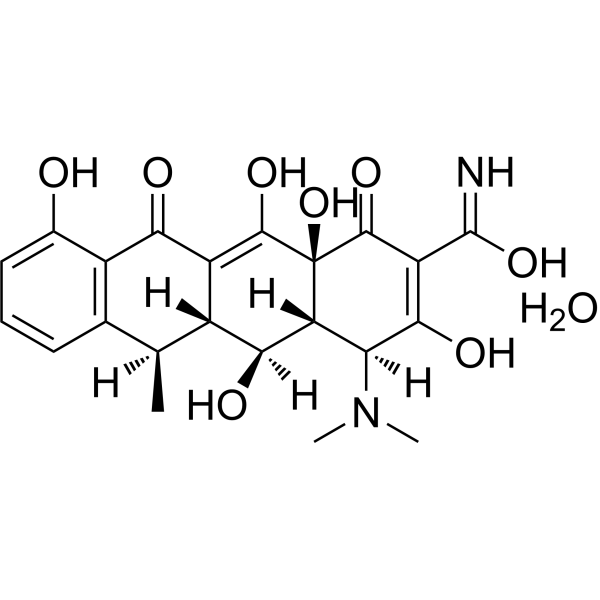
    4-Epidoxycycline is a liver metabolite of the antibiotic doxycycline (doxycycline, HY-N0565) and doesn't have antibiotic properties in mice. 4-Epidoxycycline’s ability to regulate HER2 gene expression in vitro and in live mouse models is similar to that of doxycycline, and it shows comparable high efficacy in tumor tissues, achieving over 95% tumor regression rates .
    4-Epidoxycycline
  • HY-147338

    5-Methyl-CTP

    DNA/RNA Synthesis Others
    5-Methylcytidine 5′-triphosphate (5-Methyl-CTP) is a modified nucleoside triphosphates. 5-Methylcytidine 5′-triphosphate can apply in replacing unmodified mRNA, resulting in the increase of translational properties and stability, as well as the reduction of innate immune responses in human and other mammalian cells .
    5-Methylcytidine 5′-triphosphate
  • HY-105896
    SB399885
    1 Publications Verification

    5-HT Receptor Neurological Disease
    SB399885 is a potent, selective, brain penetrant and orally active 5-HT6 receptor antagonist with pKi values 9.11 and 9.02 for human recombinant and native 5-HT6 receptors, respectively. SB399885 has cognitive enhancing properties .
    SB399885
  • HY-P10370

    Bacterial Apoptosis Infection Cancer
    d-(KLAKLAK)2, as an antibacterial and anti-tumor polypeptide, is a representative of the antimicrobial peptide group, and also has good anticancer properties. d-(KLAKLAK)2 is able to kill bacteria by damaging their cell membranes, causing cell contents to leak out. d-(KLAKLAK)2 can also inhibit tumor cell proliferation by causing mitochondrial swelling and mitochondrial membrane destruction, triggering apoptosis (programmed cell death) .
    d-(KLAKLAK)2, Proapoptotic Peptide
  • HY-B1126

    iGluR Neurological Disease Cancer
    Orphenadrine hydrochloride is an orally active and non-competitive NMDA receptor antagonist (crosses the blood-brain barrier) with a Ki of 6.0 μM. Orphenadrine hydrochloride relieves stiffness, pain and discomfort due to muscle strains, sprains or other injuries. Orphenadrine hydrochloride is also used to relieve tremors associated with parkinson's disease. Orphenadrine citrate has good neuroprotective properties, can be used in studies of neurodegenerative diseases .
    Orphenadrine hydrochloride
  • HY-119996A
    AR-C141990 hydrochloride
    1 Publications Verification

    Monocarboxylate Transporter Inflammation/Immunology
    AR-C141990 hydrochloride is a potent lactate transporters (monocarboxylate transporters; MCTs) inhibitor with pKi values of 7.6, 6.6 for MCT-1 and MCT-2, respectively . AR-C141990 hydrochloride has immunosuppressive properties and inhibits graft versus host response .
    AR-C141990 hydrochloride
  • HY-110099

    CXCR Inflammation/Immunology
    (±)-NBI-74330 is a potent and selective CXCR3 antagonist. (±)-NBI-74330 not only reduces tactile and thermal hypersensitivity but also enhances the analgesic properties of morphine. (±)-NBI-74330 can reduce microglial cell activation, increase astroglial cell activation, and downregulate the expression of some CXCR3 ligands in a rat neuropathic pain model .
    (±)-NBI-74330
  • HY-120419

    Monoamine Oxidase Neurological Disease
    PF9601N, an monoamine oxidase B (MAO-B) inhibitor, possesses neuroprotective properties in several in vitro and in vivo models of Parkinson's disease (PD). PF9601N can be used for the research of neurodegenerative diseases mediated by excitotoxicity . PF9601N is a click chemistry reagent, it contains an Alkyne group and can undergo copper-catalyzed azide-alkyne cycloaddition (CuAAc) with molecules containing Azide groups.
    PF9601N
  • HY-P2572

    Opioid Receptor Neurological Disease
    Deltakephalin is a potent, selective opiate δ-receptor agonist. Deltakephalin has analgesic properties .
    Deltakephalin
  • HY-N9735

    Bacterial Infection
    8-Hydroxy-9,10-diisobutyryloxythymol is a natural monoterpenoid with antibacterial properties. 8-Hydroxy-9,10-diisobutyryloxythymol against S. aureus, S. flexneri, and S. paratyphi-B with MIC values of 6.25 μg/mL .
    8-Hydroxy-9,10-diisobutyryloxythymol
  • HY-P2898

    Biochemical Assay Reagents Neurological Disease
    Chondroitinase C degrades chondroitin sulfate glycosaminoglycans that inhibit axonal growth within the endoneurium of peripheral nerve. Chondroitinase C selectively enhances the axon growth-promoting properties of the endoneurial basal lamina .
    Chondroitinase C
  • HY-W250160

    Polydeoxyribonucleotide

    Sirtuin Autophagy Inflammation/Immunology
    PDRN (Polydeoxyribonucleotide) is a linear polyribonucleotide fragment mainly derived from salmon sperm. PDRN exhibits antioxidant and anti-aging properties by diminishing autophagy and enhancing SIRT1 expression. PDRN shows tissue regeneration and anti-inflammatory effects .
    PDRN
  • HY-142981

    DODA

    Liposome Others
    Dioctadecylamine (DODA) is a secondary amine that has been shown to self-organize in plate-like structures in aqueous solution. Dioctadecylamine exhibits sufficiently hydrophobic properties of nanoparticles and good dispersibility in nonpolar solvent. Dioctadecylamine does not form a monolayer above pH 3.9 .
    Dioctadecylamine
  • HY-158125

    PSMA Cancer
    PSMA binder-2 is a ligand for PSMA and can be used to synthesize Ac-PSMA-trillium. Ac-PSMA-trillium is a suitable PSMA-targeting compound with improved PSMA binding properties and pharmacokinetic properties. PSMA ligands have different biological applications after being modified with different radioactive isotopes. If labeled with 111In, it can be used as DOTA chelating agent and imaging agent. Or labeled with 225Ac as a Macropa chelator for targeted radionuclide therapy (TRT) in the study of metastatic castration-resistant prostate cancer (mCRPC) .
    PSMA binder-2
  • HY-P3548

    Opioid Receptor Neurological Disease
    [D-Ala2]-Met-Enkephalinamide, an opioid peptide, is a potent opioid agonist. [D-Ala2]-Met-Enkephalinamide decreases bile flow by a central mechanism. [D-Ala2]-Met-Enkephalinamide has analgesic properties .
    [D-Ala2]-Met-Enkephalinamide
  • HY-N11845

    Lipoxygenase Metabolic Disease Inflammation/Immunology
    Sigmoidin B, a prenylated flavanone, is a selective 5-lipoxygenase inhibitor. Sigmoidin B is a potent scavenger of the DPPH radical. Sigmoidin B has antigenotoxic activity that inhibits genotoxicity induced by Aflatoxin B1 (HY-N6615), with an IC50 of 18.7 μg/mL. Sigmoidin B has anti-inflammatory activity and antioxidant properties .
    Sigmoidin B
  • HY-158122

    DNA-PK Cancer
    Lys(CO-C3-p-I-Ph)-O-tBu is a pharmacokinetic modifier (PK modifier) that can improve the pharmacokinetic properties of PSMA ligand molecules. Lys(CO-C3-p-I-Ph)-O-tBu can increase the residence time of PSMA ligand in plasma by increasing its binding capacity to albumin. Lys(CO-C3-p-I-Ph)-O-tBu also reduces salivary gland absorption, possibly extending the half-life of the active compound .
    Lys(CO-C3-p-I-Ph)-O-tBu
  • HY-W018811

    Bacterial Infection
    Antibacterial agent 268 (Compound 10e) is an antibacterial agent with antimycobacterial properties. Antibacterial agent 268 shows high anti-bacterial properties at sub-micromolar values (MIC=0.44-0.07 μM) .
    Antibacterial agent 268
  • HY-P99495

    RWJ 49004

    HIV Inflammation/Immunology
    Cedelizumab (RWJ 49004) is a IgG4 monoclonal antibody targeting CD4. Cedelizumab has immunosuppressant properties .
    Cedelizumab
  • HY-N2361

    Others Neurological Disease
    N-Benzyllinoleamide can be isolated from Lepidium meyenii Walp., has pharmaceutical property against exercise-induced fatigue .
    N-Benzyllinoleamide
  • HY-164067

    Biochemical Assay Reagents Others
    Silylanization hyaluronate ester is a hyaluronate ester derivative with good moisturizing properties and biocompatibility, and can be used in cosmetic research .
    Silylanization hyaluronate ester
  • HY-N1875

    p-Hydroxybenzyl Et ether

    Estrogen Receptor/ERR Inflammation/Immunology
    4-(Ethoxymethyl)phenol (p-Hydroxybenzyl Et ether) is a potent antioxidant from Amburana cearensis leaf extract, with in vitro cytogenotoxic properties. Amburana cearensis leaves can be used foe the research of respiratory diseases and inflammations .
    4-(Ethoxymethyl)phenol
  • HY-W096990A

    Biochemical Assay Reagents Others
    Sodium 1-octanesulfonate monohydrate, 97%(T) is an ion-pairing agent with anionic surfactant properties, which interacts with a Tobramycin (HY-B0441) molecule whose amino group is protonated .
    Sodium 1-octanesulfonate monohydrate, 97%(T)
  • HY-W025830

    Biochemical Assay Reagents Neurological Disease
    2-(1-(2-Amino-2-oxoethyl)cyclohexyl)acetic acid has neurological properties and can be used to study the structure and function of proteins and enzymes, as well as protein-protein interactions. 2-(1-(2-Amino-2-oxoethyl)cyclohexyl)acetic acid can also be used to study the structure and function of compounds .
    2-(1-(2-Amino-2-oxoethyl)cyclohexyl)acetic acid
  • HY-109150

    IRL790

    Dopamine Receptor Neurological Disease
    Mesdopetam (IRL790) is a dopamine D3 receptor antagonist (Ki=90 nM; IC50=9.8 μM for human recombinant D3 receptor) with psychomotor stabilizing properties. Mesdopetam is used for the research of motor and psychiatric complications in Parkinson disease .
    Mesdopetam
  • HY-170573

    Monoamine Oxidase Cancer
    LOX-IN-5 (compound 22) is a selective and orally active lysyl oxidase-like 2 (LOXL2) inhibitor with an IC50 of <300 nM. LOX-IN-5 possess anti-fibrosis properties .
    LOXL2-IN-1
  • HY-N8413

    Toll-like Receptor (TLR) Reactive Oxygen Species (ROS) NF-κB Inflammation/Immunology
    Chlojaponilactone B is a lindenane-type sesquiterpenoid with anti-inflammatory properties. Chlojaponilactone B suppresses inflammatory responses by inhibiting TLR4 and subsequently decreasing reactive oxygen species (ROS) generation, downregulating the NF-κB, thus reducing the expression of the pro-inflammatory cytokines iNOS, NO, COX-2, IL-6 and TNF-α .
    Chlojaponilactone B

Inquiry Online

Your information is safe with us. * Required Fields.

Salutation


Country or Region *

Applicant Name *


Organization Name *

Department *


Email Address *


Product Name *

Cat. No.


Requested quantity *

Phone Number *


Remarks

Inquiry Online

Inquiry Information

Product Name:
Cat. No.:
Quantity:
MCE Japan Authorized Agent:

