11 Results for "

proteasomal system

" in MedChemExpress (MCE) Product Catalog:
Products (11)

11 Results for "proteasomal system" in MCE Product Catalog:

1
1 Cited Publications
Cat. No.: HY-115865
CAS No.: 2803617-91-4
Purity:  99.31%
Target:  

PROTACs IAP

Research Areas:  

Cancer

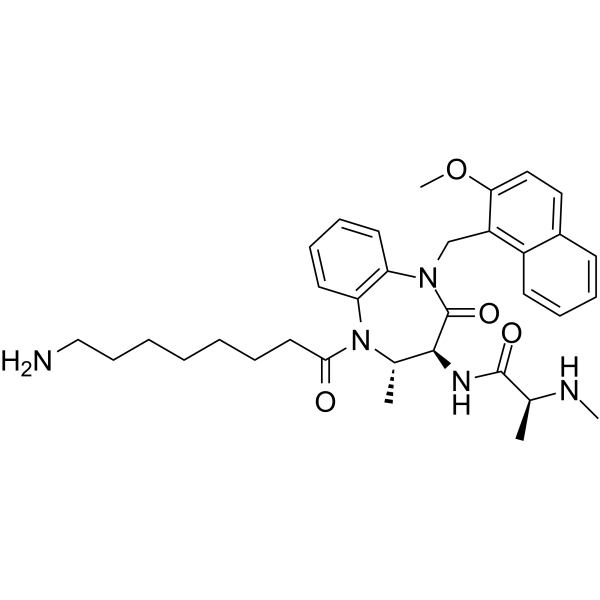
XIAP degrader-1 is a PROTAC-like degrader with a Kd value of 1 μM for XIAP. XIAP degrader-1 is metabolized into an active aldehyde species that covalently binds to Cys326 of FBXO22, thereby forming a ternary complex with the BIR2 domain of XIAP. XIAP degrader-1 induces polyubiquitination and proteasomal degradation of XIAP via the ubiquitin-proteasome system, a process dependent on NEDD8 conjugation, the SCF FBXO22 ligase complex, as well as the functional activities of XIAP ligase, E1 and the proteasome .
loading...
    loading...
1
1 Cited Publications
Cat. No.: HY-W054146
CAS No.: 145888-79-5
Target:  

Proteasome

Research Areas:  

Cancer

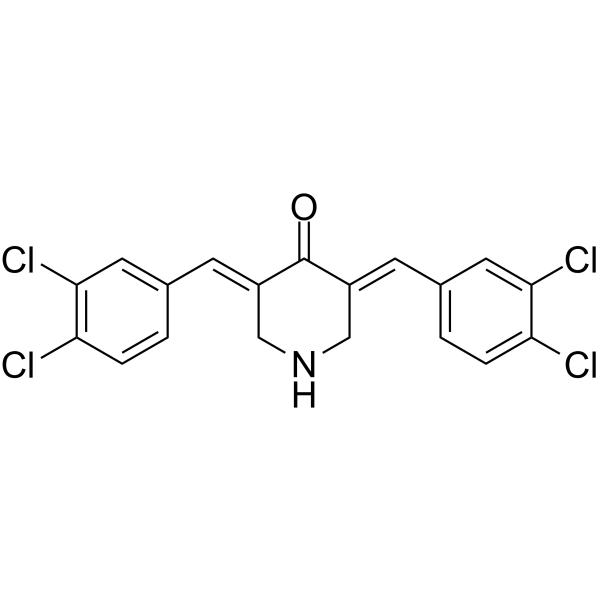
RAMB4 is a ubiquitin-proteasome system (UPS)-stressor. RAMB4 inhibits ubiquitin-mediated protein degradation upstream of the 20S proteasomal catalytic activites. RAMB4 triggers a ubiquitin-proteasome-system (UPS)-stress response without affecting 20S proteasome catalytic activities. Anticancer activity .
loading...
    loading...
Cat. No.: HY-131911
CAS No.: 2488851-89-2
Purity:  99.00%
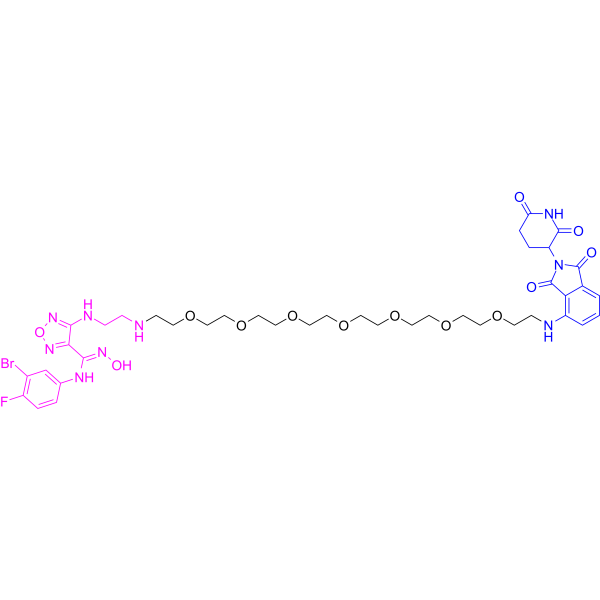
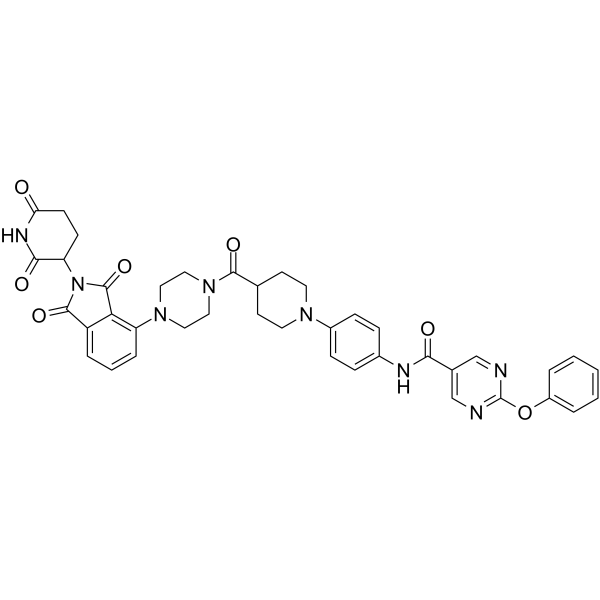
PROTAC IDO1 Degrader-1 is a potent IDO1 (Indoleamine 2,3-dioxygenase 1) PROTAC degrader with a DC50 of 2.84 μM. PROTAC IDO1 Degrader-1 forms a ternary complex with IDO1 and the CRBN E3 ligase, and induces polyubiquitination of IDO1 followed by proteasomal degradation via the ubiquitin-proteasome system. PROTAC IDO1 Degrader-1 is applicable for related research on cancer immunity .
loading...
    loading...
Cat. No.: HY-157216
Research Areas:  

Cancer

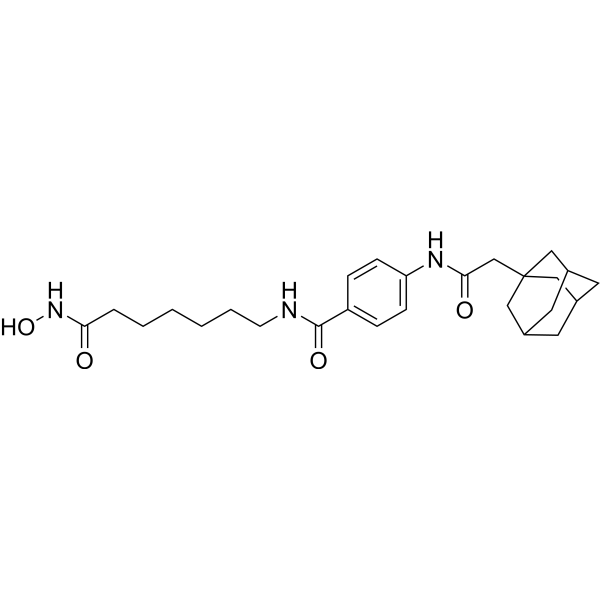
HDAC1 Degrader-1 is a HDAC1 degrader with an IC50 of 192.3 nM. HDAC1 Degrader-1 induces degradation of HDAC1 in multiple myeloma cells via the proteasome system and enhances apoptosis of multiple myeloma cells. HDAC1 Degrader-1 can be used for research on multiple myeloma .
loading...
    loading...
Cat. No.: HY-139972
CAS No.: 2761281-50-7
Purity:  99.42%
PROTAC (H-PGDS)-7 is a selective, linker-free H-PGDS PROTAC degrader with a DC50 of 17.3 pM. PROTAC (H-PGDS)-7 binds to CRBN and forms a ternary complex with H-PGDS, inducing the degradation of H-PGDS via the ubiquitin-proteasome system through polyubiquitination and proteasomal degradation processes. PROTAC (H-PGDS)-7 inhibits the upregulated expression of TNFα, IL-1β, TGFβ1 and CD11b in mice with cardiac hypertrophy models. PROTAC (H-PGDS)-7 can be used in studies related to Duchenne muscular dystrophy and allergic diseases .
loading...
    loading...
Cat. No.: HY-187502
Target:  

JAK PROTACs RIP kinase

Research Areas:  

Others

Jak1 RIMTAC-1 is a JAK1 RIMTAC degrader (a PROTAC-like agent) with a DC50 of 322.8 nM. Jak1 RIMTAC-1 forms a ternary complex with JAK1 and RIPK1, thereby recruiting the VHL E3 ligase complex to ubiquitinate JAK1 via the ubiquitin-proteasome system and mediate its subsequent proteasomal degradation. Jak1 RIMTAC-1 does not alter JAK1 mRNA levels (pink: Jak1 ligand-1 (HY-187503); blue: RIPK1-ligand-4 (HY-187391); black: Linker (HY-B0704)) .
loading...
    loading...
Cat. No.: HY-187500
Target:  

Akt PROTACs RIP kinase

Research Areas:  

Others

Akt RIMTAC-1 is a Akt RIMTAC degrader (a PROTAC-like agent) with a DC50 of 3.52 μM. Akt RIMTAC-1 forms a ternary complex with AKT and RIPK1, and recruits the VHL E3 ligase complex to mediate ubiquitination and proteasomal degradation. Akt RIMTAC-1 does not alter AKT1 mRNA levels (pink: AKT ligand-5 (HY-187501); blue: RIPK1-ligand-4 (HY-187391); black: Linker (HY-23166)) .
loading...
    loading...
Cat. No.: HY-187810
Synonyms: LC-04-118
Research Areas:  

Cancer

dWBP4-1 (LC-04-118) is a CRBN-dependent molecular glue degrader targeting WBP4. dWBP4-1 binds to the IMiD site of CRBN via its glutarimide ring, induces the formation of the CRBN-WBP4 ternary complex (EC50 = 224 nM), and mediates the rapid degradation of WBP4 through the G-loop dependent ubiquitin-proteasome pathway, a process that can be rescued by MLN4924 (HY-70062), Lenalidomide (HY-A0003) or Bortezomib (HY-10227). dWBP4-1 causes almost no perturbation at the transcriptome and alternative splicing levels, exhibits no obvious cytotoxicity, and produces no hook effect. dWBP4-1 can be used for the construction of chemical genetic protein degradation platforms and research related to acute T-lymphoblastic leukemia .
loading...
    loading...
Cat. No.: HY-180909
TMU454 is an ASGPR-targeting GalNAc-PROTAC BRD4 degrader conjugate. TMU454 undergoes ASGPR-mediated endocytosis and CTSB cleavage to release MZ1, which selectively degrades BRD4 in ASGPR-positive hepatocellular carcinoma cells via the VHL/UPS/proteasome pathway. TMU454 inhibits cancer cell proliferation and colony formation, and suppresses tumor growth in vivo. TMU454 can be used for research related to hepatocellular carcinoma .
loading...
    loading...
Cat. No.: HY-182623
CAS No.: 2640723-72-2
Research Areas:  

Cancer

WB214 is an MDM2 and GSPT1 molecular glue degrader with human MDM2 Ki >10 μM. WB214 induces a neo-interaction between MDM2 and the cereblon E3 ligase complex, triggering MDM2 ubiquitination, proteasomal degradation, and bystander p53 degradation, and does not bind MDM2’s p53 binding region. WB214 induces GSPT1 degradation, and exhibits anti-proliferative activity in leukemia cells. WB214 can be used for the research of leukemia .
loading...
    loading...
Cat. No.: HY-184322
Research Areas:  

Cancer

LC-MG-10 is a selective molecular glue degrader targeting FGFR2, with a DC50 of 230.2 nM in KATO III cells. LC-MG-10 induces proteasomal degradation of FGFR2 via a covalent molecular glue mechanism. LC-MG-10 inhibits cancer cell proliferation. LC-MG-10 suppresses FGFR2-mediated PI3K/AKT and MAPK/ERK signaling pathways. LC-MG-10 can be used in studies related to gastric cancer .
loading...
    loading...
  • 1

