8 Results for "

quinone antibacterial

" in MedChemExpress (MCE) Product Catalog:
Products (8)

8 Results for "quinone antibacterial" in MCE Product Catalog:

Cat. No.: HY-W010323
CAS No.: 615-94-1
Synonyms: DHBQ
Research Areas:  

Others

2,5-Dihydroxy-1,4-benzoquinone (DHBQ) is a redox-active quinone-based organic ligand with antibacterial activity that can be obtained from fungal metabolites. After 2,5-Dihydroxy-1,4-benzoquinone is incorporated into the Fe (dhbq) metal-organic framework, a two-electron redox process occurs, which helps improve the discharge capacity of Li +-ion battery cathodes. 2,5-Dihydroxy-1,4-benzoquinone can be used to construct conductive metal-organic frameworks suitable for Li +-ion battery cathodes .
loading...
    loading...
Cat. No.: HY-122482
CAS No.: 27267-70-5
Purity:  97.7%
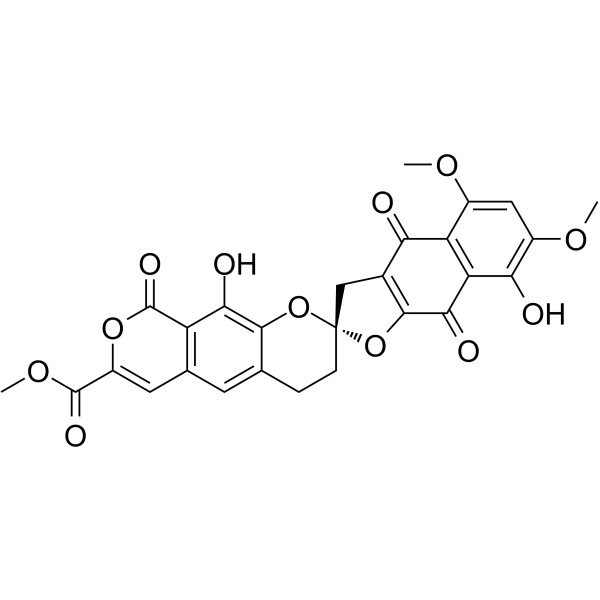
β-Rubromycin, a quinone antibacterial agent, is a selective HIV-1 reverse transcriptase inhibitor with a Ki of 0.27 μM. β-Rubromycin is a potent telomerase inhibitor with an IC50 of 3 μM. β-Rubromycin inhibits the proliferation of both K-562 and HeLa cells with IC50 values of 19.5 µM and 22.7 µM, respectively .
loading...
    loading...
Cat. No.: HY-106338
CAS No.: 200625-47-4
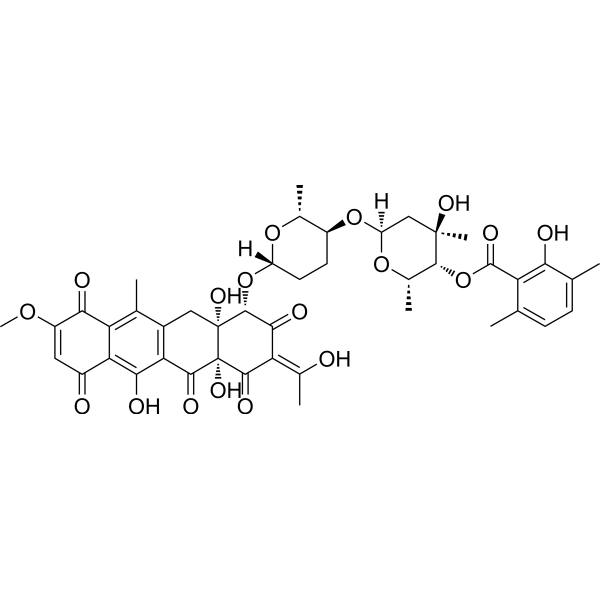
Polyketomycin is a tetracyclic quinone glycoside antibiotic isolated from Streptomyces sp. or Streptomyces diastatochromogenes. Polyketomycin inhibits growth of Gram-positive bacteria, and its MIC values is less than 0.2 µg/mL. Polyketomycin has antibacterial, anticancer, antimalarial activities .
loading...
    loading...
Cat. No.: HY-N14134
CAS No.: 10023-11-7
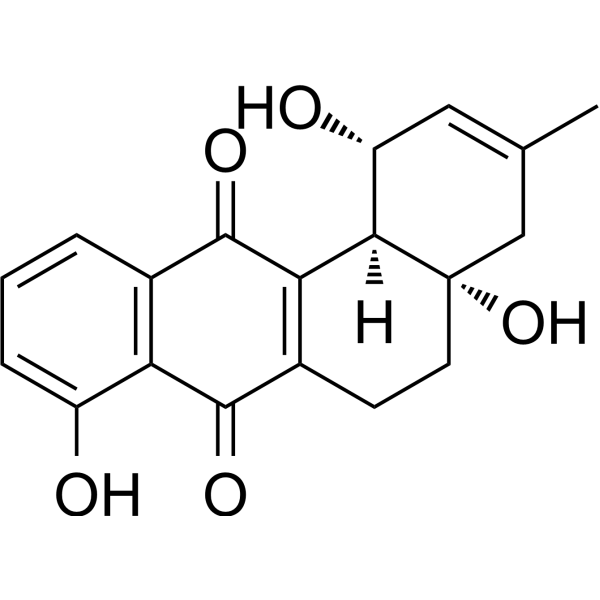
Deoxyfrenolicin is a quinone antibiotic that can be isolated from the fermentation broth of the Streptomyces roseofulvus strain AM-3867. Deoxyfrenolicin belongs to the frenolicin class of antibiotics. Deoxyfrenolicin exhibits antibacterial activity in vitro and can effectively inhibit the activity of Mycoplasma gallisepticum .
loading...
    loading...
Cat. No.: HY-N14291
CAS No.: 2207-57-0
4-Methoxy-p-toluquinone is a quinone antibiotic found in the fungus Coprinus siniilis, Lentinus degener. 4-Methoxy-p-toluquinone has anti-bacterial, mycobacterial and fungal effects, but is weak against Gram-negative bacteria. The serum will inactivate it .
loading...
    loading...
Cat. No.: HY-145379
CAS No.: 3039491-16-9
Miaosporone A, an angucyclic quinone, exhibits antimalarial activity against Plasmodium falciparum K1 and antibacterial activity against Mycobacterium tuberculosis with respective IC50 values of 2.5 and 2.4 μM and displays cytotoxic activities against both cancerous (MCF-7 and NCI-H187) and nonmalignant (Vero) cells .
loading...
    loading...
Cat. No.: HY-118362
CAS No.: 113579-07-0
Target:  

Bacterial

Research Areas:  

Infection

Netzahualcoyonol is a quinone methyl triterpene isolated from the roots of Salacia multiflora (Lam.) DC. Netzahualcoyonol exhibits antibacterial and anti-biofilm activities. Netzahualcoyonol inhibits Gram-positive bacteria (MIC=3.26–52 μM). Additionally, Netzahualcoyonol demonstrates cytotoxicity against Hep G2 cells (IC50 = 1.95 μM) but exhibits low toxicity towards Vero cells .
loading...
    loading...
Cat. No.: HY-L243
95 compounds

Quinone compounds are a significant class of natural products featuring a conjugated quinone structure, widely distributed in plants, fungi, and microorganisms. Based on their core structures, they can be primarily categorized into benzoquinones, naphthoquinones, phenanthrenequinones, and anthraquinones, among others. This structural diversity endows quinone compounds with a broad spectrum of pharmacological activities, making them key components in traditional Chinese medicine (such as rhubarb, Lithospermum erythrorhizon, and Salvia miltiorrhiza). Modern research has confirmed that their activities encompass anti-tumor, anti-inflammatory, antibacterial, antiviral, antiplatelet aggregation, and neuroprotective effects, among others, establishing them as an important source for drug development.

MCE designs a unique collection of 95 quinones that all come from natural products. MCE Quinones Library is a useful tool for drug discovery that can be used for high throughput screening (HTS) and high content screening (HCS).

