16 Results for "

radiation sensitizer

" in MedChemExpress (MCE) Product Catalog:
Products (16)

16 Results for "radiation sensitizer" in MCE Product Catalog:

23
23 Publications Verification
Cat. No.: HY-B1247
CAS No.: 553-12-8
Synonyms: PPIX
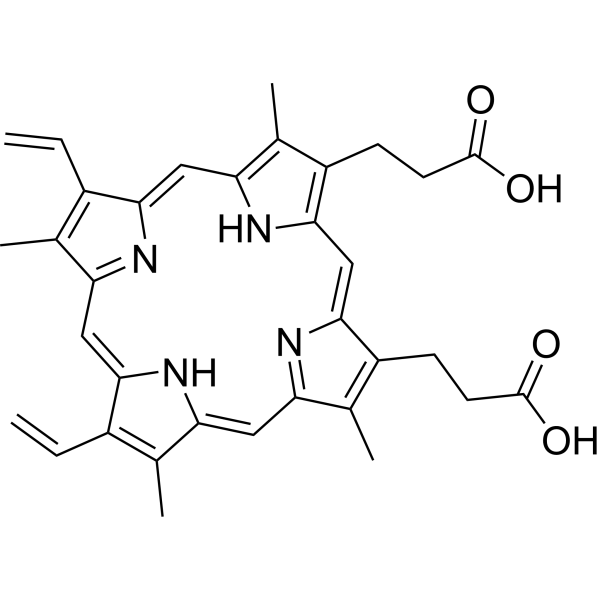
Protoporphyrin IX is a final intermediate in the heme biosynthetic pathway, which acts as a radiation sensitizer enhancing ROS generation even in a hypoxic state and inducing DNA damage. Protoporphyrin IX also acts as a photo sensitizer undergoing photobleaching that occurs through direct degradation by light irradiation. Protoporphyrin IX is formed and accumulated following 5-aminolevulinic acid (5-ALA) (HY-W000450) administration in the tumor cells of rats. Protoporphyrin IX causes selective improvement of basal cell carcinoma when activated red fluorescence of a peak wavelength at 405 nm. Protoporphyrin IX is promising for research of sonodynamic and photodynamic agents for a wide range of cancers, such as bladder cancer and nodular basal cell carcinoma .
loading...
    loading...
23
23 Publications Verification
Cat. No.: HY-B1247A
CAS No.: 50865-01-5
Synonyms: PPIX disodium
Target:  

Endogenous Metabolite

Research Areas:  

Cancer

Protoporphyrin IX disodium is a final intermediate in the heme biosynthetic pathway, which acts as a radiation sensitizer enhancing ROS generation even in a hypoxic state and inducing DNA damage. Protoporphyrin IX disodium also acts as a photo sensitizer undergoing photobleaching that occurs through direct degradation by light irradiation. Protoporphyrin IX disodium is formed and accumulated following 5-aminolevulinic acid (5-ALA) (HY-W000450) administration in the tumor cells of rats. Protoporphyrin IX disodium causes selective improvement of basal cell carcinoma when activated red fluorescence of a peak wavelength at 405 nm. Protoporphyrin IX disodium is promising for research of sonodynamic and photodynamic agents for a wide range of cancers, such as bladder cancer and nodular basal cell carcinoma .
loading...
    loading...
1
1 Cited Publications
Cat. No.: HY-16349
CAS No.: 6506-37-2
Synonyms: K-1900
Target:  

Parasite Antibiotic

Research Areas:  

Infection Cancer

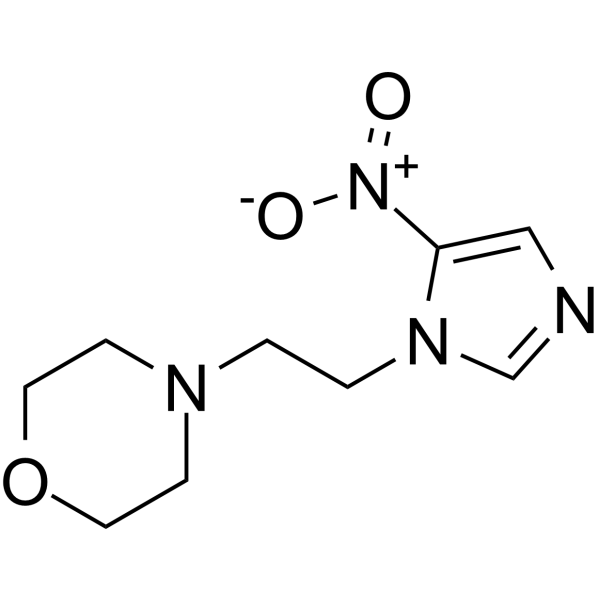
Nimorazole (K-1900), a 2-nitroimidazole, is a hypoxic cell-radiation sensitizer. Nimorazole has anti-infective and anti-protozoal against trichomoniasis. Nimorazole has the potential for head and neck cancer .
loading...
    loading...
Cat. No.: HY-B1247R
CAS No.: 553-12-8
Synonyms: PPIX (Standard)
Protoporphyrin IX (Standard) is the analytical standard of Protoporphyrin IX. This product is intended for research and analytical applications. Protoporphyrin IX is a final intermediate in the heme biosynthetic pathway, which acts as a radiation sensitizer enhancing ROS generation even in a hypoxic state and inducing DNA damage. Protoporphyrin IX also acts as a photo sensitizer undergoing photobleaching that occurs through direct degradation by light irradiation. Protoporphyrin IX is formed and accumulated following 5-aminolevulinic acid (5-ALA) (HY-W000450) administration in the tumor cells of rats. Protoporphyrin IX causes selective improvement of basal cell carcinoma when activated red fluorescence of a peak wavelength at 405 nm. Protoporphyrin IX is promising for research of sonodynamic and photodynamic agents for a wide range of cancers, such as bladder cancer and nodular basal cell carcinoma .
loading...
    loading...
Cat. No.: HY-164279
CAS No.: 1207615-74-4
Target:  

DNA/RNA Synthesis

Research Areas:  

Cancer

YTR107 is a radiation sensitizer. YTR107 binds to nucleophosmin1 (NPM1) and inhibits pentamer formation. YTR107 inhibits recruitment of nucleophosmin to sites of DNA damage, suppresses repair of DNA double strand breaks, and enhances radiosensitization .
loading...
    loading...
Cat. No.: HY-N7147
CAS No.: 56495-82-0
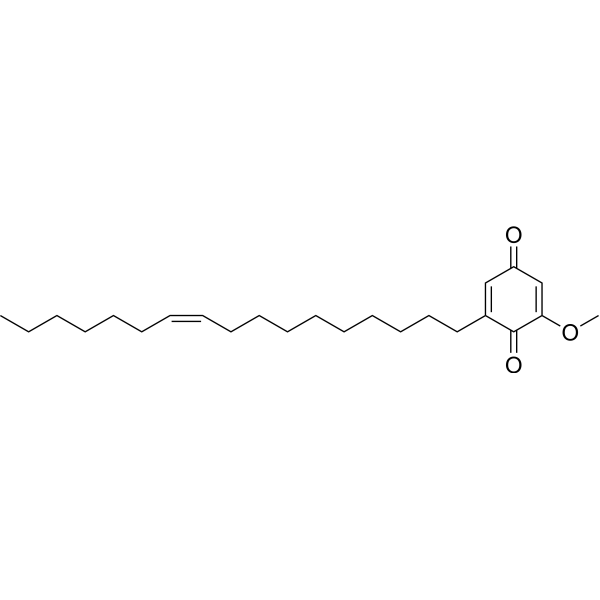
Irisquinone, a natural product, is an anticancer agent. Irisquinone is also a radiation sensitizer for cancer. Irisquinone reduces GSH level and inhibits the repair of DNA singular strand breaks .
loading...
    loading...
Cat. No.: HY-161622
Research Areas:  

Cancer

K1586 is an amidine derivative that efficiently targets Chk1. K1586 enhances the degradation of Chk1 that sensitizes colorectal cancer cells to ionizing radiation. K1586 shows anticancer effects .
loading...
    loading...
Cat. No.: HY-161839
CAS No.: 3107747-45-2
Research Areas:  

Cancer

AKR1C2/3-IN-1 (compound 3a) is a potent AKR1C2 and AKR1C3 inhibitor with IC50 values of 90, 50 nM, respectively. AKR1C2/3-IN-1 can be used as a radiation sensitizer and as a potentiator of chemotherapy cytotoxicity .
loading...
    loading...
Cat. No.: HY-105061
CAS No.: 13551-87-6
Synonyms: Ro 7-0582; SR 1354
Target:  

Bacterial Parasite

Research Areas:  

Infection Cancer

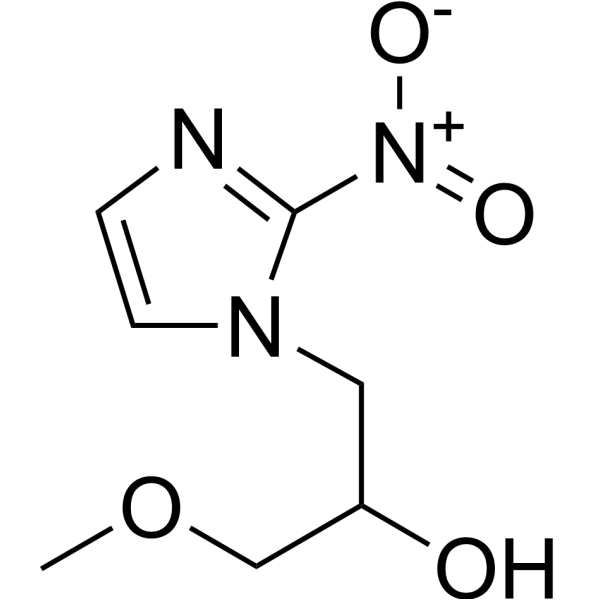
Misonidazole (Ro 7-0582; SR 1354) is a hypoxic tumor cell radiosensitizer . Misonidazole also has antimicrobial effects .
loading...
    loading...
Cat. No.: HY-129662
CAS No.: 82381-67-7
Research Areas:  

Others

Ro 31-0052 is a basic radiation sensitizer, a 3'-hydroxypiperidine analog of Ro 03-8799, with improved hydrophilicity. This type of designed radiation sensitizer has better pharmacokinetic properties and has the potential to replace clinically used Misonidazole (HY-105061) and Metronidazole (HY-B0318) .
loading...
    loading...
Cat. No.: HY-117980
CAS No.: 1661-29-6
Synonyms: AB 132
Target:  

DNA/RNA Synthesis

Research Areas:  

Cancer

Meturedepa (AB 132) functions as a radiation sensitizer, enhancing the biological effects of radiation. When combined with suboptimal doses of X-ray radiation, this combined therapy achieves better outcomes in terms of tumor shrinkage compared to Meturedepa used alone. Meturedepa is applicable in the research of bronchogenic carcinoma .
loading...
    loading...
Cat. No.: HY-16349R
CAS No.: 6506-37-2
Synonyms: K-1900 (Standard)
Research Areas:  

Infection Cancer

Nimorazole (Standard) is the analytical standard of Nimorazole. This product is intended for research and analytical applications. Nimorazole (K-1900), a 2-nitroimidazole, is a hypoxic cell-radiation sensitizer. Nimorazole has anti-infective and anti-protozoal against trichomoniasis. Nimorazole has the potential for head and neck cancer .
loading...
    loading...
Cat. No.: HY-W014394R
CAS No.: 82654-98-6
Protoporphyrin IX (Standard) is the analytical standard of Protoporphyrin IX. This product is intended for research and analytical applications. Protoporphyrin IX is a final intermediate in the heme biosynthetic pathway, which acts as a radiation sensitizer enhancing ROS generation even in a hypoxic state and inducing DNA damage. Protoporphyrin IX also acts as a photo sensitizer undergoing photobleaching that occurs through direct degradation by light irradiation. Protoporphyrin IX is formed and accumulated following 5-aminolevulinic acid (5-ALA) (HY-W000450) administration in the tumor cells of rats. Protoporphyrin IX causes selective improvement of basal cell carcinoma when activated red fluorescence of a peak wavelength at 405 nm. Protoporphyrin IX is promising for research of sonodynamic and photodynamic agents for a wide range of cancers, such as bladder cancer and nodular basal cell carcinoma .
loading...
    loading...
Cat. No.: HY-L179
40 compounds

Radiotherapy is a common treatment for various cancers, and more than 50% of cancer patients require radiotherapy during the disease treatment. With advances in radiation technology and a better understanding of tumor biology, the efficacy of radiation therapy has gradually improved, and more and more patients have benefited from it. However, even with the use of advanced radiotherapy techniques, there are still many malignant tumor cells with low sensitivity to radiation, leading to the radiation effect is not ideal. To solve this problem, radiosensitizers have received more and more attention. Radiosensitizer is a kind of drug that can enhance the radiosensitivity of tumor cells and improve the effect of radiotherapy. Radiation sensitizers act in a variety of ways, such as killing hypoxic cells, enhancing DNA damage, inhibiting DNA damage repair, and blocking cell cycle progression, making tumor cells more susceptible to radiation damage and death than surrounding normal cells.

MCE designs a unique collection of 40 compounds with definite reported radiosensitization. It can be used for drug combination research in anti-cancer treatment.

Cat. No.: HY-121277
CAS No.: 477-74-7
Research Areas:  

Others

Benzoflavine is an acridine dye and photodynamic sensitizer that regulates embryonic development. Benzoflavine can adsorb to the surface of Arbacia sea urchin egg cell membranes, enhance the sensitivity of highly physiologically active embryonic regions to visible light radiation, and induce anterior-posterior developmental differences; at high concentrations, it can independently inhibit embryonic development without illumination, and its photosensitive response range covers the blue-violet region of visible light. Benzoflavine can be used in research fields such as developmental biology, organic synthesis, and photobiochemistry .
loading...
    loading...
Cat. No.: HY-180573
Target:  

Arf Family GTPase

Research Areas:  

Cancer

ART5537 is a selective EXO1 inhibitor with a IC50 of 3.4 nM and a Kd of 6.8 nM. ART5537 exerts cellular homologous recombination (HR) inhibition with EC50 of 7.2 nM in HAP1 parental cells. ART5537 shows >200-fold selectivity over a panel of the wider nuclease superfamily. ART5537 exerts biological effects that are exclusively driven by EXO1 inhibition. ART5537 demonstrates sensitization to ionizing radiation and synergy with Olaparib (HY-10162). ART5537 can be used for research in breast cancer and colorectal adenocarcinoma .
loading...
    loading...
  • 1

