
6 Results for "

titanium surfaces

" in MedChemExpress (MCE) Product Catalog:
Products (6)

6 Results for "titanium surfaces" in MCE Product Catalog:

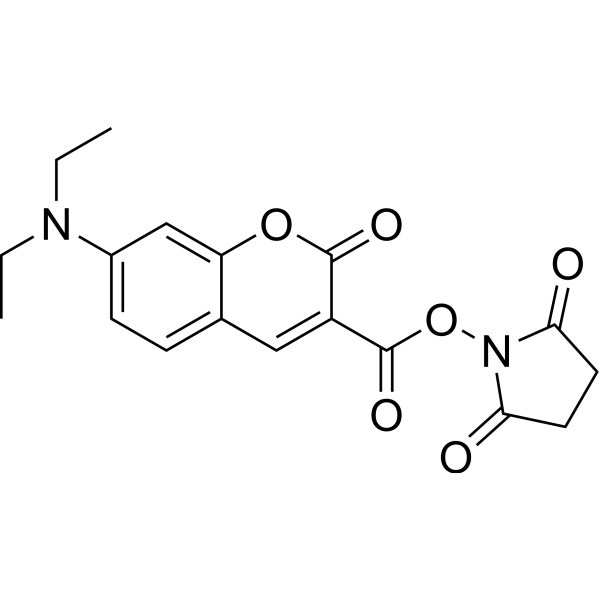
Cat. No.: HY-D0068
CAS No.: 139346-57-9
Synonyms: 7-Diethylaminocoumarin-3-carboxylic acid, SE
Target:  

Fluorescent Dye

Research Areas:  

Others

DEAC, SE (7-Diethylaminocoumarin-3-carboxy acid, SE) is an amine-reactive fluorescent succinimidyl ester (NHS ester) dye that is excitable by a 405 nm laser and emits blue fluorescence. DEAC, SE covalently couples with APTES, incorporates into organosilica colloids through co-condensation with TPM or other silane coupling agents, and can also be used for post-synthetic infiltration labeling of porous titanium dioxide protrusions and covalent binding with surface hydroxyl groups. DEAC, SE is used for fluorescent labeling of colloidal particles and confocal microscopy imaging studies .
loading...
    loading...
Cat. No.: HY-W004048
CAS No.: 657-84-1
Synonyms: Sodium p-toluenesulfonate
Sodium 4-methylbenzenesulfonate (Sodium p-toluenesulfonate) is a drug intermediate, capable of being used to synthesize xanthine oxidase inhibitors. Sodium 4-methylbenzenesulfonate can be used as a dopant to construct a polypyrrole (PPy) conductive film on the surface of titanium (Ti) implants .
loading...
    loading...
Cat. No.: HY-P5552
CAS No.: 709611-59-6
Target:  

Bacterial Fungal

Research Areas:  

Infection

Melimine is an antimicrobial peptide with broad-spectrum antimicrobial activity against Gram-negative/Gram-positive bacteria, fungi and protozoa. Melimine neutralizes endotoxin activity by interacting with the phosphate groups of lipid A, depolarizes and permeabilizes the cytoplasmic membrane of *Pseudomonas aeruginosa*, and induces bacterial lysis. Melimine exerts additive antiviral effects against H1N1 and MHV-1 when used in combination with RK610. Melimine retains its antimicrobial activity when conjugated to polymer and titanium surfaces. Melimine can be used in infection-related research .
loading...
    loading...
Cat. No.: HY-P10306
Target:  

Bacterial

Research Areas:  

Infection

Cys-LL37 is a biomaterial with antimicrobial properties developed by covalently fixing to the surface of titanium. Cys-LL37 uses a flexible hydrophilic polyethylene glycol spacer and selective n-terminal coupling LL37, a surface peptide layer that kills bacteria on contact is formed. Cys-LL37 can be used in research to develop new antimicrobial biomaterials .
loading...
    loading...
Cat. No.: HY-184642
Titanium dioxide magnetic beads are magnetic microparticle carriers whose surface is coated with titanium dioxide nanoparticles. This material is commonly used in protein digests of biological samples for the simple, convenient, efficient, highly specific, and reproducible enrichment of phosphorylated peptides. The surface properties of titanium dioxide magnetic beads make them show no significant preference for monophosphorylated or polyphosphorylated peptides, making them ideal for single-step enrichment of phosphorylated peptides in mass spectrometry-based proteomics analysis.
loading...
    loading...
Cat. No.: HY-P5552A
Target:  

Bacterial Fungal

Research Areas:  

Infection

Melimine acetate is an antimicrobial peptide with broad-spectrum antimicrobial activity against Gram-negative/Gram-positive bacteria, fungi and protozoa. Melimine acetate neutralizes endotoxin activity by interacting with the phosphate groups of lipid A, depolarizes and permeabilizes the cytoplasmic membrane of *Pseudomonas aeruginosa*, and induces bacterial lysis. Melimine acetate exerts additive antiviral effects against H1N1 and MHV-1 when used in combination with RK610. Melimine acetate retains its antimicrobial activity when conjugated to polymer and titanium surfaces. Melimine acetate can be used in infection-related research .
loading...
    loading...

