



DEAC, SE

Based on 1 Customer Validation
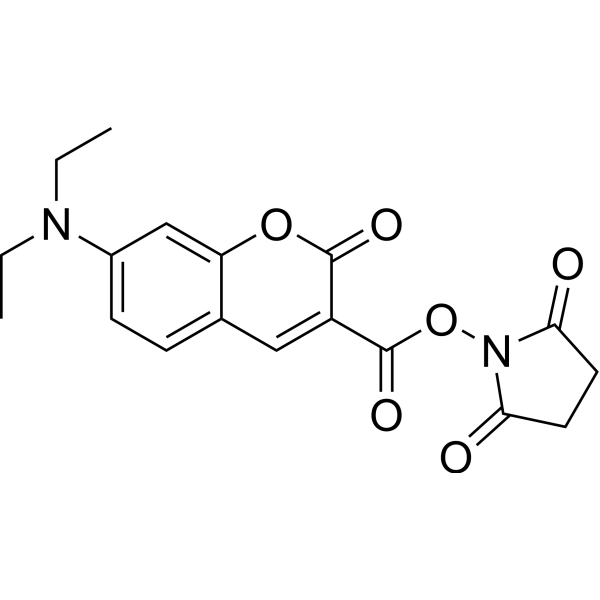
DEAC, SE (7-Diethylaminocoumarin-3-carboxy acid, SE) is an amine-reactive fluorescent succinimidyl ester (NHS ester) dye that is excitable by a 405 nm laser and emits blue fluorescence. DEAC, SE covalently couples with APTES, incorporates into organosilica colloids through co-condensation with TPM or other silane coupling agents, and can also be used for post-synthetic infiltration labeling of porous titanium dioxide protrusions and covalent binding with surface hydroxyl groups. DEAC, SE is used for fluorescent labeling of colloidal particles and confocal microscopy imaging studies.
For research use only. We do not sell to patients.
- Purity : 99.32%
- CAS No.: 139346-57-9
- Formula: C18H18N2O6
- Molecular Weight:358.35
-
Storage:
4°C, protect from light
* In solvent : -80°C, 6 months; -20°C, 1 month (protect from light)

To place orders, for customer services and technical support, please contact: MedChemExpress USA
Tel: 609-228-6898 E-mail: [email protected] [email protected]


-
 Biological Activity
-
Chemical Information
-
Solvent & Solubility
- Purity & Documentation
- References
-
 Help & FAQs




Biological Activity
Description
In Vitro
Guidelines (The following is our recommended protocol. This protocol is for reference only and should be modified according to your specific needs).
1. Stock Solution Preparation
1.1 Solvent: ethanol.
1.2 DEAC, SE-APTES conjugate stock solution: Add 20 mg DEAC, SE to 1 g (1.27 mL) ethanol and 20 μL APTES; stir the solution overnight.
2. Working Solution Preparation
2.1 Diluent: dispersion of silica particles with titanium dioxide protrusions.
2.2 Working solution: Add 100 μL ammonium hydroxide and 40 μL DEAC, SE-APTES conjugate stock solution to 10 mL particle dispersion.
2.3 Note: Adjust the working solution concentration as needed; prepare fresh before use.
3. Staining Procedure
3.1 For SCA silicone or TPM-based colloids[1]:
Use SCA silicone or TPM-based colloids as samples. DEAC, SE is integrated onto APTES via covalent attachment, and APTES itself can co-condense with TPM or other SCA.
3.2 For silica particles with titanium dioxide protrusions[2]:
Use silica particles with titanium dioxide protrusions as samples. For confocal imaging, OTMS-patterned silica particles with DEAC, SE-labeled titanium dioxide protrusions can be dispersed in CHC. Add DEAC, SE-APTES conjugate stock solution and ammonium hydroxide to the particle dispersion and shake for 2 h. The DEAC, SE-APTES conjugate penetrates the porous titanium dioxide and reacts with surface OH groups. Wash residual dye by centrifugation and replacing the supernatant with fresh ethanol until the supernatant has no obvious color; use more than 3 washing steps.
5. Detection and Analysis
5.1 Instrument type: fluorescence microscope, confocal fluorescence imaging, and confocal microscope.
5.2 Wavelength settings: Excite DEAC, SE with a 405 nm diode laser; DEAC, SE emits blue light.
5.3 Result analysis: The dye is incorporated into SCA silicone and can be observed and tracked by fluorescence microscopy. DEAC, SE-labeled titanium dioxide protrusions appear blue in confocal micrographs, allowing the titanium dioxide protrusions to be distinguished from the particle core. DEAC, SE provides blue fluorescence.
MedChemExpress (MCE) has not independently confirmed the accuracy of these methods. They are for reference only. .
Emission (Em)
445


Chemical Information
-
CAS No. 139346-57-9
-
Appearance Solid
-
Molecular Weight 358.35
-
Formula C18H18N2O6
-
Color Light yellow to yellow
-
SMILES
O=C(C1=CC2=CC=C(N(CC)CC)C=C2OC1=O)ON3C(CCC3=O)=O
-
Synonyms
7-Diethylaminocoumarin-3-carboxylic acid, SE
-
Shipping
Room temperature in continental US; may vary elsewhere.
-
Storage
4°C, protect from light
* In solvent : -80°C, 6 months; -20°C, 1 month (protect from light)


Solvent & Solubility
In Vitro:
DMSO : 16.67 mg/mL (46.52 mM; ultrasonic and warming and heat to 60°C; Hygroscopic DMSO has a significant impact on the solubility of product, please use newly opened DMSO)
Please refer to the solubility information to select the appropriate solvent. Once prepared, please aliquot and store the solution to prevent product inactivation from repeated freeze-thaw cycles.
Storage method and period of stock solution: -80°C, 6 months; -20°C, 1 month (protect from light). When stored at -80°C, please use it within 6 months. When stored at -20°C, please use it within 1 month.
Please refer to the solubility information to select the appropriate solvent. Once prepared, please aliquot and store the solution to prevent product inactivation from repeated freeze-thaw cycles.
Storage method and period of stock solution: -80°C, 6 months; -20°C, 1 month (protect from light). When stored at -80°C, please use it within 6 months. When stored at -20°C, please use it within 1 month.
Concentration (start) × Volume (start) = Concentration (final) × Volume (final)


Purity & Documentation
-
Data Sheet (277 KB)
-
SDS (393 KB)
- English - EN (393 KB)
- Français - FR (393 KB)
- Deutsch - DE (393 KB)
- Norwegian - NO (393 KB)
- Español - ES (393 KB)
- Swedish - SV (393 KB)
- Italian - IT (393 KB)
- Korean - KR (393 KB)
- Portuguese - PT (393 KB)
-
Handling Instructions (2659 KB)
References
[1]. Kamp M, et al. Spearheading a new era in complex colloid synthesis with TPM and other silanes. Nature reviews. Chemistry. 2024 Jun;8(6):433-453. [Content Brief]
[2]. Kamp M, et al. Multivalent Patchy Colloids for Quantitative 3D Self-Assembly Studies. Langmuir : the ACS journal of surfaces and colloids. 2020 Mar 10;36(9):2403-2418. [Content Brief]


Complete Stock Solution Preparation Table
Please refer to the solubility information to select the appropriate solvent. Once prepared, please aliquot and store the solution to prevent product inactivation from repeated freeze-thaw cycles.
Storage method and period of stock solution: -80°C, 6 months; -20°C, 1 month (protect from light). When stored at -80°C, please use it within 6 months. When stored at -20°C, please use it within 1 month.
| Optional Solvent | Concentration Solvent Mass | 1 mg | 5 mg | 10 mg | 25 mg |
|---|---|---|---|---|---|
| DMSO | 1 mM | 2.7906 mL | 13.9528 mL | 27.9057 mL | 69.7642 mL |
| 5 mM | 0.5581 mL | 2.7906 mL | 5.5811 mL | 13.9528 mL | |
| 10 mM | 0.2791 mL | 1.3953 mL | 2.7906 mL | 6.9764 mL | |
| 15 mM | 0.1860 mL | 0.9302 mL | 1.8604 mL | 4.6509 mL | |
| 20 mM | 0.1395 mL | 0.6976 mL | 1.3953 mL | 3.4882 mL | |
| 25 mM | 0.1116 mL | 0.5581 mL | 1.1162 mL | 2.7906 mL | |
| 30 mM | 0.0930 mL | 0.4651 mL | 0.9302 mL | 2.3255 mL | |
| 40 mM | 0.0698 mL | 0.3488 mL | 0.6976 mL | 1.7441 mL |


DEAC, SE Related Classifications
HY-D0068 Related Classifications
 Powered by Bioz