



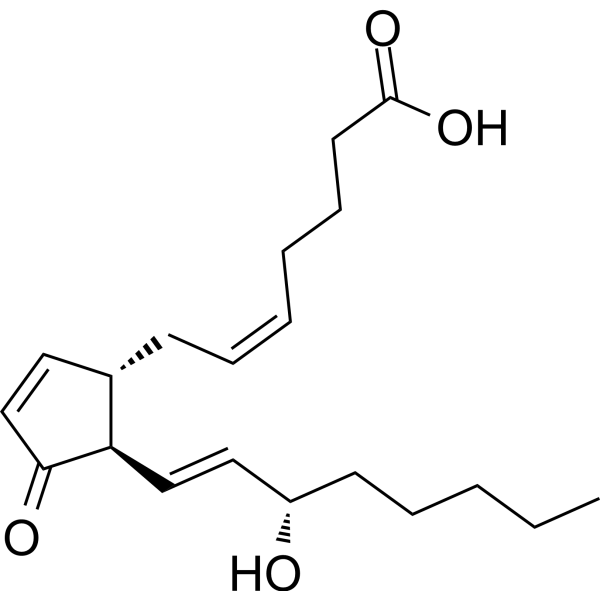
15-keto-Prostaglandin E2

Based on 1 Customer Validation
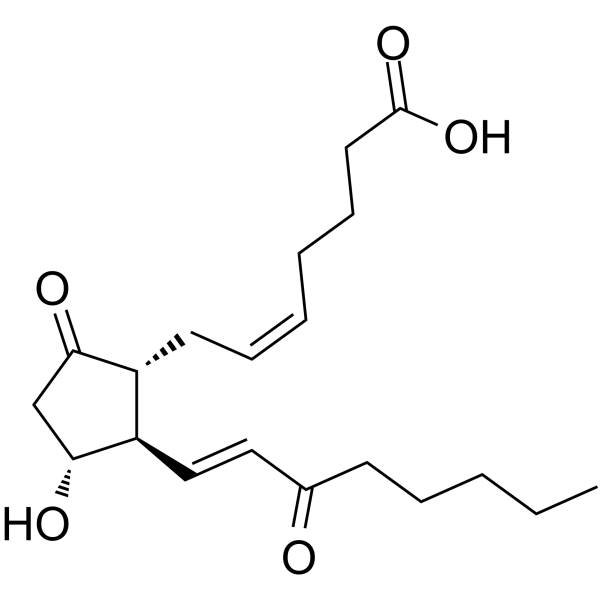
15-keto-Prostaglandin E2 (15-keto-PGE2) is an endogenous PGE2 metabolite. 15-keto-Prostaglandin E2 inhibits STAT3 activation by binding to the Cys259 residue of STAT3. 15-keto-Prostaglandin E2 binds to and stabilizes EP2 and EP4 receptors. 15-keto-Prostaglandin E2 inhibits the growth and progression of breast cancer cells. 15-keto-Prostaglandin E2 activates PPAR-γ and promotes fungal growth. 15-keto-Prostaglandin E2 disrupts glomerular vascularization during zebrafish development and reduces the surface area of the glomerular filtration barrier.
For research use only. We do not sell to patients.
- Purity : 99.0%
- CAS No.: 26441-05-4
- Formula: C20H30O5
- Molecular Weight:350.45
-
Storage:
-20°C, stored under nitrogen
* In solvent : -80°C, 6 months; -20°C, 1 month (stored under nitrogen)

To place orders, for customer services and technical support, please contact: MedChemExpress USA
Tel: 609-228-6898 E-mail: [email protected] [email protected]


-
 Biological Activity
-
Chemical Information
- Purity & Documentation
- References
-
 Help & FAQs


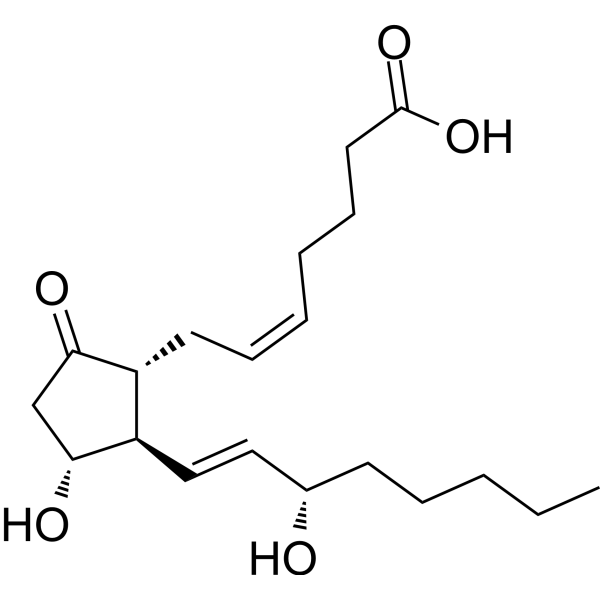


All Endogenous Metabolite Isoforms
More

Biological Activity
Description
IC50 & Target
[1]|
PPARγ |
EP2 |
EP4 |
STAT3 |
Human Endogenous Metabolite |
In Vitro
15-keto-PGE2 (1 μM; 20 min) binds to and stabilizes HiBiT-tagged hEP2 receptors on the cytoplasmic membrane of MMY28 yeast[1].
15-keto-PGE2 (10-20 μM; 24 h) dose-dependently inhibits the clonogenic capacity of MDA-MB-231 cells[3].
MedChemExpress (MCE) has not independently confirmed the accuracy of these methods. They are for reference only.
In Vivo
15-keto-Prostaglandin E2 (10 μM; immersion) significantly increases the fungal load of Cryptococcus neoformans Δplb1-GFP in zebrafish larvae, reaching 1.56 times that of the control group[2].
15-keto-Prostaglandin E2 (70-140 μg/kg; subcutaneous injection; administered daily for 4 consecutive weeks) dose-dependently inhibits the growth of MDA-MB-231 breast cancer xenografts in BALB/c nude mice[3].
MedChemExpress (MCE) has not independently confirmed the accuracy of these methods. They are for reference only.
-
Animal Model:Tg[wt1b:eGFP] (embryos; early treatment: 6-48 hpf; late treatment: 72-96 hpf)[1]
-
Dosage:500 μM
-
Administration:immersion; continuous
-
Result:Caused mild yolk edema, with 80% of embryos showing affected pronephros structure plus yolk edema.
Resulted in 20% of glomeruli exhibiting impaired podocyte intercalation and failed glomerular cleft formation at 48 hpf (early treatment).
Induced podocyte clustering at the embryo midline and impaired podocyte intercalation around glomerular capillaries, affecting ~83% of glomeruli (late treatment).
Reduced glomerular surface area significantly in treated embryos compared to controls, while glomerular volume showed a non-significant numerical decrease (late treatment).
Reversed all morphological defects, restoring glomerular surface area to control levels when combined with EP2/EP4 receptor antagonists.
-
Animal Model:BALB/c (nu/nu) athymic nude mice (female, 7 weeks old)[3]
-
Dosage:70 μg/kg; 140 μg/kg
-
Administration:s.c.; daily; 4 weeks
-
Result:Retarded tumor growth significantly in both treatment groups, with average tumor volume reduced in a dose-dependent manner.
Markedly decreased STAT3 phosphorylation (P-STAT3Y705) in tumor tissue at 140 μg/kg, as measured by Western blot and immunohistochemical analysis.
Caused no body weight loss or signs of toxicity.
Showed decreased tumor density in treated mice compared to controls via H&E staining.


Chemical Information
-
CAS No. 26441-05-4
-
Appearance Solid
-
Molecular Weight 350.45
-
Formula C20H30O5
-
Color White to light yellow
-
SMILES
CCCCCC(/C=C/[C@@H]1[C@H](C(C[C@H]1O)=O)C/C=C\CCCC(O)=O)=O
-
Synonyms
15-keto-PGE2
-
Structure Classification
-
Initial Source
Gracilaria verrucosa (Huds.) Papenf.
-
Shipping
Room temperature in continental US; may vary elsewhere.
-
Storage
-20°C, stored under nitrogen
* In solvent : -80°C, 6 months; -20°C, 1 month (stored under nitrogen)


Purity & Documentation
-
Data Sheet (278 KB)
-
SDS (557 KB)
- English - EN (557 KB)
- Français - FR (557 KB)
- Deutsch - DE (557 KB)
- Norwegian - NO (557 KB)
- Español - ES (557 KB)
- Swedish - SV (557 KB)
- Italian - IT (557 KB)
- Korean - KR (557 KB)
- Portuguese - PT (557 KB)
-
Handling Instructions (2659 KB)
References
[1]. Kourpa A, et al. 15-keto-Prostaglandin E2 exhibits bioactive role by modulating glomerular cytoarchitecture through EP2/EP4 receptors. Life Sci. 2022;310:121114. [Content Brief]
[2]. Evans RJ, et al. 15-keto-prostaglandin E2 activates host peroxisome proliferator-activated receptor gamma (PPAR-γ) to promote Cryptococcus neoformans growth during infection. PLoS Pathog. 2019;15(3):e1007597. Published 2019 Mar 28. [Content Brief]
[3]. Lee EJ, et al. 15-Keto prostaglandin E2 suppresses STAT3 signaling and inhibits breast cancer cell growth and progression. Redox Biol. 2019;23:101175. [Content Brief]

Calculators
Concentration (start) × Volume (start) = Concentration (final) × Volume (final)


15-keto-Prostaglandin E2 Related Classifications
HY-113205 Related Classifications
 Powered by Bioz