



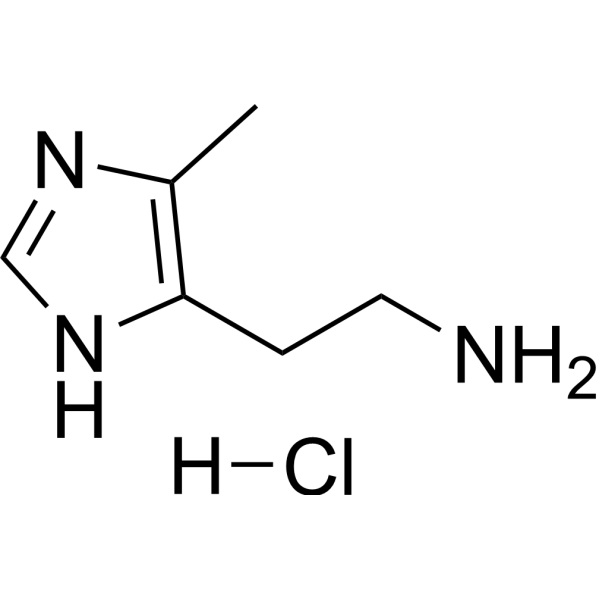
4-Methylhistamine hydrochloride
4-Methylhistamine hydrochloride is the hydrochloride salt of 4-Methylhistamine (HY-W580721). 4-Methylhistamine hydrochloride is a potent and selective agonist of histamine 4 receptor (H4R) with a Ki of 50 nM. 4-Methylhistamine hydrochloride has a >100-fold selectivity for the hH4R over the other histamine receptor subtypes. 4-Methylhistamine hydrochloride can potently activate the hH4R (pEC50 = 7.4). 4-Methylhistamine hydrochloride can be used for the researches of cancer, inflammation and immunology, such as lung cancer and skin inflammation.
For research use only. We do not sell to patients.
- CAS No.: 84103-51-5
- Formula: C6H12ClN3
- Molecular Weight:161.63
-
Storage:
Please store the product under the recommended conditions in the Certificate of Analysis.

To place orders, for customer services and technical support, please contact: MedChemExpress USA
Tel: 609-228-6898 E-mail: [email protected] [email protected]


-
 Biological Activity
-
Chemical Information
- Purity & Documentation
- References
-
 Help & FAQs


All Histamine Receptor Isoforms
More

Biological Activity
Description
In Vitro
4-Methylhistamine (1-10 μM, 12 h) hydrochloride inhibits cell proliferation in A549, H157, H460 and H322 cells[4].
4-Methylhistamine (1 μM, 12 h) hydrochloride decreases the TGF-β1 mRNA expression in A549 cells[4].
MedChemExpress (MCE) has not independently confirmed the accuracy of these methods. They are for reference only.
-
Cell Line:A549, H157, H460 and H322 cells
-
Concentration:1 μM
-
Incubation Time:12 h
-
Result:Increased E-cadherin levels and decreased Vimentin levels.
In Vivo
4-Methylhistamine (20-40 mg/kg, i.p., once a day for 10 days) hydrochloride attenuates Imiquimod (HY-B0180)-induced psoriasis-like skin inflammation in mice[3].
4-Methylhistamine (100 μmol/kg, i.v., every other day for 33 days) hydrochloride decreases the average tumour volume and prolongs survival in A549 tumor mice[4].
MedChemExpress (MCE) has not independently confirmed the accuracy of these methods. They are for reference only.
-
Animal Model:Balb/c mice with chronic restraint[2]
-
Dosage:30 mg/kg
-
Administration:Intraperitoneally injection, twice a day before 2 days prior to stress
-
Result:Increase in the CD4+ T cells as well as in IFN-γ production.
Decreased IL-4 expression.
Upregulated expression of IL-1β, IFN-γ and TNF-α mRNA.
-
Animal Model:Imiquimod (HY-B0180)-induced psoriasis-like dermatitis mice[3]
-
Dosage:20 and 40 mg/kg
-
Administration:Intraperitoneally injection, once a day for 10 days
-
Result:Ameliorated the total clinical severity scores.
Attenuated the psoriatic phenotypes, including epidermal hyperplasis, hyperkeratosis and lymphocytes infiltration.
Led to reductions in the levels of Th1 cytokines (TNF-a, IFN-a, and IL-27).
Increased CD4+CD25+FoxP3+ regulatory T (Treg) cells.
-
Animal Model:A549 tumor mice[4]
-
Dosage:100 μmol/kg
-
Administration:Intravenously injection, every other day for 33 days
-
Result:Decreased tumor volume and the proliferation of tumour cells.
Prolonged survival of mice.
Increased the mRNA expression of E-cadherin and decreased Vimentin levels.


Chemical Information
-
CAS No. 84103-51-5
-
Molecular Weight 161.63
-
Formula C6H12ClN3
-
SMILES
NCCC1=C(C)N=CN1.[H]Cl
-
Shipping
Room temperature in continental US; may vary elsewhere.
-
Storage
Please store the product under the recommended conditions in the Certificate of Analysis.


Purity & Documentation
References
[1]. Lim HD, et al. Evaluation of histamine H1-, H2-, and H3-receptor ligands at the human histamine H4 receptor: identification of 4-methylhistamine as the first potent and selective H4 receptor agonist. J Pharmacol Exp Ther. 2005 Sep;314(3):1310-21. [Content Brief]
[2]. Ahmad SF, et al. Stimulation of the histamine 4 receptor with 4-methylhistamine modulates the effects of chronic stress on the Th1/Th2 cytokine balance. Immunobiology. 2015 Mar;220(3):341-9. [Content Brief]
[3]. Kim CH, et al. Inhibitory Effect of Imiquimod-Induced Psoriasis-Like Skin Inflammation in Mice by Histamine H4 Receptor Agonist 4-Methylhistamine. Scand J Immunol. 2016 Jun;83(6):409-17. [Content Brief]
[4]. Cai WK, et al. Activation of histamine H4 receptors decreases epithelial-to-mesenchymal transition progress by inhibiting transforming growth factor-β1 signalling pathway in non-small cell lung cancer. Eur J Cancer. 2014 Apr;50(6):1195-206. [Content Brief]

Calculators
Concentration (start) × Volume (start) = Concentration (final) × Volume (final)


4-Methylhistamine hydrochloride Related Classifications
HY-W580721A Related Classifications
 Powered by Bioz