



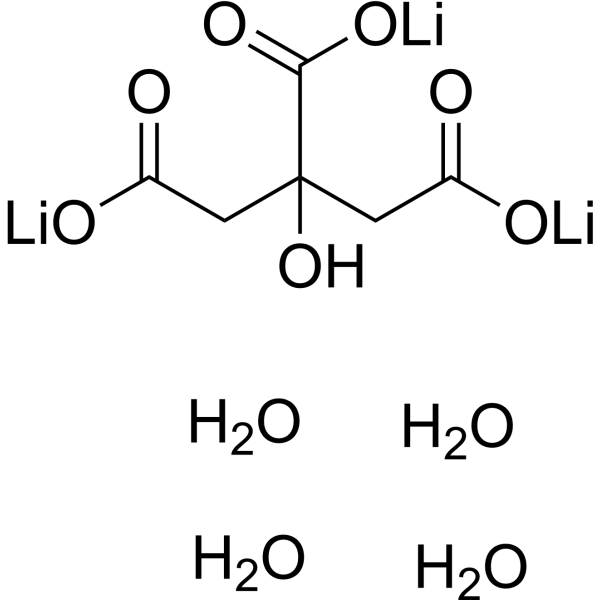
Lithium citrate tetrahydrate
Based on 13 publication(s) in Google Scholar
Lithium citrate (Litarex) tetrahydrate is a natural preservative and food tartness enhancer. Lithium citrate tetrahydrate induces apoptosis and cell cycle arrest at G2/M phase and S phase in HaCaT cells. Lithium citrate tetrahydrate cause oxidative damage of the liver by means of the decrease of antioxidative enzyme activities. Lithium citrate tetrahydrate is also an acidulant, emulsifier, sequestrant and buffering agent widely used across many industries.
For research use only. We do not sell to patients.
- Purity : 99.94%
- CAS No.: 6080-58-6
- Formula: C6H13Li3O11
- Molecular Weight:281.98
-
Storage:
4°C, sealed storage, away from moisture
* In solvent : -80°C, 6 months; -20°C, 1 month (sealed storage, away from moisture)

To place orders, for customer services and technical support, please contact: MedChemExpress USA
Tel: 609-228-6898 E-mail: [email protected] [email protected]


-
 Biological Activity
-
Chemical Information
-
Solvent & Solubility
- Purity & Documentation
- References
-
 Help & FAQs





Publications Citing Use of MedChemExpress (MCE) Lithium citrate tetrahydrate
More- Nature. 2025 Jul;643(8070):192-200. [Abstract]
- Mol Cancer. 2025 Oct 2;24(1):238. [Abstract]
- J Exp Clin Cancer Res. 2025 Jul 8;44(1):195. [Abstract]
- Cell Rep Med. 2026 Feb 17;7(2):102621. [Abstract]
- Food Chem. 2025 Oct 15:489:144992. [Abstract]
- Food Chem. 2023 Mar 30;405(Pt A):134807. [Abstract]
- Food Res Int. 2026 Feb 6.
- Regen Biomater. 2024 Aug 22:11:rbae098. [Abstract]
- Life Sci. 2024 Jun 15:347:122682. [Abstract]
- BMC Complement Med Ther. 2026 Apr 2;26(1):177. [Abstract]
- Bone. 2025 Apr:193:117411. [Abstract]
- J Sep Sci. 2025 Nov;48(11):e70312. [Abstract]
- New J Chem. 03 Aug 2022.
All Endogenous Metabolite Isoforms
More

Biological Activity
Description
In Vitro
Lithium citrate tetrahydrate (0-12.5 mM; 24 h) shows antiproliferative activity in a dose dependent manner[3].
Lithium citrate tetrahydrate (12.5 mM; 72 h) induces apoptosis and cell cycle arrest at G2/M phase and S phase in a dosedependent manner[3].
Lithium citrate tetrahydrate (12.5 mM; 48 h) increases the expression of FAS, BAX, BID, AIF, EndoG, cytochrome c, PARP, GADD153, GRP78 and caspase-3, -8, -9, and decreases of BCL-2 and BCL-Xl[3].
MedChemExpress (MCE) has not independently confirmed the accuracy of these methods. They are for reference only.
-
Cell Line:HaCaT cells
-
Concentration:0, 2.5, 5, 7.5, 10, 12.5 mM
-
Incubation Time:24 h
-
Result:Inhibited the cell viability in a dose dependent manner.
-
Cell Line:HaCaT cells
-
Concentration:12.5 mM
-
Incubation Time:0, 12, 24, 48, 72 h
-
Result:Induced apoptosis and cell cycle arrest at G2/M phase and S phase in a dose-dependent manner.
-
Cell Line:HaCaT cells
-
Concentration:12.5 mM
-
Incubation Time:12, 24, 48, 72 h
-
Result:Increased the expression of FAS, BAX, BID, AIF, EndoG, cytochrome c, PARP, GADD153, GRP78 and caspase-3, -8, -9, and decreased of BCL-2 and BCL-Xl.
In Vivo
Lithium citrate tetrahydrate (120, 240, and 480 mg/kg; i.p.) induces apoptosis by increases caspase-3 activity in a dose-dependent manner in mouse hepatocytes[1].
Lithium citrate tetrahydrate (120, 240, and 480 mg/kg; i.p.; weekly for 3 weeks) causes renal toxicity in mice[2].
MedChemExpress (MCE) has not independently confirmed the accuracy of these methods. They are for reference only.
-
Animal Model:20 g male Kunming mice[2]
-
Dosage:120, 240, 480 mg/kg
-
Administration:i.p.; weekly for 3 weeks
-
Result:T-SOD and GSH-Px activities in the treated groups decreased with increasing doses of citric acid, NOS activity tended to increase, and H2O2 and MDA contents gradually decreased.


Chemical Information
-
CAS No. 6080-58-6
-
Appearance Solid
-
Molecular Weight 281.98
-
Formula C6H13Li3O11
-
Color White to off-white
-
SMILES
O=C(CC(C(O[Li])=O)(O)CC(O[Li])=O)O[Li].O.O.O.O
-
Synonyms
Litarex tetrahydrate
-
Structure Classification
-
Initial Source
Aspergillus niger
-
Shipping
Room temperature in continental US; may vary elsewhere.
-
Storage
4°C, sealed storage, away from moisture
* In solvent : -80°C, 6 months; -20°C, 1 month (sealed storage, away from moisture)


Publications (13)
-
Journal Impact Factor
-
Most Recent
-
Nature
2025 Jul;643(8070):192-200. PMID: 39695227 -
Mol Cancer
Hsa_circ_0038737 promotes PARPi resistance in castration-resistant prostate cancer via IGF2BP3-mediated DNPH1 mRNA stabilization. [Abstract]2025 Oct 2;24(1):238. PMID: 41039575 -
J Exp Clin Cancer Res
Genomic profiling of a collection of patient-derived xenografts and cell lines identified ixabepilone as an active drug against chemo-resistant osteosarcoma. [Abstract]2025 Jul 8;44(1):195. PMID: 40624718 -
Cell Rep Med
Bacterial vesicles from intratumoral L. salivarius enhance PD-1 blockade via FPR1-mediated macrophage polarization in gastric cancer. [Abstract]2026 Feb 17;7(2):102621. PMID: 41707647 -
Food Chem
Flavonoid-mediated metabolic underpinning quality variation in red bud-sport pear mutants. [Abstract]2025 Oct 15:489:144992. PMID: 40466530 -
Food Chem
Discovery of novel ascorbic acid derivatives and other metabolites in fruit of Rosa roxburghii Tratt through untargeted metabolomics and feature-based molecular networking. [Abstract]2023 Mar 30;405(Pt A):134807. PMID: 36370576 -
-
Regen Biomater
Polyzwitterion-grafted decellularized bovine intercostal arteries as new substitutes of small-diameter arteries for vascular regeneration. [Abstract]2024 Aug 22:11:rbae098. PMID: 39224131 -
Life Sci
Homogentisic acid metabolism inhibits papillary thyroid carcinoma proliferation through ROS and p21-induced cell cycle arrest. [Abstract]2024 Jun 15:347:122682. PMID: 38702025 -
BMC Complement Med Ther
Hepatotoxicity prediction for traditional Chinese medicine: a two-step in silico framework integrating network and machine learning approaches. [Abstract]2026 Apr 2;26(1):177. PMID: 41923057 -
Bone
The protection of nicotinamide riboside against diabetes mellitus-induced bone loss via OXPHOS. [Abstract]2025 Apr:193:117411. PMID: 39884488 -
J Sep Sci
Cell Metabolomics Reveals the Hepatotoxic Mechanism of Copper in Normal Rat Liver Cells Using Reversed-Phase and Hydrophilic Interaction Liquid Chromatography-Quadrupole-Time-of-Flight Mass Spectrometry. [Abstract]2025 Nov;48(11):e70312. PMID: 41172059 -


Solvent & Solubility
In Vitro:
H2O : ≥ 100 mg/mL (354.64 mM)
* "≥" means soluble, but saturation unknown.
Please refer to the solubility information to select the appropriate solvent. Once prepared, please aliquot and store the solution to prevent product inactivation from repeated freeze-thaw cycles.
Storage method and period of stock solution: -80°C, 6 months; -20°C, 1 month (sealed storage, away from moisture). When stored at -80°C, please use it within 6 months. When stored at -20°C, please use it within 1 month.
* Note: If you choose water as the stock solution, please dilute it to the working solution, then filter and sterilize it with a 0.22 μm filter before use.
Please refer to the solubility information to select the appropriate solvent. Once prepared, please aliquot and store the solution to prevent product inactivation from repeated freeze-thaw cycles.
Storage method and period of stock solution: -80°C, 6 months; -20°C, 1 month (sealed storage, away from moisture). When stored at -80°C, please use it within 6 months. When stored at -20°C, please use it within 1 month.
* Note: If you choose water as the stock solution, please dilute it to the working solution, then filter and sterilize it with a 0.22 μm filter before use.
Concentration (start) × Volume (start) = Concentration (final) × Volume (final)
In Vivo:
For the following dissolution methods, please prepare the working solution directly:
It is recommended to prepare fresh solutions and use them promptly within a short period of time.
The percentages shown for the solvents indicate their volumetric ratio in the final prepared solution. If precipitation or phase separation occurs during preparation, heat and/or sonication can be used to aid dissolution.
Add each solvent one by one: PBS
Solubility: 50 mg/mL (177.32 mM); Clear solution; Need ultrasonic


Purity & Documentation
-
Data Sheet (284 KB)
-
SDS (393 KB)
- English - EN (393 KB)
- Français - FR (393 KB)
- Deutsch - DE (393 KB)
- Norwegian - NO (393 KB)
- Español - ES (393 KB)
- Swedish - SV (393 KB)
- Italian - IT (393 KB)
- Korean - KR (393 KB)
- Portuguese - PT (393 KB)
-
Handling Instructions (2659 KB)
References
[1]. Chen X, et al. Study on injury effect of food additive citric acid on liver tissue in mice. Cytotechnology. 2014 Mar;66(2):275-82. [Content Brief]
[2]. Chen X, Lv Q, Liu Y, Deng W. Effects of the food additive, citric acid, on kidney cells of mice. Biotech Histochem. 2015 Jan;90(1):38-44. [Content Brief]
[3]. Ying TH, et al. Citric acid induces cell-cycle arrest and apoptosis of human immortalized keratinocyte cell line (HaCaT) via caspase- and mitochondrial-dependent signaling pathways. Anticancer Res. 2013 Oct;33(10):4411-20. [Content Brief]
[4]. Ciriminna R, et al. Citric acid: emerging applications of key biotechnology industrial product. Chem Cent J. 2017 Mar 8;11:22. [Content Brief]


Complete Stock Solution Preparation Table
Please refer to the solubility information to select the appropriate solvent. Once prepared, please aliquot and store the solution to prevent product inactivation from repeated freeze-thaw cycles.
Storage method and period of stock solution: -80°C, 6 months; -20°C, 1 month (sealed storage, away from moisture). When stored at -80°C, please use it within 6 months. When stored at -20°C, please use it within 1 month.
| Optional Solvent | Concentration Solvent Mass | 1 mg | 5 mg | 10 mg | 25 mg |
|---|---|---|---|---|---|
| H2O | 1 mM | 3.5464 mL | 17.7318 mL | 35.4635 mL | 88.6588 mL |
| 5 mM | 0.7093 mL | 3.5464 mL | 7.0927 mL | 17.7318 mL | |
| 10 mM | 0.3546 mL | 1.7732 mL | 3.5464 mL | 8.8659 mL | |
| 15 mM | 0.2364 mL | 1.1821 mL | 2.3642 mL | 5.9106 mL | |
| 20 mM | 0.1773 mL | 0.8866 mL | 1.7732 mL | 4.4329 mL | |
| 25 mM | 0.1419 mL | 0.7093 mL | 1.4185 mL | 3.5464 mL | |
| 30 mM | 0.1182 mL | 0.5911 mL | 1.1821 mL | 2.9553 mL | |
| 40 mM | 0.0887 mL | 0.4433 mL | 0.8866 mL | 2.2165 mL | |
| 50 mM | 0.0709 mL | 0.3546 mL | 0.7093 mL | 1.7732 mL | |
| 60 mM | 0.0591 mL | 0.2955 mL | 0.5911 mL | 1.4776 mL | |
| 80 mM | 0.0443 mL | 0.2216 mL | 0.4433 mL | 1.1082 mL | |
| 100 mM | 0.0355 mL | 0.1773 mL | 0.3546 mL | 0.8866 mL |
* Note: If you choose water as the stock solution, please dilute it to the working solution, then filter and sterilize it with a 0.22 μm filter before use.


Lithium citrate tetrahydrate Related Classifications
HY-B1295 Related Classifications
 Powered by Bioz