



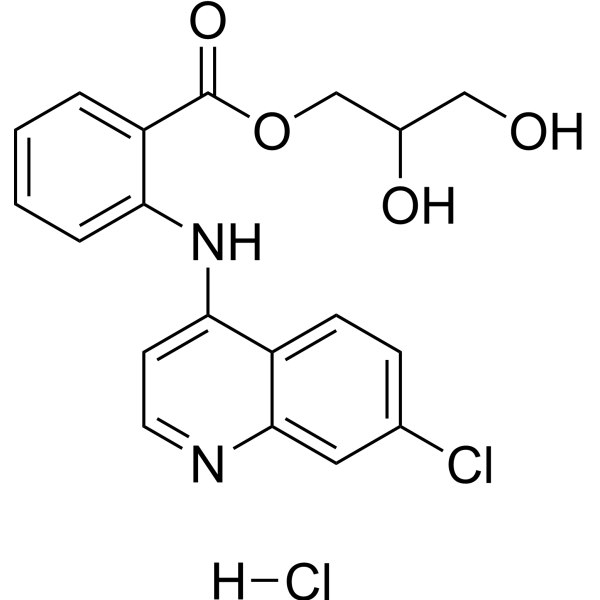
Glafenine hydrochloride
Based on 5 publication(s) in Google Scholar
Glafenine (Glafenin) hydrochloride is a non-selective, non-steroidal anti-inflammatory drug-based COX-1/COX-2 inhibitor. Glafenine hydrochloride exerts anti-inflammatory, anti-proliferative and anti-cell migration effects by inhibiting the arachidonic acid metabolic pathway and reducing prostaglandin synthesis. Glafenine hydrochloride can induce cell cycle arrest in vascular smooth muscle cells and endothelial cells and reduce the synthesis of the extracellular matrix protein Tenascin. Glafenine hydrochloride can be used in the research of inflammatory-related diseases, vascular restenosis and cystic fibrosis (CF).
For research use only. We do not sell to patients.
- Purity : 99.08%
- CAS No.: 65513-72-6
- Formula: C19H18Cl2N2O4
- Molecular Weight:409.26
-
Storage:
4°C, sealed storage, away from moisture
* In solvent : -80°C, 6 months; -20°C, 1 month (sealed storage, away from moisture)

To place orders, for customer services and technical support, please contact: MedChemExpress USA
Tel: 609-228-6898 E-mail: [email protected] [email protected]


-
 Biological Activity
-
Chemical Information
-
Solvent & Solubility
- Purity & Documentation
- References
-
 Help & FAQs



Publications Citing Use of MedChemExpress (MCE) Glafenine hydrochloride
More

Biological Activity
Description
IC50 & Target
|
COX-1 |
COX-2 |
In Vitro
Glafenine hydrochloride (10-100 μM; 4-20 days) inhibits cell proliferation and colony formation in human aortic smooth muscle cells (haSMCs) and endothelial cells (ECs) in a dose-dependent manner, induces cell cycle arrest at the G2/M phase, and reduces the synthesis of the extracellular matrix protein tenascin[1].
Glafenine hydrochloride (10 μM; 24 h) promotes the maturation and translocation of the F508del-CFTR mutant protein to the cell surface and enhances its chloride channel function in human bronchial epithelial cells (HBE) by inhibiting the COX-2-mediated arachidonic acid pathway[2].
MedChemExpress (MCE) has not independently confirmed the accuracy of these methods. They are for reference only.
-
Cell Line:Human aortic smooth muscle cells (haSMCs), human endothelial cells (ECs)
-
Concentration:10 μM, 50 μM, 100 μM
-
Incubation Time:4 days (short-term), 20 days (long-term)
-
Result:In haSMCs, short-term treatment (4 days) with 50 μM and 100 μM significantly reduced cell proliferation by 30-50% compared to control, while long-term treatment (20 days) with all concentrations caused dose-dependent inhibition, with 100 μM nearly halting proliferation.
Clonogenic activity was reduced by 40-70% in both short- and long-term treatments.
Flow cytometry revealed a G2/M phase block (25-35% increase) and reduced G1 phase (15-20% decrease) in haSMCs at 50-100 μM.
-
Cell Line:Human aortic smooth muscle cells (haSMCs), human endothelial cells (ECs)
-
Concentration:10 μM, 50 μM, 100 μM
-
Incubation Time:4 days (short-term), 20 days (long-term)
-
Result:Resulted a 60% reduction in tenascin expression in haSMCs treated with 100 μM for 4 days.
Significantly decreased proliferation by 25-40% after 4 days at 50 μM and 100 μM, in ECs, without significant cytotoxicity observed at ≤50 μM.
In Vivo
MedChemExpress (MCE) has not independently confirmed the accuracy of these methods. They are for reference only.
-
Animal Model:Zebrafish (Danio rerio) larvae (AB strain, 5 days post-fertilization)[3]
-
Dosage:25 μM
-
Administration:Immersion in culture medium for 12 h
-
Result:Caused dose-dependent intestinal injury, characterized by apoptotic cell accumulation in the lumen, detected by acridine orange (AO) staining and activated caspase-3 immunohistochemistry.
Resulted ER pitting and mitochondrial vacuolization in intestinal epithelial cells (IECs) in transmission electron microscopy (TEM) assay, indicating ER and mitochondrial stress.
Disrupted intestinal architecture with pyknotic nuclei and cellular hypertrophy in segments 1 and 2 in histological analysis.


Chemical Information
-
CAS No. 65513-72-6
-
Appearance Solid
-
Molecular Weight 409.26
-
Formula C19H18Cl2N2O4
-
Color Light yellow to yellow
-
SMILES
[H]Cl.O=C(OCC(O)CO)C1=CC=CC=C1NC2=CC=NC3=CC(Cl)=CC=C23
-
Synonyms
Glafenin hydrochloride
-
Shipping
Room temperature in continental US; may vary elsewhere.
-
Storage
4°C, sealed storage, away from moisture
* In solvent : -80°C, 6 months; -20°C, 1 month (sealed storage, away from moisture)


Publications (5)
-
Journal Impact Factor
-
Most Recent
-
Acta Pharm Sin B
DeepICER: A deep learning framework for predicting compound-induced gene expression profiles. [Abstract]2026 May;16(5):2947-2963. PMID: 42180546 -
-
Int J Biol Macromol
Reticuline isomerase AKR1B1 with aldo-keto reductase activity and detoxification function from the insect Blaps rhynchopetera. [Abstract]2026 Mar:352:151224. PMID: 41791543 -
Bioorg Chem
Identification of FTY720 and COH29 as novel topoisomerase I catalytic inhibitors by experimental and computational studies. [Abstract]2024 Jun:147:107412. PMID: 38696845 -
Indian J Ophthalmol
Ranitidine protects Müller cells against ferroptosis in diabetic retinopathy by regulating the AKT1/GSK3β pathway. [Abstract]2026 Feb 1;74(2):250-258. PMID: 41581041


Solvent & Solubility
In Vitro:
DMSO : 41.67 mg/mL (101.82 mM; Need ultrasonic; Hygroscopic DMSO has a significant impact on the solubility of product, please use newly opened DMSO)
Please refer to the solubility information to select the appropriate solvent. Once prepared, please aliquot and store the solution to prevent product inactivation from repeated freeze-thaw cycles.
Storage method and period of stock solution: -80°C, 6 months; -20°C, 1 month (sealed storage, away from moisture). When stored at -80°C, please use it within 6 months. When stored at -20°C, please use it within 1 month.
Please refer to the solubility information to select the appropriate solvent. Once prepared, please aliquot and store the solution to prevent product inactivation from repeated freeze-thaw cycles.
Storage method and period of stock solution: -80°C, 6 months; -20°C, 1 month (sealed storage, away from moisture). When stored at -80°C, please use it within 6 months. When stored at -20°C, please use it within 1 month.
Concentration (start) × Volume (start) = Concentration (final) × Volume (final)
In Vivo:
Select the appropriate dissolution method based on your experimental animal and administration route.
- For the following dissolution methods, please ensure to first prepare a clear stock solution using an In Vitro approach and then sequentially add co-solvents:
- To ensure reliable experimental results, the clarified stock solution can be appropriately stored based on storage conditions. As for the working solution for In Vivo experiments, it is recommended to prepare freshly and use it on the same day.
- The percentages shown for the solvents indicate their volumetric ratio in the final prepared solution. If precipitation or phase separation occurs during preparation, heat and/or sonication can be used to aid dissolution.
Add each solvent one by one: 10% DMSO 40% PEG300 5% Tween-80 45% Saline
Solubility: ≥ 2.08 mg/mL (5.08 mM); Clear solution
This protocol yields a clear solution of ≥ 2.08 mg/mL (saturation unknown).
Taking 1 mL working solution as an example, add 100 μL DMSO stock solution (20.8 mg/mL) to 400 μL PEG300, and mix evenly; then add 50 μL Tween-80 and mix evenly; then add 450 μL Saline to adjust the volume to 1 mL.
Preparation of Saline: Dissolve 0.9 g sodium chloride in ddH₂O and dilute to 100 mL to obtain a clear Saline solution.
Add each solvent one by one: 10% DMSO 90% (20% SBE-β-CD in Saline)
Solubility: ≥ 2.08 mg/mL (5.08 mM); Clear solution
This protocol yields a clear solution of ≥ 2.08 mg/mL (saturation unknown).
Taking 1 mL working solution as an example, add 100 μL DMSO stock solution (20.8 mg/mL) to 900 μL 20% SBE-β-CD in Saline, and mix evenly.
Preparation of 20% SBE-β-CD in Saline (4°C, storage for one week): 2 g SBE-β-CD powder is dissolved in 10 mL Saline, completely dissolve until clear.
In Vivo Dissolution Calculator
Please enter the basic information of animal experiments:
-
-
-
-
Recommended: Prepare an additional quantity of animals to account for potential losses during experiments.
Please enter your animal formula composition:
-
%DMSO +
Recommended: Keep the proportion of DMSO in working solution below 2% if your animal is weak.
-
%+
-
+%Tween-80 + +
-
%Saline +
The co-solvents required include: DMSO, . All of co-solvents are available by MedChemExpress (MCE). , Tween 80. All of co-solvents are available by MedChemExpress (MCE).
Working solution concentration: 0.22 mg/mL
Method for preparing stock solution: mg drug dissolved in μL DMSO. Stock solution concentration: mg/mL. * In solvent : -80°C, 6 months; -20°C, 1 month (sealed storage, away from moisture)
1. Take μL DMSO stock solution;
2. Add μL .
μL , mix evenly;
3. Then add μL Tween 80, mix evenly;
4. Then add μL
Please ensure that the stock solution in the first step is dissolved to a clear state, and add co-solvents in sequence. You can use ultrasonic heating (ultrasonic cleaner, recommended frequency 20-40 kHz), vortexing, etc. to assist dissolution.


Purity & Documentation
-
Data Sheet (286 KB)
-
SDS (394 KB)
- English - EN (394 KB)
- Français - FR (394 KB)
- Deutsch - DE (394 KB)
- Norwegian - NO (394 KB)
- Español - ES (394 KB)
- Swedish - SV (394 KB)
- Italian - IT (394 KB)
- Korean - KR (394 KB)
- Portuguese - PT (394 KB)
-
Handling Instructions (2659 KB)
References
[1]. Schöber W, et al. Impact of glafenine hydrochloride on human endothelial cells and human vascular smooth muscle cells: a substance reducing proliferation, migration and extracellular matrix synthesis. Cell Biol Int. 2003;27(12):987-96 [Content Brief]
[2]. Carlile GW, et al. The NSAID glafenine rescues class 2 CFTR mutants via cyclooxygenase 2 inhibition of the arachidonic acid pathway. Sci Rep. 2022 Mar 17;12(1):4595 [Content Brief]
[3]. Goldsmith JR, et al. Glafenine-induced intestinal injury in zebrafish is ameliorated by μ-opioid signaling via enhancement of Atf6-dependent cellular stress responses. Dis Model Mech. 2013 Jan;6(1):146-59. [Content Brief]
[4]. Chiu AM, et al. High Throughput Assay Identifies Glafenine as a Corrector for the Folding Defect in Corneal Dystrophy-Causing Mutants of SLC4A11. Invest Ophthalmol Vis Sci. 2015 Dec;56(13):7739-53. [Content Brief]


Complete Stock Solution Preparation Table
Please refer to the solubility information to select the appropriate solvent. Once prepared, please aliquot and store the solution to prevent product inactivation from repeated freeze-thaw cycles.
Storage method and period of stock solution: -80°C, 6 months; -20°C, 1 month (sealed storage, away from moisture). When stored at -80°C, please use it within 6 months. When stored at -20°C, please use it within 1 month.
| Optional Solvent | Concentration Solvent Mass | 1 mg | 5 mg | 10 mg | 25 mg |
|---|---|---|---|---|---|
| DMSO | 1 mM | 2.4434 mL | 12.2172 mL | 24.4343 mL | 61.0859 mL |
| 5 mM | 0.4887 mL | 2.4434 mL | 4.8869 mL | 12.2172 mL | |
| 10 mM | 0.2443 mL | 1.2217 mL | 2.4434 mL | 6.1086 mL | |
| 15 mM | 0.1629 mL | 0.8145 mL | 1.6290 mL | 4.0724 mL | |
| 20 mM | 0.1222 mL | 0.6109 mL | 1.2217 mL | 3.0543 mL | |
| 25 mM | 0.0977 mL | 0.4887 mL | 0.9774 mL | 2.4434 mL | |
| 30 mM | 0.0814 mL | 0.4072 mL | 0.8145 mL | 2.0362 mL | |
| 40 mM | 0.0611 mL | 0.3054 mL | 0.6109 mL | 1.5271 mL | |
| 50 mM | 0.0489 mL | 0.2443 mL | 0.4887 mL | 1.2217 mL | |
| 60 mM | 0.0407 mL | 0.2036 mL | 0.4072 mL | 1.0181 mL | |
| 80 mM | 0.0305 mL | 0.1527 mL | 0.3054 mL | 0.7636 mL | |
| 100 mM | 0.0244 mL | 0.1222 mL | 0.2443 mL | 0.6109 mL |


Glafenine hydrochloride Related Classifications
HY-B1153A Related Classifications
 Powered by Bioz