



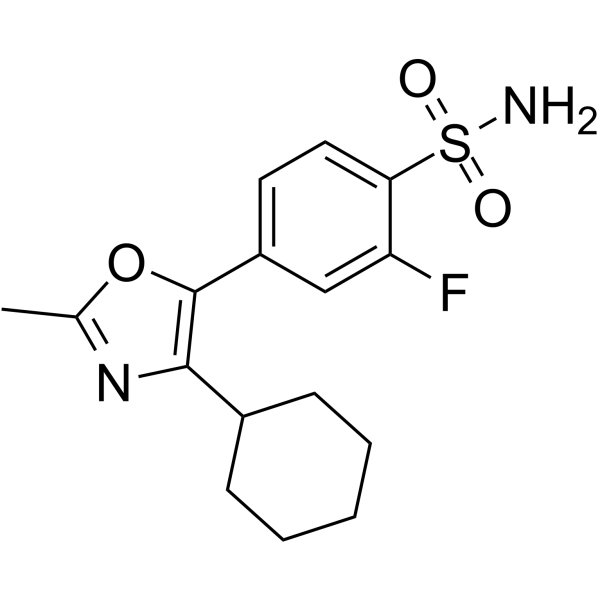
Tilmacoxib

Based on 1 Customer Validation
Tilmacoxib (JTE522) is a highly selective, time-dependent and irreversible human COX-2 inhibitor with an IC50 of 85 nM in an enzyme assay.
Nur für Forschungszwecke. Wir verkaufen nicht an Patienten.
- Reinheit : 99.0%
- CAS. Nr.: 180200-68-4
- Formel: C16H19FN2O3S
- Molecular Weight:338.40
-
Speicherung:Powder -20°C, 3 years , 4°C, 2 years ; In solvent -80°C, 6 months , -20°C, 1 month

To place orders, for customer services and technical support, please contact: MedChemExpress USA
Tel: 609-228-6898 E-mail: [email protected] [email protected]


-
 Biologische Aktivität
-
Chemical Information
- Protokoll
- Reinheit & Dokumentation
- Verweise
-
 Help & FAQs




Biologische Aktivität
Beschreibung
IC50 & Target
|
Human COX-2 85 nM (IC50) |
In Vitro
Inhibitory activity and the mechanism of action of Tilmacoxib (JTE-522), a novel selective cyclooxygenase (COX)-2 inhibitor, on human COX-1 and COX-2 are investigated and compared with those of reference compounds. In an enzyme assay, Tilmacoxib inhibits yeast-expressed human recombinant COX-2 with an IC50 of 0.085 μM. In contrast, Tilmacoxib does not inhibit human COX-1 prepared from human platelets at concentrations up to 100 μM. In a cell-based assay, Tilmacoxib diminishes lipopolysaccharide-induced prostaglandin E2 production in human peripheral blood mononuclear cells (COX-2) (IC50=15.1 nM). On the other hand, Tilmacoxib is less potent at inhibiting calcium ionophore-induced thromboxane B2 production in washed human platelets (COX-1) (IC50=6.21 μM). Tilmacoxib shows highly selective inhibition of human COX-2, and its activity is more selective than that of other COX-2 inhibitors (NS-398 and SC-58635). Human recombinant COX-2 activity is attenuated by Tilmacoxib in a dose-dependent and time-dependent manner[1]. Inhibition of proliferation of gastric epithelial cells by a cyclooxygenase 2 inhibitor, Tilmacoxib (JTE522), is also mediated by a PGE2-independent pathway Combination of Tilmacoxib and Arachidonic acid results in a marked retardation of wound healing compared to the control, but Tilmacoxib does not completely suppress the increase in cellular PGE2 content following the addition of arachidonate[2].
MedChemExpress (MCE) has not independently confirmed the accuracy of these methods. They are for reference only.
In Vivo
MedChemExpress (MCE) has not independently confirmed the accuracy of these methods. They are for reference only.


Chemical Information
-
CAS. Nr. 180200-68-4
-
Appearance Solid
-
Molecular Weight 338.40
-
Formel C16H19FN2O3S
-
Color White to off-white
-
SMILES
O=S(C1=CC=C(C2=C(C3CCCCC3)N=C(C)O2)C=C1F)(N)=O
-
Synonyms
JTE522; JTP19605; RWJ57504
-
Versand
Room temperature in continental US; may vary elsewhere.
-
Speicherung
Powder -20°C 3 years 4°C 2 years In solvent -80°C 6 months -20°C 1 month

Protokoll
Cell Assay[2]
Tilmacoxib is resolved with DMSO prior to the experiment and concentrations of 1-100 μM are assessed. Effects of Arachidonic acid are assessed at concentrations of 0, 5 and 20 μg/mL. Further, the combination of Tilmacoxib (100 μM) with Arachidonic acid (20 μg/mL) is assessed in additional experiments. Circular artificial wounds are created after formation of complete monolayer cell sheets. Tilmacoxib and Arachidonic acid are added just after wound formation. The process of epithelial restoration is monitored by measuring the cell-free area using an inverted phase-contrast microscope every 24 h. Changes in the cell-free area during restoration are analyzed quantitatively with an image analyser[2].
MedChemExpress (MCE) has not independently confirmed the accuracy of these methods. They are for reference only.
Animal Administration[3]
Rats[3]
A total of 80 male F344 rats, 5 weeks old, are used. Rats at 6 weeks of age after 1 week of acclimatization are divided randomly into five groups. The rats in groups 1-3 (20 rats each) are injected s.c. with DMH (20 mg/kg body wt) from 1 week after the start of the experiment, once weekly for four successive weeks. Those in groups 4 and 5 (10 rats each) are injected s.c. with 0.9% saline at the same time. Group 2 is treated with Tilmacoxib at a dose of 3 mg/kg body wt by oral gavage, five times weekly from the start of the experiment to the end of the experiment. Groups 3 and 5 are treated with Tilmacoxib at the dose of 10 mg/kg body wt in the same manner as group 2. Groups 1 and 4 are treated with 0.5% CMC alone, without Tilmacoxib. Body weight, water and food consumption are measured weekly during the experiment.
MedChemExpress (MCE) has not independently confirmed the accuracy of these methods. They are for reference only.


Reinheit & Dokumentation
-
Data Sheet (279 KB)
-
SDS (252 KB)
- English - EN (252 KB)
- Français - FR (252 KB)
- Deutsch - DE (252 KB)
- Norwegian - NO (252 KB)
- Español - ES (252 KB)
- Swedish - SV (252 KB)
- Italian - IT (252 KB)
- Korean - KR (252 KB)
- Portuguese - PT (252 KB)
-
Handling Instructions (2659 KB)
Verweise
[1]. Wakitani K, et al. Profile of JTE-522 as a human cyclooxygenase-2 inhibitor. Jpn J Pharmacol. 1998 Nov;78(3):365-71. [Content Brief]
[2]. Hirose M, et al. Inhibition of proliferation of gastric epithelial cells by a cyclooxygenase 2 inhibitor, JTE522, is also mediated by a PGE2-independent pathway. Aliment Pharmacol Ther. 2002 Apr;16 Suppl 2:83-9. [Content Brief]
[3]. Wei M, et al. Chemopreventive effect of JTE-522, a selective cyclooxygenase-2 inhibitor, on 1, 2-dimethylhydrazine-induced rat colon carcinogenesis. Cancer Lett. 2003 Dec 8;202(1):11-6. [Content Brief]

Calculators
Konzentration (Stammlösung) × Volumen (Stammlösung) = Konzentration (Ziellösung) × Volumen (Ziellösung)


Tilmacoxib Related Classifications
HY-U00197 Related Classifications
 Powered by Bioz