



Cancer Targeted Therapy
Cancer targeted therapy is the foundation of precision medicine; it uses drugs or other substances to target specific genes and proteins that control cancer cells’ growth, division and spreading. Compared to traditional chemotherapy drugs, targeted-drugs can specifically act on cancer cells with high efficacy without damaging normal cells. Drugs used in cancer targeted therapy mainly includes small molecules and macromolecules (e.g., monoclonal antibodies), which can target cancer cells and constituents in the tumor microenvironment to activate the immune system. Anti-angiogenesis drugs, such as those targeting vascular endothelial growth factor (VEGF), epidermal growth factor receptor (EGFR), transforming growth factor (TGF)-α, TGF-β, Tumor necrosis factor (TNF)-α, and platelet-derived endothelial growth factor (PDGFR) inhibit the proliferation and metastasis of cancer cells. In recent years, the proportion of antibody drugs in cancer treatment has gradually become prominent. Antibody-drug conjugates (ADCs) are a new type of targeted drugs that are composed of monoclonal antibody, cytotoxic drug and linker. ADCs can deliver drugs to tumor cells and minimize the toxicity to normal tissues. Proteolysis-targeting chimera (PROTAC) is a useful technology for targeted protein degradation. PROTAC exploits the ubiquitin-proteasome system and forms a ternary complex with a hijacked E3 ubiquitin ligase and target protein, leading to polyubiquitination and degradation of the target protein.
Targeted therapy is a useful strategy in treatment of cancer either alone or in combination with standard chemotherapy. At present, targeted therapy has proved significant clinical success in the treatment of many types of cancer, including breast cancer, colorectal cancer, leukemia, ovarian cancer and lung cancer.
-
mmu-miR-7658-5p inhibitor
 0 ImagesCat. No.: HY-RI04066
mmu-miR-7658-5p inhibitors are chemically-modified oligonucleotides that hybridize with mature miRNAs. The miRNA inhibitors have full-length nucleotide 2'-methoxy modification. The miRNA inhibitors strongly compete with mature miRNAs to prevent the complementary pairing of miRNAs and their target genes, thereby inhibiting miRNAs from functioning.
-
ATR-IN-24
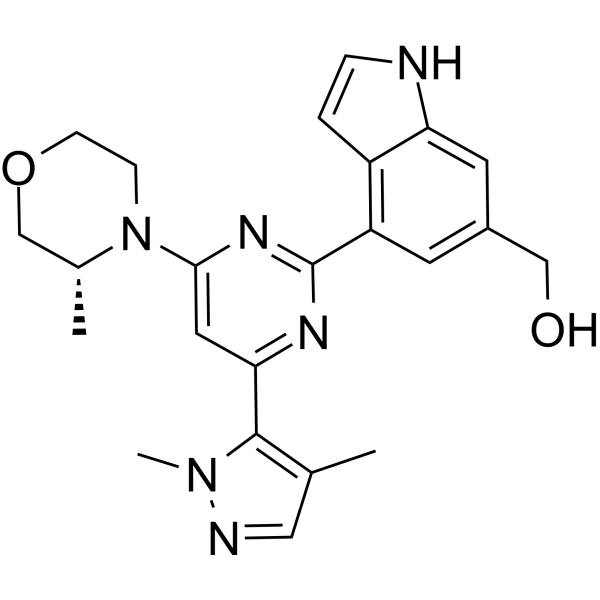 0 ImagesCat. No.: HY-153462CAS No.: 2370889-43-1
ATR-IN-24 (Compound 1) is a ATR inhibitor. ATR-IN-24 has anticancer activity.
-
L-Val-D-Cit-PAB
 0 ImagesCat. No.: HY-159797CAS No.: 2226490-91-9
L-Val-D-Cit-PAB is an ADC linker, and can be used for synthesis of ADCs.
-
PROTAC SOS1 ligand 1
 0 ImagesCat. No.: HY-168638CAS No.: 3027977-34-7
PROTAC SOS1 ligand 1, a BI-3406 (HY-125817) analog, is a ligand for target SOS1 protein for PROTACT SIAIS562055 (HY-168637).
-
hsa-miR-1243 antagomir
 0 ImagesCat. No.: HY-RI00137A
hsa-miR-1243 antagomirs are chemically-modified oligonucleotides that hybridize with mature miRNAs. The miRNA antagomirs have 2 phosphorothioates at the 5' end, 4 phosphorothioates at the 3' end, 1 cholesterol group at the 3' end, and full-length nucleotide 2'-methoxy modification. The miRNA antagomirs strongly compete with mature miRNAs to prevent the complementary pairing of miRNAs and their target genes, thereby inhibiting miRNAs from functioning. Stability of miRNA antagomirs appears to be significantly higher than miRNA inhibitors, they exhibits enhanced cellular uptake, stability and regulatory activity in vivo.
-
hsa-miR-3655 inhibitor
 0 ImagesCat. No.: HY-RI00760
hsa-miR-3655 inhibitors are chemically-modified oligonucleotides that hybridize with mature miRNAs. The miRNA inhibitors have full-length nucleotide 2'-methoxy modification. The miRNA inhibitors strongly compete with mature miRNAs to prevent the complementary pairing of miRNAs and their target genes, thereby inhibiting miRNAs from functioning.
-
hsa-miR-4761-5p inhibitor
 0 ImagesCat. No.: HY-RI01381
hsa-miR-4761-5p inhibitors are chemically-modified oligonucleotides that hybridize with mature miRNAs. The miRNA inhibitors have full-length nucleotide 2'-methoxy modification. The miRNA inhibitors strongly compete with mature miRNAs to prevent the complementary pairing of miRNAs and their target genes, thereby inhibiting miRNAs from functioning.
-
hsa-miR-6718-5p antagomir
 0 ImagesCat. No.: HY-RI02001A
hsa-miR-6718-5p antagomirs are chemically-modified oligonucleotides that hybridize with mature miRNAs. The miRNA antagomirs have 2 phosphorothioates at the 5' end, 4 phosphorothioates at the 3' end, 1 cholesterol group at the 3' end, and full-length nucleotide 2'-methoxy modification. The miRNA antagomirs strongly compete with mature miRNAs to prevent the complementary pairing of miRNAs and their target genes, thereby inhibiting miRNAs from functioning. Stability of miRNA antagomirs appears to be significantly higher than miRNA inhibitors, they exhibits enhanced cellular uptake, stability and regulatory activity in vivo.
-
RSK2-IN-2
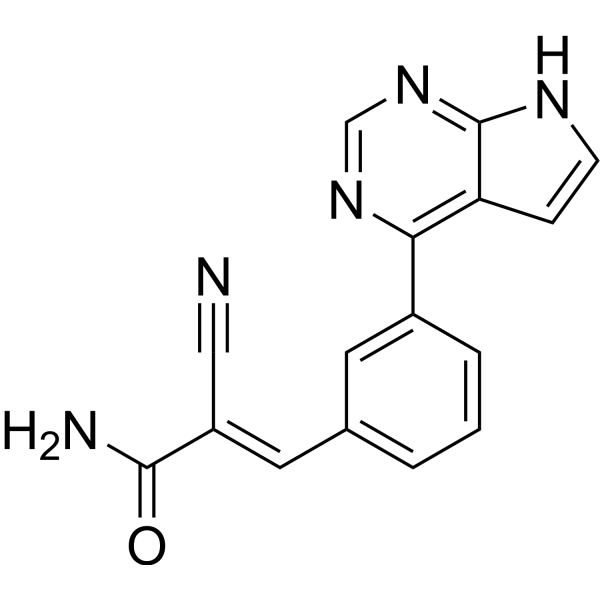 0 ImagesCat. No.: HY-150643CAS No.: 1637749-78-0
-
5-(2-Hydroxyethyl)-2’,3’-di-O-toluoyl-2’-deoxyuridine
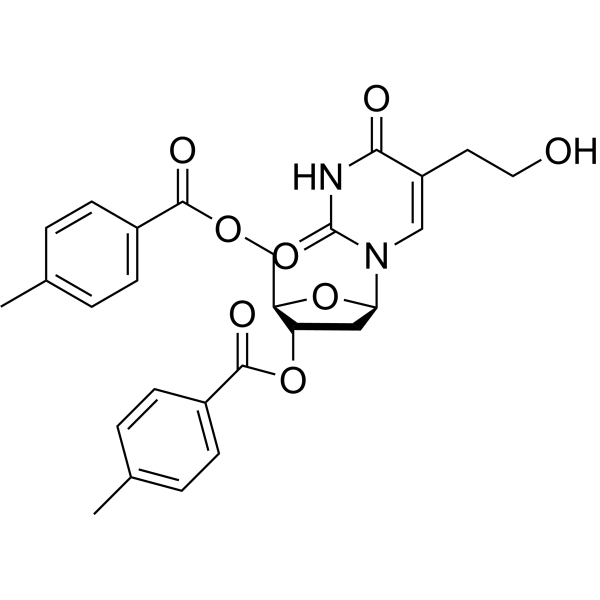 0 ImagesCat. No.: HY-154160
5-(2-Hydroxyethyl)-2’,3’-di-O-toluoyl-2’-deoxyuridine is a purine nucleoside analog. Purine nucleoside analogs have broad antitumor activity targeting indolent lymphoid malignancies. Anticancer mechanisms in this process rely on inhibition of DNA synthesis, induction of apoptosis, etc.
-
Cbl-b-IN-6
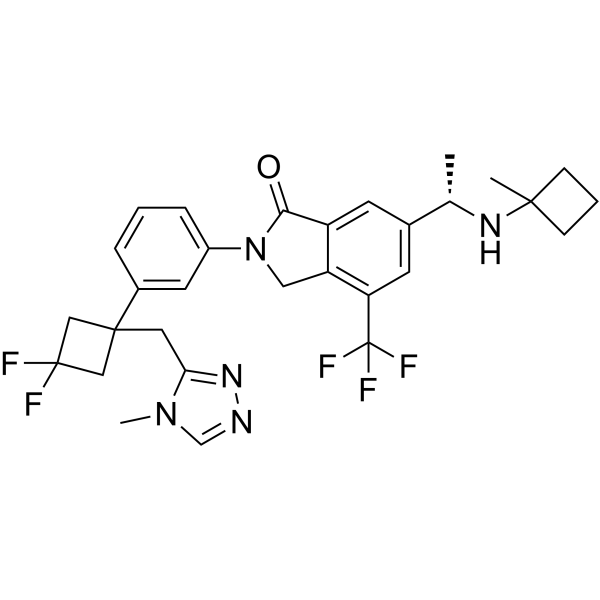 0 ImagesCat. No.: HY-156762CAS No.: 2815221-33-9
Cbl-b-IN-6 (Compound 246) is a casitas B-lineage lymphoma-b (Cbl-b) and c-Cbl inhibitor with IC50s of 6.7 nM and 5.2 nM, respectively.
-
VNPP433-3β hydrochloride
 0 ImagesCat. No.: HY-160777BCAS No.: 3026905-91-6Synonyms: Galeterone 3β-imidazole hydrochloride
VNPP433-3β (Galeterone 3β-imidazole) hydrochloride is an orally active molecular glue degrader, which degrades androgen receptor (AR) and its splice variants (AR-Vs) and MAP kinase-interacting serine/threonine protein kinase Mnk1/2. VNPP433-3β hydrochloride induces cell apoptosis. VNPP433-3β hydrochloride inhibits tumor growth in the CWR22Rv1 xenograft mouse model. VNPP433-3β hydrochloride can be used for the study of castration resistant prostate cancer (CRPC) and pancreatic ductal adenocarcinoma (PDAC).
-
AR Degrader-1
 0 ImagesCat. No.: HY-163641
AR Degrader-1 is a molecular glue degrader targeting the androgen receptor (AR). AR Degrader-1 induces androgen receptor degradation by recruiting the DCAF16 E3 ligase substrate receptor, thereby triggering ubiquitination and proteasomal degradation. AR Degrader-1 exhibits relatively selective degradation of the androgen receptor in prostate cancer cells, reducing the levels of only a small number of other proteins. AR Degrader-1 can be used in studies related to prostate cancer.
-
APL-1091
 0 ImagesCat. No.: HY-169323CAS No.: 2921735-87-5Synonyms: Mal-Exo-EEVC-MMAE
APL-1091 (Mal-Exo-EEVC-MMAE) is an ADC payload-linker conjugate (Drug-Linker Conjugates for ADC). APL-1091 is formed by the conjugation of the Mal-Exo-EEVC (HY-169353) linker and MMAE (HY-15162), a microtubule inhibitor. APL-1091 resists aggregation at high drug-to-antibody ratio (DAR), exhibits excellent plasma stability, and reduces premature payload release. When conjugated with Trastuzumab (HY-P9907), APL-1091 displays anti-tumor activity in gastric cancer xenograft models. APL-1091 can be used for ADC synthesis and gastric cancer-related research.
-
Coumestan
 0 Images
Coumestan is a secondary metabolite found in leguminous plants and can be used as drug intermediate Coumestan can be used to synthesize various coumarin compounds such as Coumestrol (HY-N2335), Glytabastan B, and Coumestan Pks13 inhibitor. Coumestans can be used for the study of anti-cancer, anti-inflammatory, anti-oxidative, antibacterial, neuroprotective and organ protective.
-
hsa-miR-146b-3p inhibitor
 0 ImagesCat. No.: HY-RI00288
hsa-miR-146b-3p inhibitors are chemically-modified oligonucleotides that hybridize with mature miRNAs. The miRNA inhibitors have full-length nucleotide 2'-methoxy modification. The miRNA inhibitors strongly compete with mature miRNAs to prevent the complementary pairing of miRNAs and their target genes, thereby inhibiting miRNAs from functioning.
-
hsa-miR-5092 antagomir
 0 ImagesCat. No.: HY-RI01529A
hsa-miR-5092 antagomirs are chemically-modified oligonucleotides that hybridize with mature miRNAs. The miRNA antagomirs have 2 phosphorothioates at the 5' end, 4 phosphorothioates at the 3' end, 1 cholesterol group at the 3' end, and full-length nucleotide 2'-methoxy modification. The miRNA antagomirs strongly compete with mature miRNAs to prevent the complementary pairing of miRNAs and their target genes, thereby inhibiting miRNAs from functioning. Stability of miRNA antagomirs appears to be significantly higher than miRNA inhibitors, they exhibits enhanced cellular uptake, stability and regulatory activity in vivo.
-
BIM-46068
 0 ImagesCat. No.: HY-117893CAS No.: 201487-53-8
BIM-46068 is a potent, selectively human brain Farnesyltransferase (FTase) inhibitor (IC50 = 91.4 nM). BIM-46068 can specifically inhibit Ras processing in MiaPaCa-2 cancer cells. BIM-46068 can be used for the study of pancreatic cancer.
-
HPK1-IN-2 TFA
 0 ImagesCat. No.: HY-132150CPurity: 99.56%



