Others
-
Others Related Products (76556)
Related Products (76556)

-
3'-P-dATP sodium solution (100 mM)
 0 ImagesCat. No.: HY-158673Purity: 99.74%
3'-P-dATP sodium is a labeled modified deoxyoligonucleotide (dNTP) that can release pyrophosphate to produce fluorescence and has special applications in gene synthesis and sequencing.


-
L202
 0 Images
L202 is an ionizable cationic lipid (pKa=6.04) that can be used for the study of mRNA and lipid nanoparticles.
-
C3-K2-E14
 0 ImagesSynonyms: G1-nPr-C14E
C3-K2-E14 is a multi-ionizable amino-lipid featuring a central tertiary amine with two identical branches and an n-propyl group. Each branch features a propanamide linking to a branched amine, each with two C14 arms and a hydroxyl. Ionizable lipids such as this may be applied in the development of lipid nanoparticles for drug discovery.
-
3-Epiglycyrrhetinic acid-d2
 0 ImagesCat. No.: HY-158995SSynonyms: 3α-Glycyrrhetic acid-d2
3-Epiglycyrrhetinic acid-d2 (3α-Glycyrrhetic acid-d2) is the deuterium-labeled 3-Epiglycyrrhetinic acid. 3-Epiglycyrrhetinic acid is a derivative of glycyrrhetic acid. Glycyrrhetic acid and its derivative are considered to have anti-inflammatory, anti-ulcer, and antiviral activities.
-
N-Ethyl-N-(3-sulfopropyl)-m-anisidine sodium
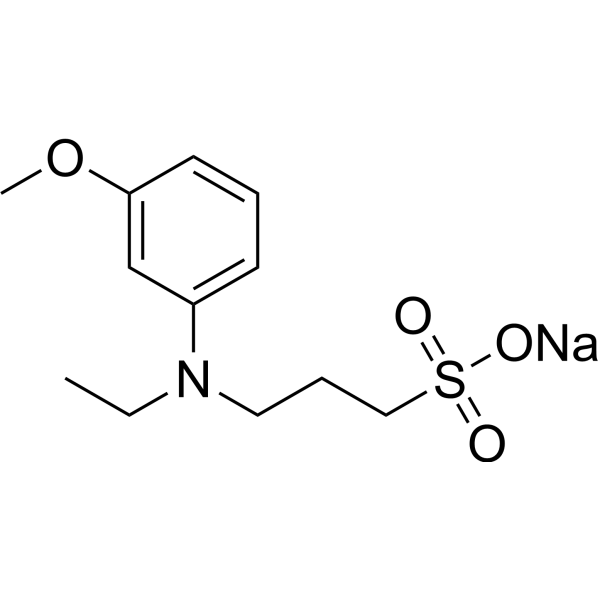 0 ImagesSynonyms: ESPA
N-Ethyl-N-(3-sulfopropyl)-m-anisidine sodium (ESPA) is a Trinder's reagent and a highly water-soluble aniline derivative. N-Ethyl-N-(3-sulfopropyl)-m-anisidine sodium has a relatively high absorption wavelength at 540 nm and can be widely used in diagnostic tests and biochemical experiments.
-
ALPS
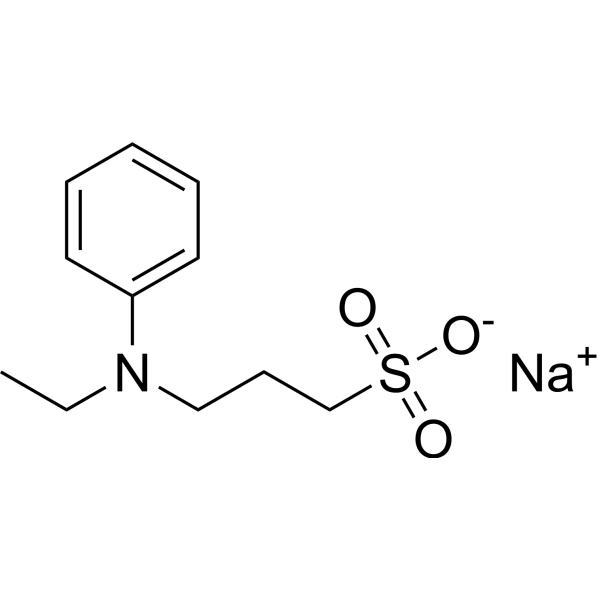 0 ImagesSynonyms: N-Ethyl-N-sulfopropylaniline sodium salt
ALPS(N-Ethyl-N-sulfopropylaniline sodium salt) is a bio-chemical reagents/chromogenic reagent.
-
DSPSAPVNVT(Val-13C5,15N)R TFA
 0 ImagesCat. No.: HY-159064S
DSPSAPVNVT(Val-13C5,15N)R TFA is the 13C and 15N-labeled DSPSAPVNVT(Val)R.
-
CNP-AFU
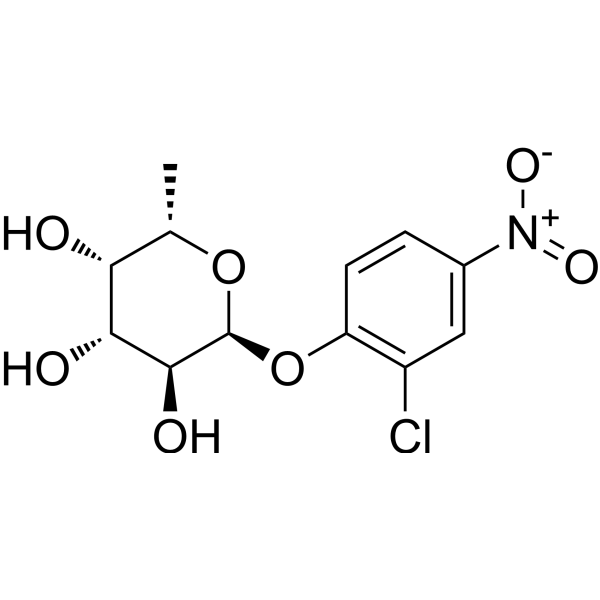 0 ImagesSynonyms: 2-Chloro-4-nitrophenyl α-L-fucopyranoside
CNP-AFU (2-Chloro-4-nitrophenyl α-L-fucopyranoside) is a substrate for alpha-L-fucosidase(AFU).
-
HDAOS
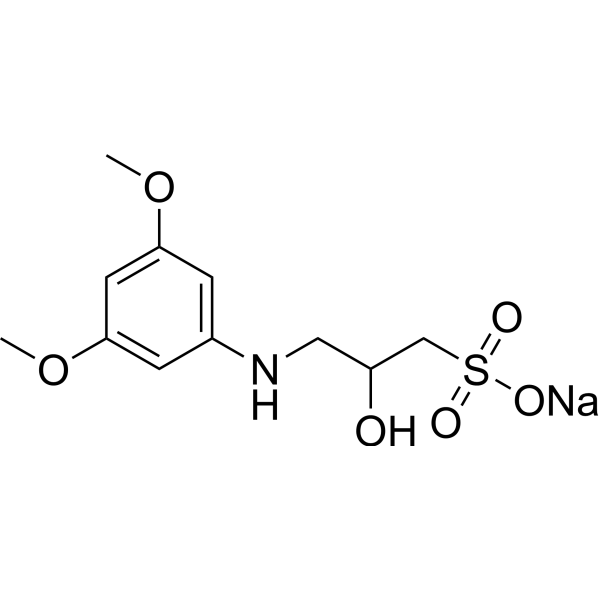 0 Images
HDAOS is a novel Trinder's reagent, which is a highly water-soluble aniline derivative. HDAOS is widely used in diagnostic tests and biochemical tests.
-
HTBA
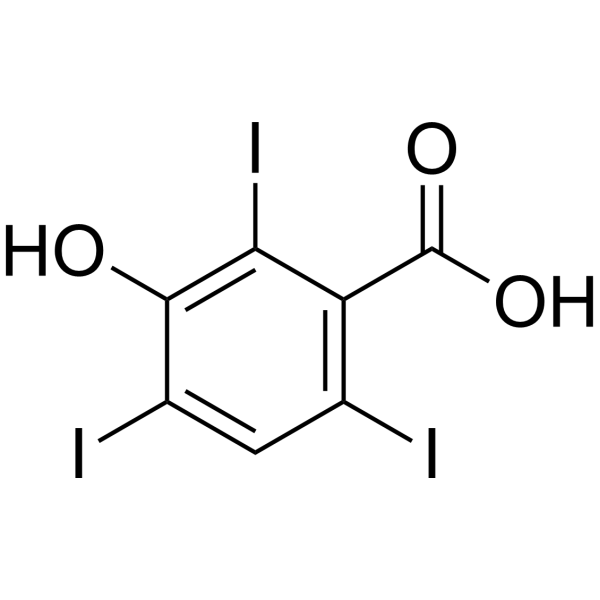 0 ImagesSynonyms: 3-Hydroxy-2,4,6-triiodobenzoic acid
HTBA (3-Hydroxy-2,4,6-triiodobenzoic acid) is a biochemical reagent and important intermediate. HTBA can be used in the research of life science, organic chemistry and other fields.
-
VQPGQN(Phe-13C9,15N)HMFTKEKLEEVIKDI TFA
 0 ImagesCat. No.: HY-159191S
VQPGQN(Phe-13C9,15N)HMFTKEKLEEVIKDI (TFA) is the 13C and 15N labeled isotope of VQPGQN-HMFTKEKLEEVIKDI (TFA).
-
DHATS(Leu-13C6,15N)PVTIPSAVST(Gly-13C2,15N)HTTPLPVTDT TFA
 0 ImagesCat. No.: HY-159193S
DHATS(Leu-13C6,15N)PVTIPSAVST(Gly-13C2,15N)HTTPLPVTDT (TFA) is the 13C and 15N labeled isotope of DHATS-PVTIPSAVST-HTTPLPVTDT (TFA).
-
C19 3'-Sulfo galactosylceramide (d18:1/19:0)
 0 ImagesSynonyms: (3'-Sulfo)Galβ-ger(d18:1/19:0); C19 Sulfatide
C19 3'-Sulfo Galactosylceramide (d18:1/19:0) is a synthetic derivative of sulfatide.
-
X-Gluc Dicyclohexylamine
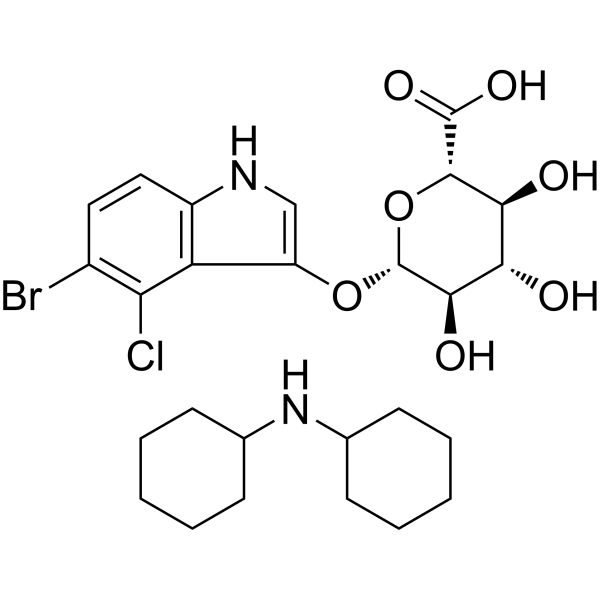 0 Images
X-Gluc Dicyclohexylamine is a dye reagent for the detection of β-glucuronidase, an enzyme produced by Escherichia coli. X-Gluc sodium can be used to detect E. coli contamination in food, water and the urinary tract. X-Gluc sodium is also widely used in molecular biology experiments to label and detect the expression of target genes (GUS reporter system).
-
Glu-Cys
 0 ImagesCat. No.: HY-159703CAS No.: 21566-73-4Synonyms: Glutamyl-cysteine; PSSGlu-Cys
-
Lipid 23
 0 Images
Lipid 23 is an ionizable cationic amino lipid that can be used to generate lipid nanoparticles (LNP). Lipid 23 can be used for mRNA delivery.
-
3',5'-UpU
 0 Images
3',5'-UpU (3',5'-Uridylyluridine) is a 3',5'-linked uridylyluridine dinucleotide. 3',5'-UpU undergoes cyclization/cleavage reactions to form uridine and uridine 2',3'-cyclic phosphate, and can also isomerize into 2',5'-UpU. Under the consecutive acid-base bifunctional catalysis of imidazole buffer, 3',5'-UpU undergoes cyclization/cleavage reactions via a phosphorane intermediate.
-
3',5'-UpU TEA
 0 ImagesCat. No.: HY-159806ACAS No.: 101609-06-7Synonyms: 3',5'-Uridylyluridine TEA
3',5'-UpU TEA (3',5'-Uridylyluridine TEA) is a 3',5'-linked uridylyluridine dinucleotide. 3',5'-UpU TEA undergoes cyclization/cleavage reactions to form uridine and uridine 2',3'-cyclic phosphate, and can also isomerize into 2',5'-UpU. Under the consecutive acid-base bifunctional catalysis of imidazole buffer, 3',5'-UpU TEA undergoes cyclization/cleavage reactions via a phosphorane intermediate.