



Fluorescent Dye
Fluorescence is a phenomenon of photoluminescence in luminescence. When an atom is irradiated by light, some electrons around the nucleus jump from their original orbitals to higher energy orbitals under the influence of light energy, i.e., from the ground state to the first or second excited single-line state, etc. Due to the instability of the first or second excited singlet state, the electron returns from the excited singlet state to the ground state accompanied by released energy, resulting in fluorescence.
Fluorescent dyes can be covalently bound or physically adsorbed in the structure of the substance. The fluorescence properties allow for the characterization, localization and quantitative analysis of the labeled object. Fluorescent dyes have shown great potential for the detection of proteins, nucleic acids, cells, and immunoassays, attributed to the advantages in non-radioactive contamination, simple experimental operation and easy observation.
Fluorescent dyes have penetrated many fields such as pharmacology, physiology, environmental science, and information science, as well as functional studies of proteins and drug screening.
All Product Categories
-
Fluorescent Dye Related Products (4888)
Related Products (4888)

-
Antibodies (4)
-
TTX-P
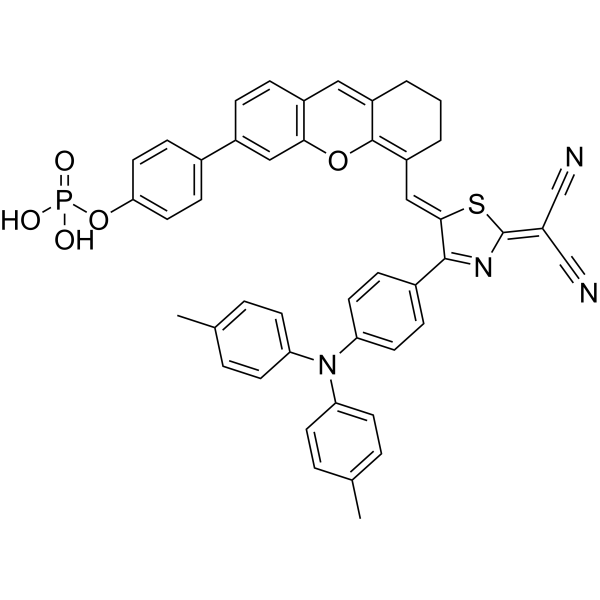 0 ImagesCat. No.: HY-149835TTX-P is a fluorescent probe. TTX-P responds in situ to the overexpressed alkaline phosphatase (ALP) in liver, imaging of diabetic liver injury in the near-infrared second-window (NIR-II) region.
-
Cholylglycylamidofluorescein
 0 ImagesCat. No.: HY-169799CAS No.: 168912-70-7Synonyms: CGamFCholylglycylamidofluorescein (CGamF) is a fluorescent probe for hepatic bile acid transport. Cholylglycylamidofluorescein is composed of Cholic acid conjugated via a glycylamino linkage to fluorescein. (Ex/Em = 492/515 nM in Aqueous)
-
NPE-caged-HPTS sodium
 0 ImagesCat. No.: HY-103467CAS No.: 223759-19-1NPE-caged-HPTS sodium is a caged fluorophore that fluoresces upon uncaged fluorophore release, releasing the free highly polar fluorophore HPTS (Exc=470/40 nm, Em=525/50 nm). HPTS releases the fluorophore rapidly and uniformly, allowing for measurement of diffusion within tissues, with a diffusion coefficient of μm2s-1, similar to that of synaptic L-glutamate.
-
ICG acid
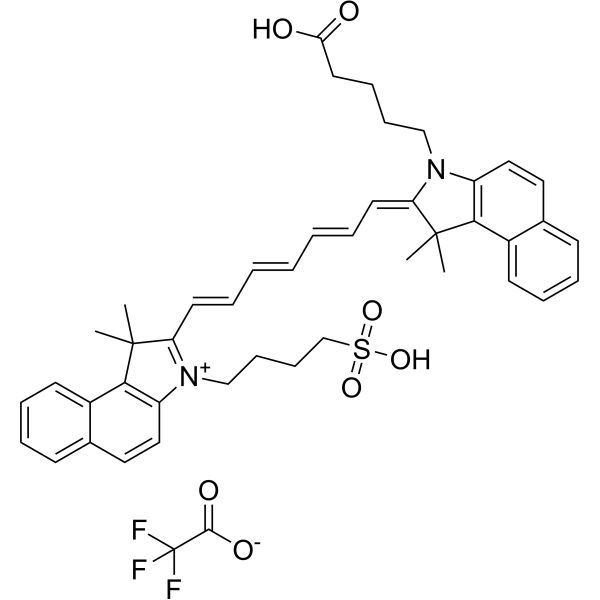 0 ImagesCat. No.: HY-D1905ICG acid is a fluorescent dye used in medical diagnostics. ICG acid has absorption peaking at 800 nm and can absorb the near IR laser energy and release heat in the dyed tissue. ICG acid has been used in fluorescence-guided surgery to identify critical structures, including intra-abdominal tumors.

-
RB-PEG3400-OH
 0 ImagesCat. No.: HY-D2882DSynonyms: Rhodamine B-PEG3400-OHRB-PEG3400-OH (Rhodamine B-PEG3400-OH) is a fluorescent dye composed of Rhodamine B (HY-Y0016), PEG and a Hydroxyl group. RB-PEG3400-OH can be used for fluorescent labeling and imaging (Ex/Em=546/610 nm).
-
Cy3 labled Nusinersen sodium
 0 ImagesCat. No.: HY-112980ECy3 labled Nusinersen sodium is a Cy3 labled Nusinersen sodium.
-
L-Pyroglutamic acid β-naphthylamide
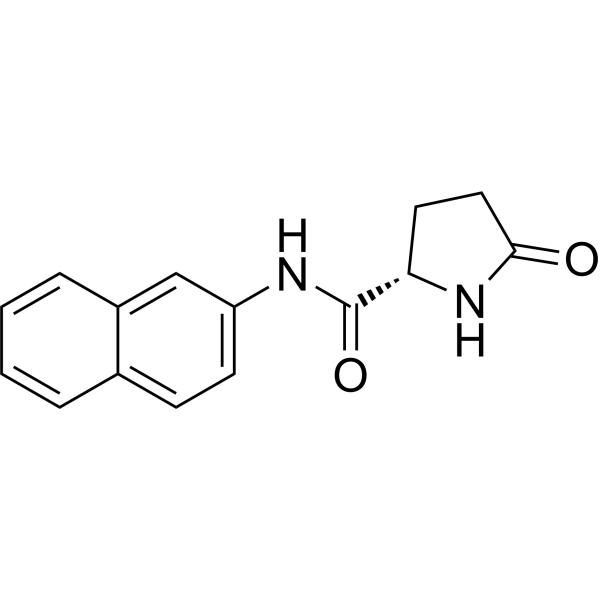 0 ImagesCat. No.: HY-W009472CAS No.: 22155-91-5Synonyms: PYRL-Pyroglutamic acid β-naphthylamide (PYR) is aglutamic acid derivatives.
-
Cy7 picolyl azide
 0 ImagesCat. No.: HY-D3337Cy7 picolyl azide is a derivative of Cyanine7 (Cy7) , a near-infrared fluorescent dye. It features picolyl azide group for enhanced CuAAC click chemistry. Main applications: fluorescence labeling and detection. Commonly used in fluorescence microscopy, flow cytometry, immunoassays, and nucleic acid detection. (Ex/Em = 750/776 nm)
-
RB-PEG3400-DSPE
 0 ImagesCat. No.: HY-D2887DSynonyms: Rhodamine B-PEG3400-DSPERB-PEG3400-DSPE (Rhodamine B-PEG3400-DSPE) is a PEG phospholipid labeled Rhodamine B (HY-Y0016). RB-PEG3400-DSPE can be used to prepare liposomes or nanoparticles for nutrients delivery such as mRNA or DNA vaccine (Ex/Em=546/610 nm).
-
6-TET phosphoramidite
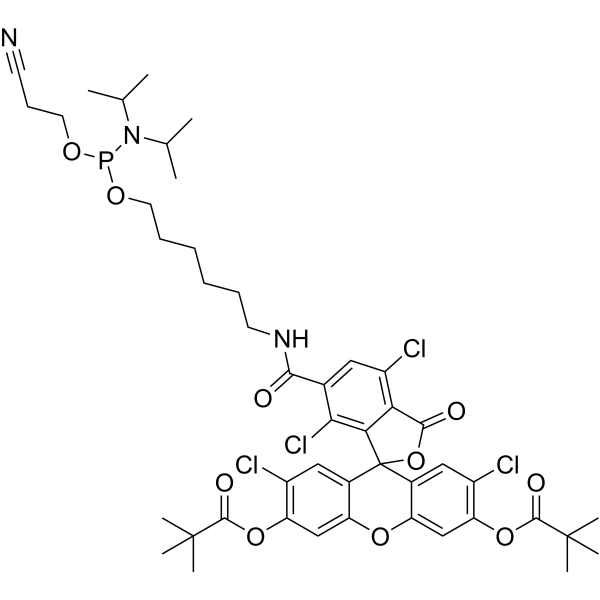 0 ImagesCat. No.: HY-D1897CAS No.: 877049-90-6Synonyms: 5′-Tetrachlorofluorescein phosphoramidite6-TET phosphoramidite (5′-Tetrachlorofluorescein phosphoramidite) is a fluorescent dye that can be used for labeling an oligonucleotide with fluorescein.
-
3,6-Diaminoacridine sulfate
 0 ImagesProflavine sulfate is a multifunctional acridine compound. 3,6-Diaminoacridine sulfate is an acridine dye and also a DNA inserter. Proflavine sulfate is a potent broad-spectrum antibacterial agent, and its mechanism is to insert into bacterial DNA, interfering with replication and transcription, causing bacterial lysis. 3,6-Diaminoacridine sulfate is a Kir3.2 potassium channel blocker and can be used to study the neurological phenotype of Down syndrome. 3,6-Diaminoacridine sulfate can penetrate the stratum corneum of the skin and accumulate in the cell nucleus and long-term exposure may induce skin cancer or other malignant tumors.

-
ICG NHS ester (solution)
 0 ImagesCat. No.: HY-DY1072CAS No.: 1622335-40-3Synonyms: ICG-OSu (solution)ICG NHS ester (ICG-OSu) (solution) is a near-infrared fluorescent agent ICG derivative. ICG NHS ester is amine-reactive and has been widely used to design in vivo imaging probes.
Solvent and concentration: DMSO: 10 mM
-
NBD dodecanoic acid N-succinimidyl ester
 0 ImagesCat. No.: HY-400541CAS No.: 689263-76-1NBD dodecanoic acid N-succinimidyl ester is a fluorescent dye.
-
6-JOE azide, CHC protected
 0 ImagesCat. No.: HY-D35086-JOE azide, CHC-protected, is a derivative of JOE (dimethoxy-dichloro-carboxyfluorescein) featuring an azide group for use in click chemistry reactions (CuAAC); it incorporates a CHC (cyclohexylcarbodiimide) protecting group to ensure stability during oligonucleotide synthesis. 6-JOE azide, CHC-protected, is primarily used for click chemistry-based bioconjugation (Ex/Em = 520/548 nm).
-
TAMRA-PEG2-N3
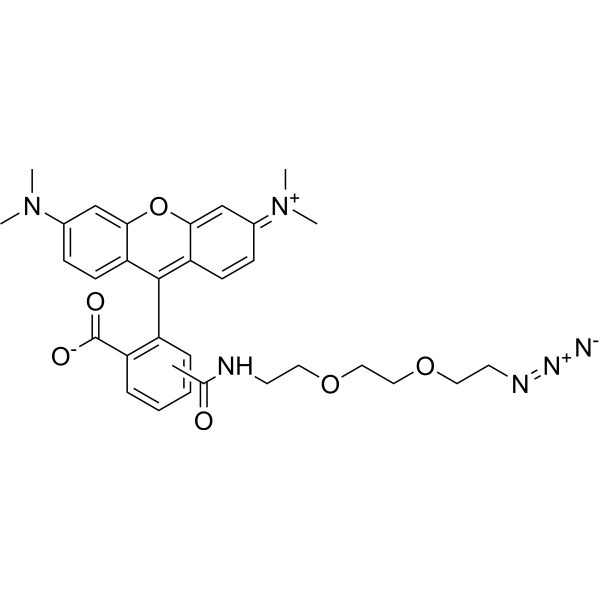 0 ImagesCat. No.: HY-D2111TAMRA-PEG2-N3 is a TAMRA (HY-135640) dye derivative containing 4 PEG units. TAMRA-PEG2-N3 undergoes copper-catalyzed azide-alkyne cycloaddition (CuAAc) with molecules containing an alkynyl group (N3). It also undergoes strain-promoted alkyne-azide cycloaddition (SPAAC) with molecules containing DBCO or BCN groups. It contains an azide group and can undergo copper-catalyzed azide-alkyne cycloaddition (CuAAc) with molecules containing alkyne groups. It can also undergo ring strain-promoted alkyne-azide cycloaddition (SPAAC) with molecules containing DBCO or BCN groups.
-
Concanavalin A-FITC
 0 ImagesCat. No.: HY-D3030Concanavalin A-FITC is a FITC (HY-66019)-labeled Concanavalin A (HY-P2149). Concanavalin A-FITC is a fluorescent probe and dye used to detect cell surface sugar-binding sites, oligosaccharide changes and track cell localization. Concanavalin A-FITC binds to α-D-glucose, α-D-mannose and mannose residues on cell surface glycoproteins, glycolipids and glycoconjugates, with fluorescence signals provided by FITC. Concanavalin A-FITC accumulates in perinuclear endoplasmic reticulum-related regions via endocytosis and localizes to mitochondria. The excitation/emission wavelength of Concanavalin A-FITC is Ex/Em = 488/>510 nm, and its emitted green fluorescence can be collected with a 530/30 nm filter during flow cytometry detection.
-
5-VIC Phosphoramidite
 0 ImagesCat. No.: HY-W10618475-VIC Phosphoramidite is a Fluorescent dye and a component of TaqMan probes for nucleic acid detection. 5-VIC Phosphoramidite serves as a 5' reporter dye, which is conjugated to probes targeting the conserved region of the S protein of porcine epidemic diarrhea virus genotype GII, and is used with Eclipse® Dark Quencher for duplex real-time quantitative PCR. 5-VIC Phosphoramidite-labeled probes targeting the Rv0222 gene in the RD4 region specific to Mycobacterium tuberculosis are applied in triplex droplet digital PCR to differentiate mycobacterial strains. During PCR amplification, the 5'→3' exonuclease activity of Taq polymerase mediates the separation of 5-VIC Phosphoramidite from the quencher, thereby generating a detectable fluorescent signal.
-
Biotin TSA(200×)
 0 ImagesCat. No.: HY-D1839Synonyms: Biotin TyramideBiotin TSA (200×) (Biotin Tyramide) is a biotin derivative used for tyramide signal amplification (TSA), as a reagent to amplify both immunohistochemical signals and in situ hybridization protocols. Biotinyl tyramide can be used for the research of tyramide signal amplification.




