



HDAC
Histone deacetylases
HDAC (Histone deacetylases) are a class of enzymes that remove acetyl groups (O=C-CH3) from an ε-N-acetyl lysine amino acid on ahistone, allowing the histones to wrap the DNA more tightly. This is important because DNA is wrapped around histones, and DNA expression is regulated by acetylation and de-acetylation. Its action is opposite to that of histone acetyltransferase. HDAC proteins are now also called lysine deacetylases (KDAC), to describe their function rather than their target, which also includes non-histone proteins. Together with the acetylpolyamine amidohydrolases and the acetoin utilization proteins, the histone deacetylases form an ancient protein superfamily known as the histone deacetylase superfamily.
HDAC Isoform Specific Products
-
HDAC
(387)
View all products
-
HDAC1
(312)
View all products
-
HDAC2
(207)
View all products
-
HDAC3
(200)
View all products
-
HDAC4
(71)
View all products
-
HDAC5
(56)
View all products
-
HDAC6
(326)
View all products
-
HDAC7
(53)
View all products
-
HDAC8
(185)
View all products
-
HDAC9
(41)
View all products
-
HDAC10
(64)
View all products
-
HDAC11
(70)
View all products
-
HD1
(3)
View all products
-
HD2
(4)
View all products
All Product Categories
-
HDAC Inhibitors
(769)
View all products
-
HDAC Antagonists
(3)
View all products
-
HDAC Activators
(14)
View all products
-
HDAC Modulators
(4)
View all products
-
HDAC MDM2 Inhibitor
(1)
View all products
-
HDAC Degraders
(41)
View all products
-
HDAC Controls
(3)
View all products
-
HDAC Substrates
(3)
View all products
-
HDAC Ligands
(10)
View all products
-
HDAC Related Products (897)
Related Products (897)

-
Antibodies (16)
-
HDAC Signaling Pathway
-
HDAC Isoform Comparison

-
HDAC1/6-IN-3
 0 ImagesCat. No.: HY-175176CAS No.: 3038691-85-6HDAC1/6-IN-3 is a potent HDAC inhibitor. HDAC1/6-IN-3 shows excellent inhibitory activities against HDAC1 (IC50 = 1.1 nM) and HDAC6 (IC50 = 2.7 nM). HDAC1/6-IN-3 significantly arrests HepG2 cells at the G0/G1 phase and induces apoptosis and pyroptosis. HDAC1/6-IN-3 exhibits significant antitumor activity in the HepG2 xenograft mode. HDAC1/6-IN-3 can be used for the study of cancers such as liver cancer, lung cancer, colon cancer and breast cancer.

-
Valproic acid magnesium
 0 ImagesCat. No.: HY-W794759CAS No.: 62959-43-7Synonyms: Magnesium valproate; VPA magnesium; 2-Propylpentanoic acid magnesiumValproic acid magnesium (Magnesium valproate) is an orally active HDAC inhibitor, with IC50 in the range of 0.5 and 2 mM. Valproic acid magnesium inhibits HDAC1 (IC50, 400 μM), and induces proteasomal degradation of HDAC2. Valproic acid magnesium activates Notch1 signaling and inhibits proliferation in small cell lung cancer (SCLC) cells. Valproic acid magnesium is used in the epilepsy, bipolar disorder, metabolic disease, HIV infection and prevention of migraine headaches.
-
HPO-DAEE
 0 ImagesCat. No.: HY-158205CAS No.: 1895934-61-8Synonyms: 4-Hydroperoxy-2-decenoic acid ethyl esterHPO-DAEE (4-Hydroperoxy-2-decenoic acid ethyl ester) elicits nuclear accumulation of Nrf2 and activated antioxidant response element (ARE). HPO-DAEE induces antioxidant genes upregulation (eg: HO-1) through Nrf2-ARE signaling. HPO-DAEE induces reactive oxygen species generation. HPO-DAEE also inhibits histone deacetylase and upregulate expression of extracellular superoxide dismutase via histone acetylation. HPO-DAEE protects against 6-hydroxydopamine-induced cell death via activation of Nrf2-ARE and eIF2α-ATF4 pathways.
-
Leuxinostat
 0 ImagesCat. No.: HY-162658Leuxinostat is an inhibitor for HDAC with IC50 of 30 nM for hHDAC6. Leuxinostat inhibits the proliferation of cells THP1, K562, U937 and MEK1, induces apoptosis in leukemia cells NB4 and MOLT-4. Leuxinostat inhibits the expansion of hematopoietic stem cells and exhibits antileukemic activity in zebrafish models.
-
HDAC degrader-2
 0 ImagesCat. No.: HY-178161HDAC degrader-2 is a selective HDAC degrader with a DC50 values of 2.55 μM against HDAC1. HDAC degrader-2 effectively induces the degradation of HDAC1 and HDAC2, but has no significant effect on the degradation of HDAC3, 4, 6 and 8. HDAC degrader-2 exerts potent antiproliferative effects against MM.1S and MCF-7 cells. HDAC degrader-2 induces apoptosis in myeloma cells. HDAC degrader-2 can be used for the study of myeloma.
-
HDAC-IN-64
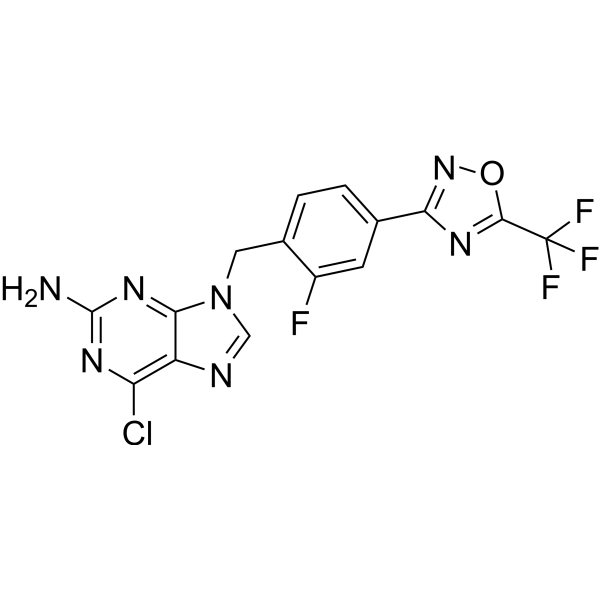 0 ImagesCat. No.: HY-156003CAS No.: 3052688-17-9HDAC-IN-64 (Compound 13) is a HDAC inhibitor. HDAC-IN-64 inhibits HDAC4/5/6/7/9 with IC50s of 24, 45, 85, 31, 37 nM. HDAC-IN-64 has anti-proliferative activity and anti-migration properties on prostate cancer (PCA) cells. HDAC-IN-64 inhibits LNCaP and RWPE-1 cell growth with GI50 of 0.32 and 1.1 μM respectively.

-
Nanatinostat TFA
 0 ImagesCat. No.: HY-13432ACAS No.: 1256448-48-2Synonyms: CHR-3996 TFANanatinostat (CHR-3996) TFA is a potent, class I selective and orally active HDAC inhibitor with IC50s of 3 nM, 4 nM, and 7 nM for HDAC1, HDAC2, and HDAC3, respectively. Nanatinostat TFA has low activity against HDAC5 (IC50 of 200 nM) and HDAC6 (IC50 of 2100 nM). Nanatinostat TFA induces apoptosis in myeloma cells. Nanatinostat TFA has potent anticancer effects, such as myeloma, advanced solid tumours and colorectal cancer.
-
CM-414
 0 ImagesCat. No.: HY-119316CAS No.: 2007971-51-7CM-414 is a brain-penetrant phosphodiesterase 5 (PDE5) and HDAC inhibitor with IC50s of 60 nM, 91 nM, 310 nM, 322 nM and 490 nM for PDE5, HDAC6, HDAC1, HDAC3 and HDAC2, respectively. CM-414 diminishes brain Aβ and tau phosphorylation (pTau) level in Tg2576 mice. CM-414 can be used for the study of Alzheimer's disease (AD).

-
PROTAC HDAC3 degrader-1
 0 ImagesCat. No.: HY-181767PROTAC HDAC3 degrader-1 is a selective PROTAC degrader targeting HDAC3 with a DC50 of 30.73 nM. PROTAC HDAC3 degrader-1 induces degradation of HDAC3 via the ubiquitin-proteasome system. PROTAC HDAC3 degrader-1 promotes apoptosis, induces DNA damage, and downregulates anti-apoptotic proteins Mcl-1 and Bcl-xL. PROTAC HDAC3 degrader-1 can be used for the research of acute myeloid leukemia.
-
PTERi
 0 ImagesPTERi is a selective inhibitor of PTER with selectivity towards HDACs. PTERi increases the level of N-acetyltaurine in both lean and obese mice, and reduces food intake in obese mice. PTERi can be used in the research of obesity.

-
H8-A5
 0 ImagesCat. No.: HY-117093CAS No.: 423731-10-6H8-A5 is a novel human histone deacetylase 8 (HDAC8) inhibitor. A highly specific ZBG-based pharmacophore model was developed by incorporating a custom zinc-binding group (ZBG) feature. Pharmacophore-based virtual screening identified three novel HDAC8 inhibitors with low micromolar IC50 values (1.8-1.9 μM). Further studies showed that H8-A5 was more selective for HDAC8 than HDAC1/4 and exhibited antiproliferative activity in MDA-MB-231 cancer cells. Molecular docking and molecular dynamics studies showed that H8-A5 could bind to HDAC8, providing a good starting point for the development of HDAC8 inhibitors for cancer treatment.
-
MC2625
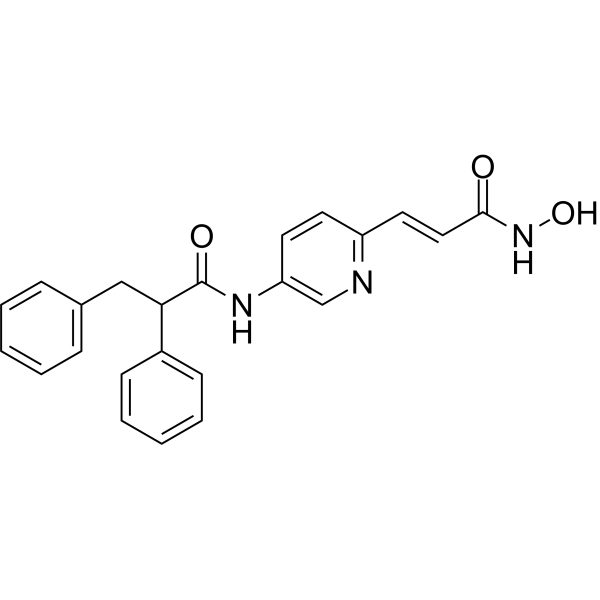 0 ImagesCat. No.: HY-152225CAS No.: 1776116-75-6MC2625 is a potent pyridine-containing histone deacetylase (HDAC) inhibitor. MC2625 show selective HDAC3 and HDAC6 inhibition with IC50s of 80 nM and 11 nM. MC2625 increases acetyl-H3 and acetyl-tubulin levels and inhibits cancer stem cells (CSCs) growth by apoptosis induction.
-
HDAC6-IN-37
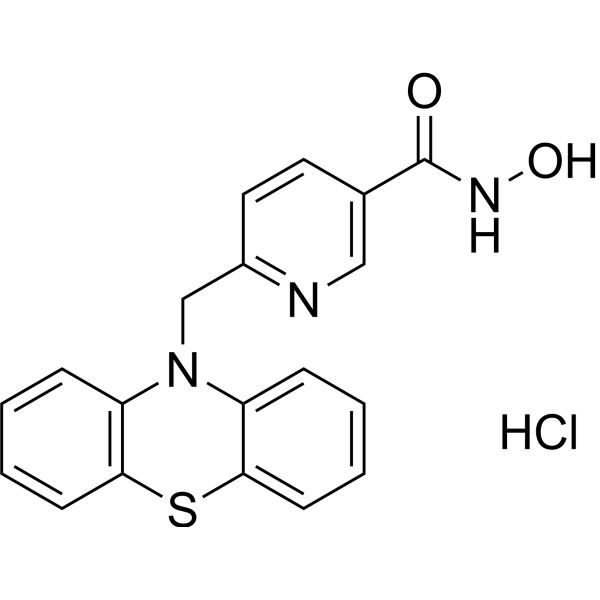 0 ImagesCat. No.: HY-158030CAS No.: 2986486-82-0HDAC6-IN-37 (compound W5) is an inhibitor of HDAC6 and has neuroprotective effects. HDAC6-IN-37 can restore the morphology of hippocampal neurons, reduce the expression of Aβ, Tau, and p-Tau proteins in the hippocampus of AD rats, and inhibit the formation of senile plaques and neurofibrillary tangles. Thus, HDAC6-IN-37 improves the Aβ/Cu2+-induced AD model in rats, regulates oxidative stress status, and balances neurotransmitter disorders in brain tissue.
-
IOR-160
 0 ImagesCat. No.: HY-176561CAS No.: 2421119-78-8IOR-160 is a dual inhibitor of casein kinase 2 (CK2) and HDACs. IOR-160 exhibits high selectivity for CK2 (IC50 = 1.7 nM) and broad inhibitory activity against HDAC (HDAC 1, 2, 3, and 6 with IC50s of 3.3 nM, 24.0 nM, 3.9 nM, and 13.0 nM, respectively, with low activity for HDAC8). IOR-160 modulates key cellular signaling pathways by inhibiting AKT phosphorylation and increasing acetylated α-tubulin. IOR-160 inhibits tumor growth and reduces tumor burden through dual CK2/HDAC inhibition. IOR-160 is indicated for use in triple-negative breast cancer research.
-
HDAC6-IN-69
 0 ImagesCat. No.: HY-180214HDAC6-IN-69 is a brain-penetrant and highly selective HDAC6 inhibitor with an IC50 of 4.0 nM. HDAC6-IN-69 shows >176-fold against other HDAC isoforms. HDAC6-IN-69 engages the target in neuronal cells by dose-dependently upregulating acetylated α-tubulin in virto. HDAC6-IN-69 has neuroprotective effect and can be used for ischemic stroke research .




