



HDAC
Histone deacetylases
HDAC (Histone deacetylases) are a class of enzymes that remove acetyl groups (O=C-CH3) from an ε-N-acetyl lysine amino acid on ahistone, allowing the histones to wrap the DNA more tightly. This is important because DNA is wrapped around histones, and DNA expression is regulated by acetylation and de-acetylation. Its action is opposite to that of histone acetyltransferase. HDAC proteins are now also called lysine deacetylases (KDAC), to describe their function rather than their target, which also includes non-histone proteins. Together with the acetylpolyamine amidohydrolases and the acetoin utilization proteins, the histone deacetylases form an ancient protein superfamily known as the histone deacetylase superfamily.
HDAC Isoform Specific Products
-
HDAC
(388)
View all products
-
HDAC1
(312)
View all products
-
HDAC2
(208)
View all products
-
HDAC3
(200)
View all products
-
HDAC4
(71)
View all products
-
HDAC5
(56)
View all products
-
HDAC6
(326)
View all products
-
HDAC7
(53)
View all products
-
HDAC8
(185)
View all products
-
HDAC9
(41)
View all products
-
HDAC10
(65)
View all products
-
HDAC11
(70)
View all products
-
HD1
(3)
View all products
-
HD2
(4)
View all products
All Product Categories
-
HDAC Inhibitors
(771)
View all products
-
HDAC Antagonists
(3)
View all products
-
HDAC Activators
(14)
View all products
-
HDAC Modulators
(4)
View all products
-
HDAC MDM2 Inhibitor
(1)
View all products
-
HDAC Degraders
(41)
View all products
-
HDAC Controls
(3)
View all products
-
HDAC Substrates
(3)
View all products
-
HDAC Ligands
(10)
View all products
-
HDAC Related Products (900)
Related Products (900)

-
Antibodies (16)
-
HDAC Signaling Pathway
-
HDAC Isoform Comparison
-
HDAC6-IN-45
 0 ImagesCat. No.: HY-161783CAS No.: 3048532-05-1HDAC6-IN-45 (Compound 15) is a selective inhibitor for HDAC6 with IC50 of 15.2 nM. HDAC6-IN-45 exhibits neurotrophic through the upregulation of GAP43 and Beta-3 tubulin markers. HDAC6-IN-45 activates the Nrf2 signaling pathway, reduces H2O2-induced ROS production, inhibits apoptosis in PC12, and exhibits neuroprotective efficacy in SCOP-induced zebrafish Alzheimer's Disease models. HDAC6-IN-45 exhibits antioxidant activity and good blood-brain barrier (BBB) permeability.

-
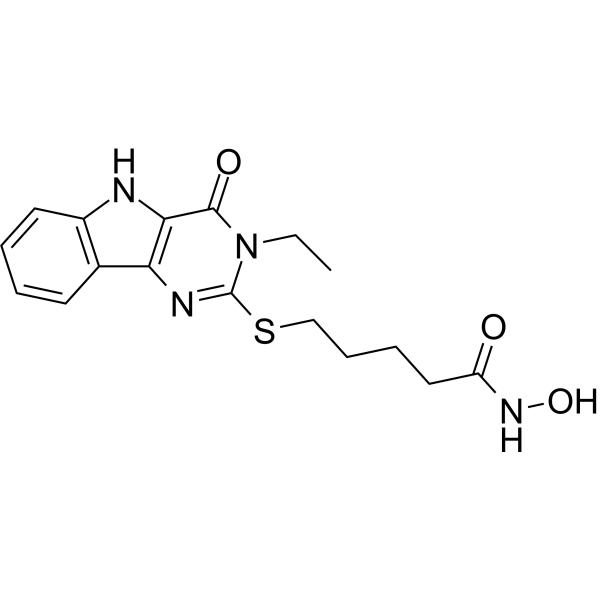
PD-L1/HDAC6-IN-1 TFA
 0 ImagesCat. No.: HY-172200APurity: 99.55%PD-L1/HDAC6-IN-1 TFA is an orally active dual inhibitor of PD-L1 and HDAC6, with IC50 values of 26.8 nM and 78 nM, respectively. PD-L1/HDAC6-IN-1 TFA binds to human and murine PD-L1 proteins with high affinity, while it reduces STAT3 phosphorylation and downregulates PD-L1 expression by inhibiting HDAC6, thus blocking the PD-1/PD-L1 interaction. PD-L1/HDAC6-IN-1 TFA exhibits potent anti-tumor activity in a mouse melanoma model. PD-L1/HDAC6-IN-1 is suitable for research on tumor immune regulation related to melanoma.

-
sEH/HDAC6-IN-1
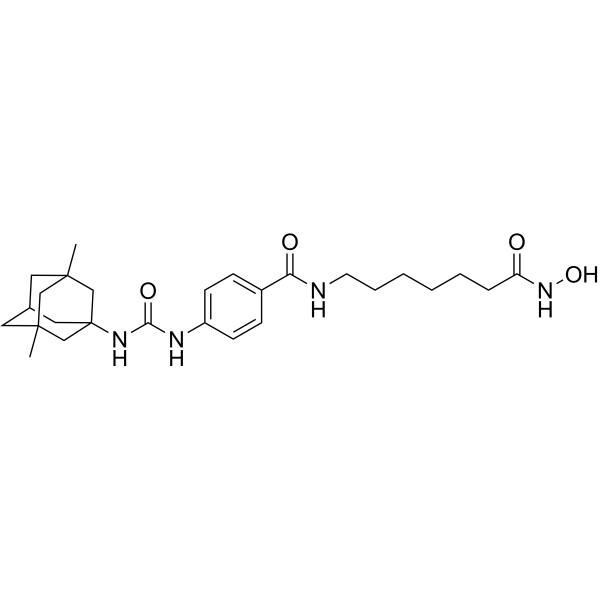 0 ImagesCat. No.: HY-163207CAS No.: 2847838-67-7
-
HDAC6-IN-38
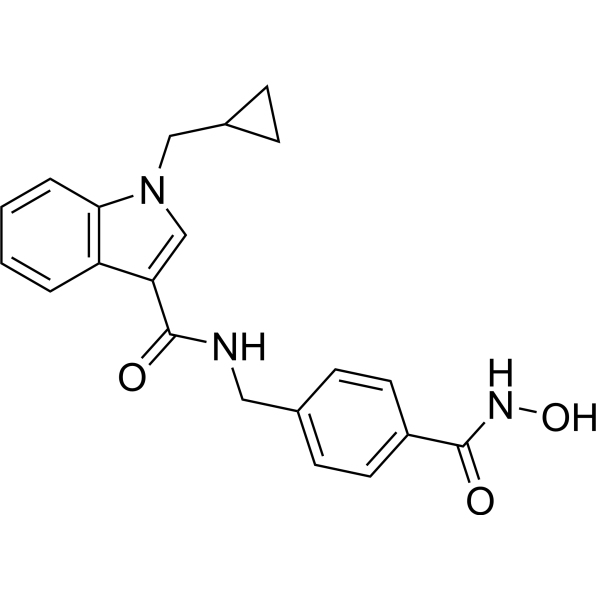 0 ImagesCat. No.: HY-163503CAS No.: 3030872-95-5HDAC6-IN-38 (Compound Z-7) is an inhibitor for histone deacetylase 6 (HDAC6), with an IC50 of 3.25 nM. HDAC6-IN-38 inhibits proliferation of cells MGC 803.
-
HDAC-IN-92
 0 ImagesCat. No.: HY-175857HDAC-IN-92 is a pan-HDAC inhibitor with an IC50 of 12.58 µM in A2780 cells. HDAC-IN-92 demonstrates broad-spectrum, notable cytotoxic activity against a range of human cancer cell lines, including ovarian, liver, and breast carcinomas. HDAC-IN-92 causes apoptosis and demonstrates a notable decrease in tumor cell colony formation. HDAC-IN-92 inhibits the formation of blood vessels in the chick chorioallantoic membrane (CAM). HDAC-IN-92 exhibits anti-tumor effect in a 4T1 tumor-bearing mouse model. HDAC-IN-92 can be used for research targeting solid tumor.
-
SH-17
 0 ImagesCat. No.: HY-187212SH-17 is a STAT3 and HDAC inhibitor, with a Kd of 0.87 μM for STAT3, and IC50 values of 115.2 nM and 9.8 nM for HDAC1 and HDAC6, respectively. SH-17 blocks intracellular ATP production and mitochondrial oxidative phosphorylation, induces cell cycle arrest at the G0/G1 phase, and triggers apoptosis. SH-17 is applicable to colon cancer research.
-
Valproic acid sodium (GMP)
 0 ImagesCat. No.: HY-10585AGCAS No.: 1069-66-5Synonyms: Sodium Valproate (GMP); VPA sodium (GMP); 2-Propylpentanoic acid sodium (GMP)Valproic acid (Sodium Valproate) sodium is an orally active HDAC inhibitor, with IC50 in the range of 0.5 and 2 mM, also inhibits HDAC1 (IC50, 400 μM), and induces proteasomal degradation of HDAC2. Valproic acid sodium activates Notch1 signaling and inhibits proliferation in small cell lung cancer (SCLC) cells. Valproic acid sodium is used in the treatment of epilepsy, bipolar disorder, metabolic disease, HIV infection and prevention of migraine headaches.
-
ZINC000028464438
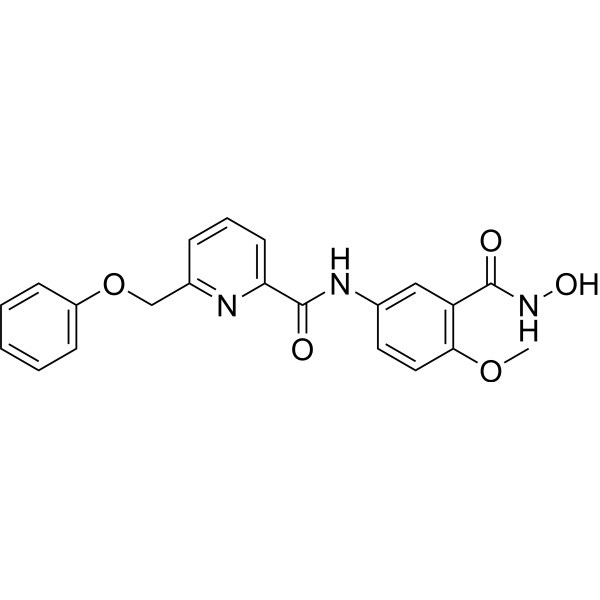 0 ImagesCat. No.: HY-157889CAS No.: 866123-66-2

-
HDAC/Top-IN-1
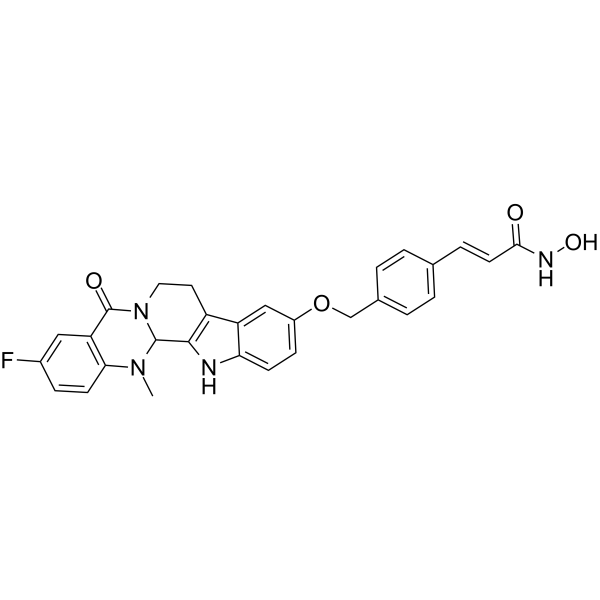 0 ImagesCat. No.: HY-144654CAS No.: 2411379-14-9HDAC/Top-IN-1 is an orally active and pan HDAC/Top dual inhibitor with IC50s of 0.036 μM, 0.14 μM, 0.059 μM, 0.089 μM and 9.8 μM for HDAC1, HDAC2, HDAC3, HDAC6 and HDAC8. HDAC/Top-IN-1 efficiently induces apoptosis with S cell-cycle arrest in HEL cells. HDAC/Top-IN-1 has exhibits excellent in vivo antitumor efficacy.
-
GV-001
 0 ImagesCat. No.: HY-182904CAS No.: 3082707-76-1GV-001 is a selective and orally active HDAC6 inhibitor with an IC50 of 1.18 nM against HDAC6. GV-001 selectively enhances α-tubulin acetylation, reduces sIL-6 and Collagen I levels, suppresses renal cyst growth, and upregulates PC1 expression. GV-001 can be used for the study of autosomal dominant polycystic kidney disease (ADPKD).
-
FLT3/HDAC-IN-3
 0 ImagesCat. No.: HY-181086CAS No.: 2864394-30-7FLT3/HDAC-IN-3 is a dual inhibitor of FLT3 and HDAC. FLT3/HDAC-IN-3 potently inhibits FLT3 (IC50 = 14 nM), HDAC1 (IC50 = 27 nM), HDAC6 (IC50 = 20 nM), and FLT3D853Y (IC50 = 55 nM), exhibits weak activity against HDAC8, and shows no activity against HDAC4. FLT3/HDAC-IN-3 possesses kinase selectivity, plasma stability, and stability in human liver microsomes. FLT3/HDAC-IN-3 demonstrates anti-proliferative effects in a variety of hematological malignancy cell lines. FLT3/HDAC-IN-3 shows efficacy in the Jeko-1 xenograft model without observed significant toxicity. FLT3/HDAC-IN-3 can be used in the study of hematological malignancies.
-
HDAC6-IN-51
 0 ImagesCat. No.: HY-169226CAS No.: 2994634-78-3HDAC6-IN-51 (Compound 7e) is a selective HDAC6 inhibitor with an IC50 value of 42.9 nM. HDAC6-IN-51 exhibits good anti-lung fibrosis activity.
-
Andrographidine E
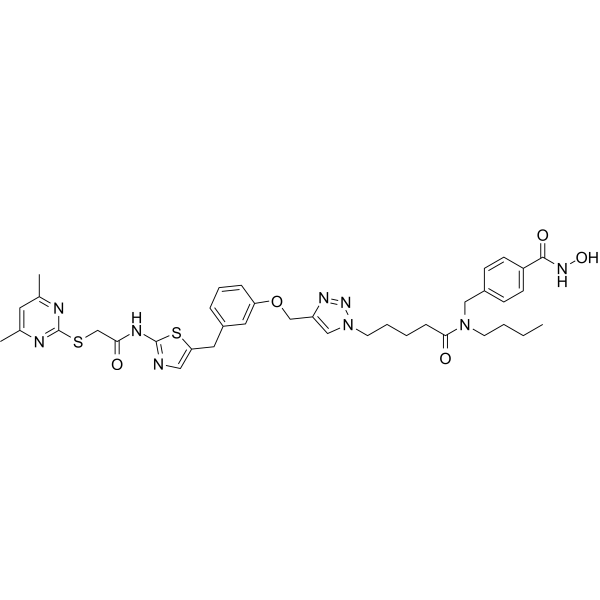
 0 ImagesCat. No.: HY-N16881CAS No.: 113963-41-0
-
KTT-1
 0 ImagesCat. No.: HY-179216CAS No.: 2397562-26-2KTT-1 is a kinetically selective and orally active HDAC2 inhibitor. KTT-1 exhibits high HDAC2-selectivity over HDAC1. KTT-1 inhibits osteoclast differentiation at an early stage by downregulating c-Fos expression. KTT-1 effectively suppresses arthritis symptoms in the collagen-induced arthritis (CIA) mouse model. KTT-1 can be used for the research of rheumatoid arthritis and neurodegenerative diseases.
-
sEH/HDAC6-IN-2
 0 ImagesCat. No.: HY-159171CAS No.: 3009011-58-6sEH/HDAC6-IN-2 is a potent dual soluble epoxide hydrolase (sEH) and HDAC6 inhibitor with IC50s of 0.9 nM, 46.8 nM, and 8 nM for human sEH, mouse sEH, and HDAC6, respectively. sEH/HDAC6-IN-2 can be used for the study of inflammatory pain.




