



Angiopoietin 1 Antibody
Angiopoietin 1 Antibody is a Rabbit-derived and non-conjugated IgG polyclonal antibody, targeting to Angiopoietin 1.
-
Host:
Rabbit
-
Isotype:
IgG
-
Application:
WB, IHC-P
-
Reactivity :
Human, Rat
-
Formulation:
Supplied in PBS with 0.05% sodium azide,0.5%BSA and 50% glycerol.
-
Conjugation:
Non-conjugated


To place orders, for customer services and technical support, please contact: MedChemExpress USA
Tel: 609-228-6898 E-mail: [email protected] [email protected]





Applications
| Application |
WB

WB: Western Blot
|
IHC-P
IHC-P: Immunohistochemistry-Paraffin
|
|---|---|---|
| Dilution Ratio | 1:500-1:1000 | 1:50-1:100 |


Product Details
Angiopoietin 1 Antibody is a Rabbit-derived and non-conjugated IgG polyclonal antibody, targeting to Angiopoietin 1.
-
Host Rabbit

-
Clonality Polyclonal

-
Species ReactivityHuman, Rat
-
Observed Molecular WeightObserved band size: 55 kDa
Note: Due to possible protein modifications or aggregation, the molecular weight should be confirmed by actual measurement, and the predicted value is for reference only.

-
Calculated Molecular Weight Predicted band size: 55 kDa

SwissProt: Q15389 Human ; O08538 Mouse ; O35460 Rat
OMIM: 619361 Human
The antiserum was produced against synthesized peptide derived from the N-terminal region of human ANGPT1.
Endogenous
Non-conjugated
Unmodified
IgG


Product Properties
-
Appearance
Liquid
-
Formulation
Supplied in PBS with 0.05% sodium azide,0.5%BSA and 50% glycerol.
-
Storage & Stability
Stored at -20°C for 1 year. Avoid repeated freeze / thaw cycles.
-
Shipping
Shipping with blue ice.


Verification Images
-
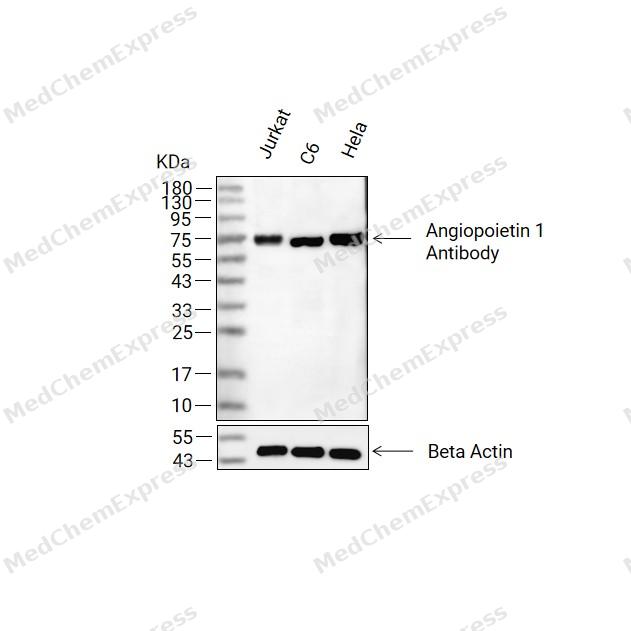 Western blot analysis of extracts from Jurkat(lane 2(20ug) , C6(lane 3(20ug) and Hela(lane 4(20ug)using Angiopoietin 1 Antibody (HY-P81847) Rabbit mAb. Proteins were transferred to a PVDF membrane and blocked with 5% non-fat milk in TBST for 2 hour at room temperature. The primary antibody (1/1000) and Loading control antibody (Beta Actin, HY-P83730, 1/10000) was used in 5% non-fat milk in TBST at 4°C overnight. Goat Anti-Mouse IgG-HRP Secondary Antibody (1/10000) was used for 1 hour at room temperature.


Background
-
Function
Angiopoietin 1 binds and activates TEK/TIE2 receptor by inducing its dimerization and tyrosine phosphorylation. Plays an important role in the regulation of angiogenesis, endothelial cell survival, proliferation, migration, adhesion and cell spreading, reorganization of the actin cytoskeleton, but also maintenance of vascular quiescence. Required for normal angiogenesis and heart development during embryogenesis. After birth, activates or inhibits angiogenesis, depending on the context. Inhibits angiogenesis and promotes vascular stability in quiescent vessels, where endothelial cells have tight contacts. In quiescent vessels, ANGPT1 oligomers recruit TEK to cell-cell contacts, forming complexes with TEK molecules from adjoining cells, and this leads to preferential activation of phosphatidylinositol 3-kinase and the AKT1 signaling cascades. In migrating endothelial cells that lack cell-cell adhesions, ANGT1 recruits TEK to contacts with the extracellular matrix, leading to the formation of focal adhesion complexes, activation of PTK2/FAK and of the downstream kinases MAPK1/ERK2 and MAPK3/ERK1, and ultimately to the stimulation of sprouting angiogenesis. Mediates blood vessel maturation/stability. Implicated in endothelial developmental processes later and distinct from that of VEGF. Appears to play a crucial role in mediating reciprocal interactions between the endothelium and surrounding matrix and mesenchyme
-
Subcellular Localization
Secreted
-
Isoforms & Post-Translational Modification
Q15389 has 2 isomers: Q15389-1: 57513 Da (predicted); Q15389-2: 57456 Da (predicted).
Glycosylated -
Subunit
Homooligomer (PubMed:28601681). Interacts with TEK/TIE2 (PubMed:28601681, PubMed:30689269). Interacts with SVEP1/polydom (By similarity). Interacts with THBD; this interaction significantly inhibits the generation of activated PC and TAFIa/CPB2 by the thrombin/thrombomodulin complex (PubMed:29323190)
-
SwissProt ID
-
Research Field
Cancer


Documentation

 Powered by Bioz
