



Hsp70 Antibody (YA359)

Based on 1 Customer Validation
Hsp70 Antibody (YA359) is a Rabbit-derived and non-conjugated IgG monoclonal antibody, targeting to Hsp70.
-
Host:
Rabbit
-
Isotype:
IgG
-
Application:
WB, ICC/IF, IHC-P, FC
-
Reactivity :
Human, Mouse, Rat
-
Formulation:
Supplied in 1*TBS (pH7.4), 0.05% BSA and 40% Glycerol. Preservative: 0.05% Sodium Azide.
-
Conjugation:
Non-conjugated


To place orders, for customer services and technical support, please contact: MedChemExpress USA
Tel: 609-228-6898 E-mail: [email protected] [email protected]



-

HY-P81072
LIAS Antibody -
HY-P80935
xCT Antibody (YA006) -
HY-P82260
ADX/FDX1 Antibody (YA2005) -
HY-P81070
Pyruvate Dehydrogenase E2 Antibody (YA912) -
HY-P80450
GPX4 Antibody (YA399) -
HY-P81071
DLST Antibody -
HY-P80412
Hsp70 Antibody (YA728) -
HY-P80608
CD81 Antibody (YA525) -
HY-P80714
Hsp90 alpha/beta Antibody (YA356)


Applications
| Application |
WB

WB: Western Blot
|
ICC/IF
ICC/IF: Immunocytochemistry/
Immunofluorescence |
IHC-P
IHC-P: Immunohistochemistry-Paraffin
|
FC
FC: Flow Cytometry
|
|---|---|---|---|---|
| Dilution Ratio | 1:500 | 1:50 | 1:50-1:500 | 1:50 |


Product Details
Hsp70 Antibody (YA359) is a Rabbit-derived and non-conjugated IgG monoclonal antibody, targeting to Hsp70.
-
Host Rabbit

-
Clonality Recombinant,Monoclonal

-
Species ReactivityHuman, Mouse, Rat
-
Observed Molecular WeightObserved band size: 70 kDa
Note: Due to possible protein modifications or aggregation, the molecular weight should be confirmed by actual measurement, and the predicted value is for reference only.

-
Calculated Molecular Weight Predicted band size: 70 kDa

Entrez Gene: 15511 Human ; 3303 Human ; 193740 Mouse ; 3304 Mouse ; 24472 Rat 294254
SwissProt: P0DMV8 Human ; P0DMV9 Human ; P17879 Mouse ; Q61696 Mouse ; P0DMW0 Rat P0DMW1
OMIM: 140550 Human
Synthetic peptide corresponding to Human Hsp70.AA range:403-641.
Endogenous
Protein A affinity purified.
Non-conjugated
Unmodified
IgG


Product Properties
-
Appearance
Solution
-
Formulation
Supplied in 1*TBS (pH7.4), 0.05% BSA and 40% Glycerol. Preservative: 0.05% Sodium Azide.
-
Concentration
Batch-dependent, Please check the COA for the concentration of each lot. Check Lot Concentration
-
Storage & Stability
Stored at -20°C for 1 year. Avoid repeated freeze / thaw cycles.
-
Shipping
Shipping with blue ice.


Verification Images
-
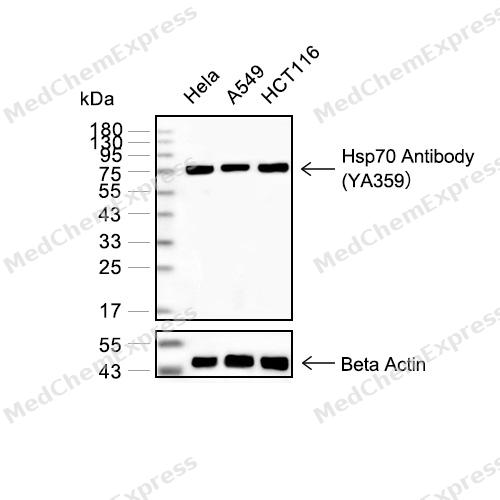 Western blot analysis of extracts from Hela(lane 2(20μg) , A549(lane 3(20μg) and HCT116(lane 4(20ug) using Hsp70(HY-P80185 Rabbit mAb. Proteins were transferred to a PVDF membrane and blocked with 5% non-fat milk in TBST for 2 hour at room temperature. The primary antibody (1/1000) and Loading control antibody (Beta Actin, HY-P80438, 1/10000) was used in 5% non-fat milk in TBST at 4°C overnight. Goat Anti-Mouse/Rabbit IgG-HRP Secondary Antibody (1/10000) was used for 1 hour at room temperature.
 -
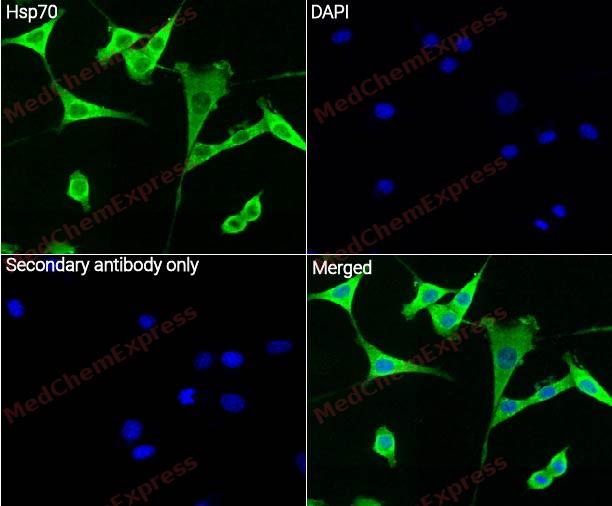 Immunocytochemistry analysis of NIH/3T3 cells labeling Hsp70 with Hsp70 Antibody (HY-P80185)at 1/50 dilution. Cells were fixed in 4% paraformaldehyde for 15 minutes at room temperature, permeabilized with 0.1% Triton X-100 for 10 minutes at room temperature, then blocked with QuickBlock™ Blocking Buffer for Immunol Staining for 10 min at room temperature. Cells were then incubated with Hsp70 Antibody (HY-P80185) at 1/50 dilution in QuickBlock™ Blocking Buffer for Immunol Staining at 4 ℃. Alexa Fluor® 488-conjugated AffiniPure Goat Anti-Rabbit IgG H&L(HY-P8002, Green) was used as the secondary antibody at 1/1,000 dilution. PBS instead of the primary antibody was used as the secondary antibody only control. The Nuclear counterstain was DAPI (Blue).
 -
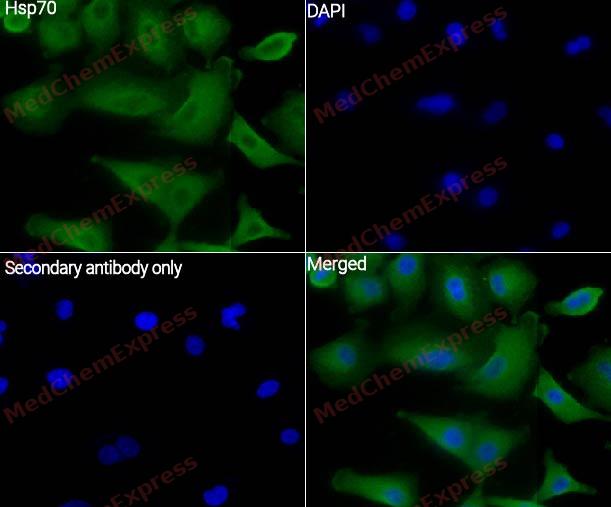 Immunocytochemistry analysis of A549 cells labeling Hsp70 with Hsp70 Antibody (HY-P80185)at 1/50 dilution. Cells were fixed in 4% paraformaldehyde for 15 minutes at room temperature, permeabilized with 0.1% Triton X-100 for 10 minutes at room temperature, then blocked with QuickBlock™ Blocking Buffer for Immunol Staining for 10 min at room temperature. Cells were then incubated with Hsp70 Antibody (HY-P80185) at 1/50 dilution in QuickBlock™ Blocking Buffer for Immunol Staining at 4 ℃. Alexa Fluor® 488-conjugated AffiniPure Goat Anti-Rabbit IgG H&L(HY-P8002, Green) was used as the secondary antibody at 1/1,000 dilution. PBS instead of the primary antibody was used as the secondary antibody only control. The Nuclear counterstain was DAPI (Blue).
 -
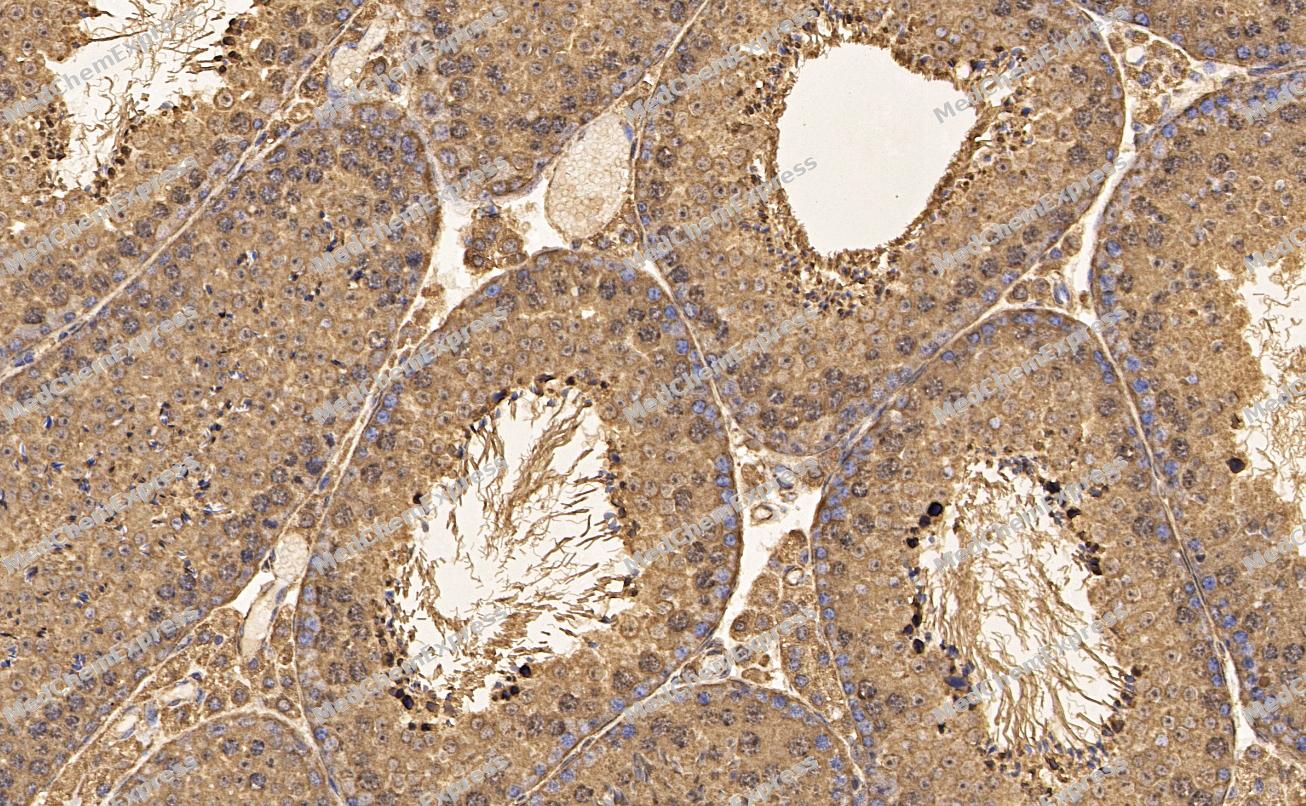 Immunohistochemical analysis of paraffin-embedded Mouse testis tissue using Hsp70 Antibody (YA359). The section was pre-treated using heat mediated antigen retrieval with Tris-EDTA buffer (pH 9.0) for 8 minutes. The tissues were blocked in QuickBlock for 20 minutes at room temperature, washed with ddH2O and PBS, and then probed with the primary antibody (HY-P80185, 1/500) in 4℃ overnight. The detection was performed using an HRP conjugated compact polymer system. DAB was used as the chromogen. Tissues were counterstained with hematoxylin and mounted with DPX.
 -
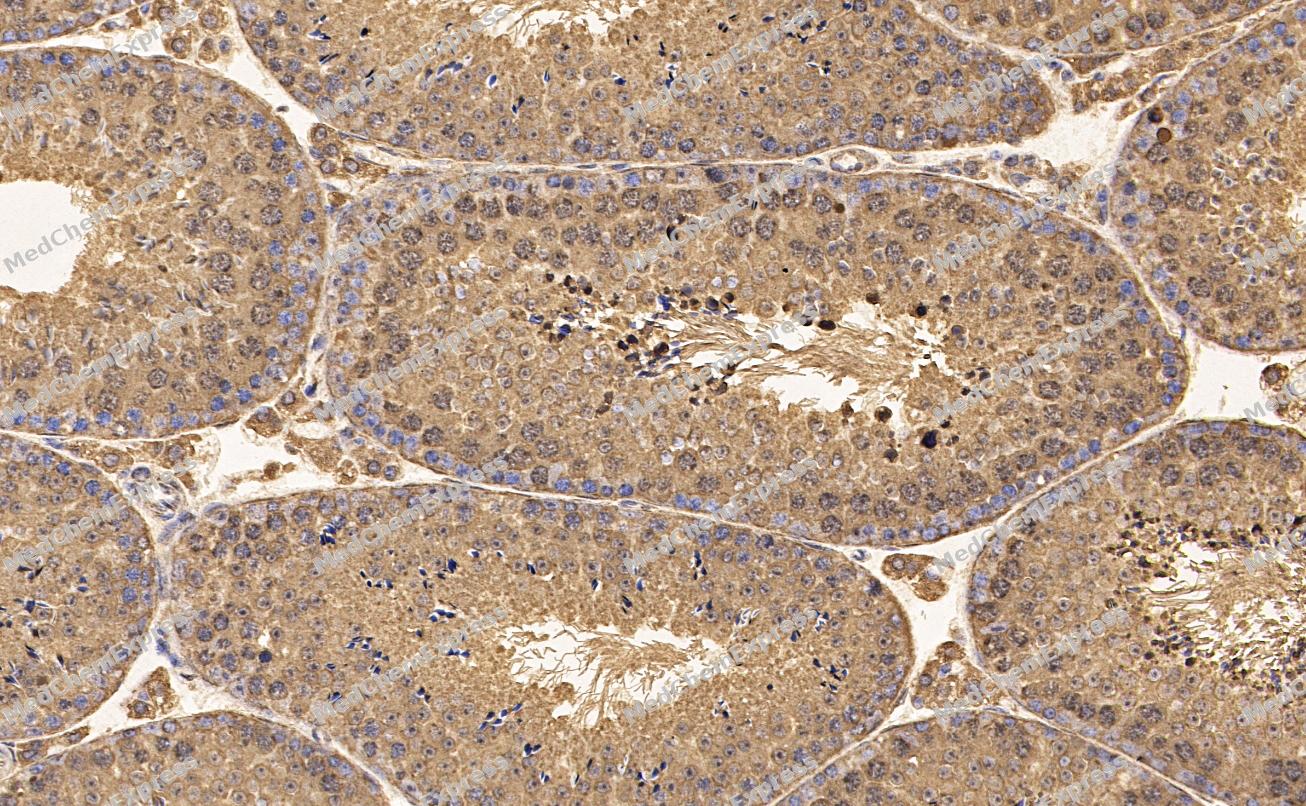 Immunohistochemical analysis of paraffin-embedded Mouse testis tissue using Hsp70 Antibody (YA359). The section was pre-treated using heat mediated antigen retrieval with Tris-EDTA buffer (pH 9.0) for 8 minutes. The tissues were blocked in QuickBlock for 20 minutes at room temperature, washed with ddH2O and PBS, and then probed with the primary antibody (HY-P80185, 1/500) in 4℃ overnight. The detection was performed using an HRP conjugated compact polymer system. DAB was used as the chromogen. Tissues were counterstained with hematoxylin and mounted with DPX.
 -
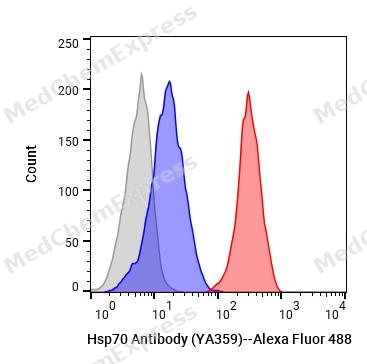 Flow cytometric analysis of 1X10^6 A549 cells labeling Hsp70 Antibody (YA359) (HY-P80185, red). Cells were fixed with 4% paraformaldehyde. Then stained with the primary antibody at 1/50 dilution for an hour at 4℃. Alexa Fluor® 488-conjugated AffiniPure Goat Anti-Rabbit IgG H&L (HY-P8002) was used as the secondary antibody at 1/1,000 dilution for 30 minutes at 4℃. Rabbit IgG Isotype Control (HY-P80879, blue) was used as the isotype control, cells without incubation with primary antibody were used as the unlabeled control (black).


Background
-
Function
HSP70 (Heat Shock Protein 70) is a highly conserved ATP-dependent molecular chaperone that maintains proteostasis by promoting protein folding, preventing aggregation of misfolded proteins, facilitating protein complex remodeling, and supporting protein translocation across cellular membranes[1][2]. Mechanistically, HSP70 functions through an ATP-regulated chaperone cycle in which substrate recognition, ATP hydrolysis, and co-chaperone interactions determine whether client proteins are refolded or directed toward degradation pathways[1]. This central role links HSP70 to cellular stress adaptation, because its expression increases in response to environmental and physiological stressors and helps preserve protein homeostasis under conditions that promote protein damage[3][4]. In disease models, impaired proteostasis and reduced chaperone capacity are associated with the accumulation of toxic misfolded proteins, whereas enhanced HSP70 activity has been linked to reduced protein aggregation, inflammation, and neuronal loss in neurodegenerative disorders including Alzheimer’s disease, Parkinson’s disease, Huntington’s disease, and amyotrophic lateral sclerosis[5]. Compared with related heat shock protein families such as HSP90, HSP70 is distinguished by its direct engagement with unfolded polypeptides and its prominent role in determining protein refolding versus degradation outcomes through co-chaperone-dependent quality-control mechanisms[1]. For experimental applications, HSP70 has become an important therapeutic research target, and both pharmacological modulators and recombinant HSP70-based approaches are widely investigated to manipulate proteostasis, cytoprotection, and stress-response pathways in models of neurodegenerative, inflammatory, and other protein-misfolding-associated diseases[1][6].
-
Subcellular Localization
Cytoplasm; Cytoplasm, cytoskeleton, microtubule organizing center, centrosome
-
Expression
Tissue_specificity:HSPA1B is testis-specific.
Induction:By heat shock -
Subunit
May be an auxiliary component of the CatSper complex. Identified in a IGF2BP1-dependent mRNP granule complex containing untranslated mRNAs (PubMed:17289661). Interacts with CHCHD3, DNAJC7, IRAK1BP1, PPP5C and TSC2 (PubMed:12853476, PubMed:15383005, PubMed:15963462, PubMed:17233114, PubMed:18620420, PubMed:21081504). Interacts with TERT; the interaction occurs in the absence of the RNA component, TERC, and dissociates once the TERT complex has formed (PubMed:11274138). Interacts with TRIM5 (via B30.2/SPRY domain) (PubMed:20053985). Interacts with METTL21A (PubMed:23921388). Interacts with PRKN (PubMed:24270810). Interacts with FOXP3 (PubMed:23973223). Interacts with NOD2; the interaction enhances NOD2 stability (PubMed:24790089). Interacts with DNAJC9 (via J domain) (PubMed:17182002, PubMed:33857403). Interacts with ATF5; the interaction protects ATF5 from degradation via proteasome-dependent and caspase-dependent processes (PubMed:22528486). Interacts with NAA10, HSP40, HSP90 and HDAC4. The acetylated form and the non-acetylated form interact with HOPX and STUB1 respectively (PubMed:27708256). Interacts with NEDD1 (PubMed:27137183). Interacts (via NBD) with BAG1, BAG2, BAG3 and HSPH1/HSP105 (PubMed:24318877). Interacts with SMAD3 (PubMed:24613385). Interacts with DNAJC8 (PubMed:27133716)
-
SwissProt ID
-
Research Field
Signal Transduction


Documentation
-
Data Sheet (262 KB)
-
SDS (251 KB)
- English - EN (251 KB)
- Français - FR (251 KB)
- Deutsch - DE (251 KB)
- Norwegian - NO (251 KB)
- Español - ES (251 KB)
- Swedish - SV (251 KB)
- Italian - IT (251 KB)
- Korean - KR (251 KB)
- Portuguese - PT (251 KB)
-
User Guide for Antibodies (1077 KB)
References
[1]. Evans CG, et al. Heat shock protein 70 (hsp70) as an emerging drug target. J Med Chem. 2010 Jun 24;53(12):4585-602. [Content Brief]
[2]. Nguyen B, et al. Thermodynamic Bounds on the Ultra- and Infra-affinity of Hsp70 for Its Substrates. Biophys J. 2017 Jul 25;113(2):362-370. [Content Brief]
[3]. Singh MK, et al. Heat Shock Response and Heat Shock Proteins: Current Understanding and Future Opportunities in Human Diseases. Int J Mol Sci. 2024 Apr 10;25(8):4209. [Content Brief]
[5]. Ben Khalaf N. Heat shock proteins (Hsp70 and Hsp90) in neurodegeneration: pathogenic roles and therapeutic potential. Front Aging Neurosci. 2026 Feb 12;18:1711422. [Content Brief]
[6]. Evgen'ev MB, et al. The Role of Hsp70 in Adaptation to Adverse Conditions and Its Possible Medical Application. Front Biosci (Landmark Ed). 2023 Feb 8;28(2):25. [Content Brief]

 Powered by Bioz
