



MEF2C Antibody (YA1438)
(Synonyms: MEF2C; Myocyte-specific enhancer factor 2C)
Based on 1 Customer Validation
MEF2C Antibody (YA1438) is a Rabbit-derived and non-conjugated IgG monoclonal antibody, targeting to MEF2C.
-
Host:
Rabbit
-
Isotype:
IgG
-
Application:
WB, IHC-P
-
Reactivity :
Human, Rat
-
Formulation:
Supplied in 50mM Tris-Glycine(pH 7.4), 0.15M NaCl, 40%Glycerol, 0.01% sodium azide and 0.05% BSA.
-
Conjugation:
Non-conjugated


To place orders, for customer services and technical support, please contact: MedChemExpress USA
Tel: 609-228-6898 E-mail: [email protected] [email protected]





Applications
| Application |
WB

WB: Western Blot
|
IHC-P
IHC-P: Immunohistochemistry-Paraffin
|
|---|---|---|
| Dilution Ratio | 1:500-1:1000 | 1:50-1:100 |


Product Details
MEF2C Antibody (YA1438) is a Rabbit-derived and non-conjugated IgG monoclonal antibody, targeting to MEF2C.
-
Host Rabbit

-
Clonality Recombinant, Monoclonal

-
Species ReactivityHuman, Rat
-
Observed Molecular WeightObserved band size: 50-60 kDa
Note: Due to possible protein modifications or aggregation, the molecular weight should be confirmed by actual measurement, and the predicted value is for reference only.

-
Calculated Molecular Weight Predicted band size: 51 kDa

Entrez Gene: 4208 Human ; 17260 Mouse ; 499497 Rat
SwissProt: Q06413 Human ; Q8CFN5 Mouse ;
OMIM: 613443 Human
A synthesized peptide derived from human MEF2C aa400-445.
Endogenous
Affinity Chromatography
Non-conjugated
Unmodified
IgG


Product Properties
-
Appearance
Liquid
-
Formulation
Supplied in 50mM Tris-Glycine(pH 7.4), 0.15M NaCl, 40%Glycerol, 0.01% sodium azide and 0.05% BSA.
-
Concentration
Batch-dependent, Please check the COA for the concentration of each lot. Check Lot Concentration
-
Storage & Stability
Stored at -20°C for 1 year. Avoid repeated freeze / thaw cycles.
-
Shipping
Shipping with blue ice.


Verification Images
-
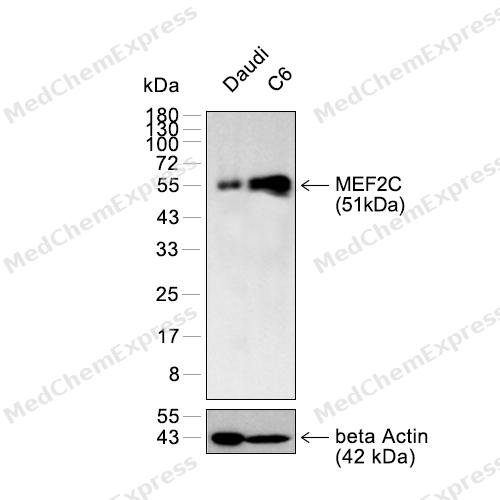 Western blot analysis of extracts from Daudi (lane 2(20μg)) and C6 (lane 3(20μg)) using MEF2C Rabbit mAb. Proteins were transferred to a PVDF membrane and blocked with 5% non-fat milk in TBST for 2 hour at room temperature. The primary antibody (1/1000) and Loading control antibody (beta Actin, HY-P83730, 1/5000) was used in 5% non-fat milk in TBST at 4°C overnight. Goat Anti-Rabbit/Mouse IgG-HRP Secondary Antibody (1/10000) was used for 1 hour at room temperature.


Background
-
Function
MEF2C transcription activator which binds specifically to the MEF2 element present in the regulatory regions of many muscle-specific genes. Controls cardiac morphogenesis and myogenesis, and is also involved in vascular development. Enhances transcriptional activation mediated by SOX18. Plays an essential role in hippocampal-dependent learning and memory by suppressing the number of excitatory synapses and thus regulating basal and evoked synaptic transmission. Crucial for normal neuronal development, distribution, and electrical activity in the neocortex. Necessary for proper development of megakaryocytes and platelets and for bone marrow B-lymphopoiesis. Required for B-cell survival and proliferation in response to BCR stimulation, efficient IgG1 antibody responses to T-cell-dependent antigens and for normal induction of germinal center B-cells. May also be involved in neurogenesis and in the development of cortical architecture. Isoforms that lack the repressor domain are more active than isoform 1
-
Subcellular Localization
Nucleus; Cytoplasm, sarcoplasm
-
Expression
Tissue_specificity:Expressed in the brain and skeletal muscle -
Isoforms & Post-Translational Modification
Q06413 has 6 isomers: Q06413-1: 51221 Da (predicted); Q06413-2: 50336 Da (predicted); Q06413-3: 47872 Da (predicted); Q06413-4: 44935 Da (predicted); Q06413-5: 52328 Da (predicted); Q06413-6: 50242 Da (predicted).
Phosphorylation on Ser-59 enhances DNA binding activity (By similarity). Phosphorylation on Ser-396 is required for Lys-391 sumoylation and inhibits transcriptional activity;Acetylated by p300 on several sites in diffentiating myocytes. Acetylation on Lys-4 increases DNA binding and transactivation (By similarity);Sumoylated on Lys-391 with SUMO2 but not by SUMO1 represses transcriptional activity;Proteolytically cleaved in cerebellar granule neurons, probably by caspase 7, following neurotoxicity. Preferentially cleaves the CDK5-mediated hyperphosphorylated form which leads to neuron apoptosis and transcriptional inactivation -
Subunit
Forms a complex with class II HDACs in undifferentiating cells. On myogenic differentiation, HDACs are released into the cytoplasm allowing MEF2s to interact with other proteins for activation. Interacts with EP300 in differentiating cells; the interaction acetylates MEF2C leading to increased DNA binding and activation (By similarity). Interacts with HDAC7 and CARM1 (By similarity). Interacts with HDAC4 and HDAC9; the interaction with HDACs represses transcriptional activity (PubMed:10523670, PubMed:11535832). Interacts with LPIN1. Interacts with MYOCD. Interacts with AKAP13 (By similarity). Interacts with FOXK1; the interaction inhibits MEF2C transactivation activity (By similarity). Interacts (via N-terminus) with HABP4; this interaction decreases DNA-binding activity of MEF2C in myocardial cells in response to mechanical stress (PubMed:15862299). Interacts with JPH2; interaction specifically takes place with the Junctophilin-2 N-terminal fragment cleavage product of JPH2 (By similarity). Interacts (via MADS box) with SOX18 (By similarity). Interacts with PHF7; the interaction promotes MEF2C binding to its transcription targets (By similarity)
-
SwissProt ID
-
Synonyms
MEF2C; Myocyte-specific enhancer factor 2C
-
Research Field
Signal Transduction


Documentation
-
Data Sheet (258 KB)
-
SDS (251 KB)
- English - EN (251 KB)
- Français - FR (251 KB)
- Deutsch - DE (251 KB)
- Norwegian - NO (251 KB)
- Español - ES (251 KB)
- Swedish - SV (251 KB)
- Italian - IT (251 KB)
- Korean - KR (251 KB)
- Portuguese - PT (251 KB)
-
User Guide for Antibodies (1077 KB)

 Powered by Bioz
