



DD-03-171

Based on 1 Customer Validation
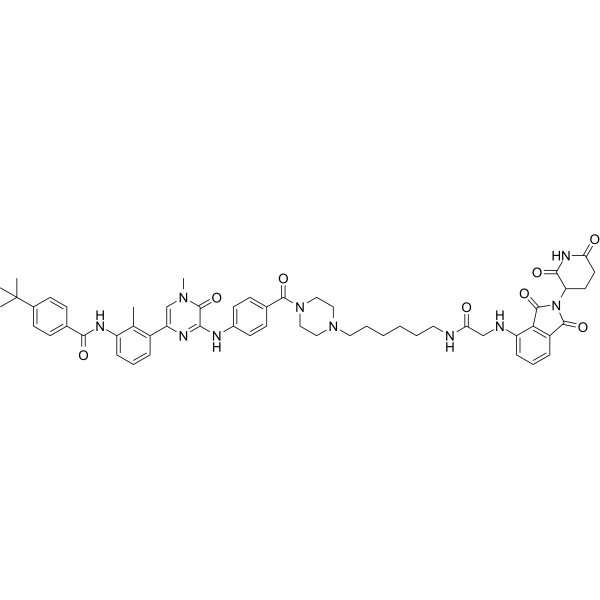
DD-03-171 is a PROTAC BTK degrader. DD-03-171 inhibits mantle cell lymphoma (MCL) cell proliferation (IC50 = 5.1 nM) and prolongs the survival of mice bearing a lymphoma PDX model by degrading BTK, IKFZ1, and IKFZ3. DD-03-171 also inhibits platelet function and thrombosis. (Pink: BTK ligand 9 (HY-168292); Black: linker (HY-28875); Blue: Thalidomide-NH-CH2-COOH (HY-131717)).
(Pink: Btk ligand (HY-168292); Blue: Cereblon ligand (HY-131717); Black: linker).
Nos produits utilisent uniquement pour la recherche. Nous ne vendons pas aux patients.
- Pureté: 98.72%
- CAS No.: 2366132-45-6
- Formule: C55H62N10O8
- Masse moléculaire:991.14
-
Stockage:Powder -20°C, 3 years , 4°C, 2 years ; In solvent -80°C, 6 months , -20°C, 1 month

To place orders, for customer services and technical support, please contact: MedChemExpress USA
Tel: 609-228-6898 E-mail: [email protected] [email protected]


-
 Activité biologique
-
Chemical Information
-
Solvant et solubilité
- Pureté et documentation
- Références
-
 Help & FAQs


Voir tous les produits spécifiques à Isoform PROTACs
More

Activité biologique
|
Cereblon |
|
Cell Line

|
Type | Value | Description | References |
|---|---|---|---|---|
| TMD8 | IC50 |
5.1 nM
Compound: DD-03-171
|
Cytotoxicity against human TMD8 cells incubated for 48 hrs by celltitre glo 2.0 assay
Cytotoxicity against human TMD8 cells incubated for 48 hrs by celltitre glo 2.0 assay
|
[PMID: 37195170] |
DD-03-171 (1-10000 nM, 2-4 h) reduces cellular BTK levels in a proteasome- and CRBN-dependent manner in Ramos B cells[1].
DD-03-171 (40-1000 nM, 16 h) overcomes Ibrutinib (HY-10997) resistance and synergizes with HCK inhibition in ABC DLBCL in TMD8 ABC DLBCL cells[1].
DD-03-171 (100-1000 nM, 16 h) degrades IKZF1/3 and BTK, has antiproliferative effects on MCL cells (ED50 = 12 nM)
DD-03-171 (0-20 μM, 4-20 h) concentration-dependent degrades BTK in human platelets[2].
MedChemExpress (MCE) has not independently confirmed the accuracy of these methods. They are for reference only.
-
Cell Line:Ramos B cells
-
Concentration:1, 10, 100, 1000, 10000 nM
-
Incubation Time:2, 4 h
-
Result:Significantly reduced cellular BTK levels at concentrations as low as 100 nM, inhibited phosphorylation of Erk1/2.
Remained below levels even 24 hours after washout.
-
Cell Line:TMD8 ABC DLBCL cells that expressed WT- or C481S-BTK
-
Concentration:40, 200, 1000 nM
-
Incubation Time:16 h
-
Result:Induced BTK degradation of WT- and C481S-BTK.
-
Cell Line:MCL cells
-
Concentration:100, 500, 1000 nM
-
Incubation Time:16 h
-
Result:Degraded IKZF1/3 as well as BTK, reduced levels of active (phosphorylated) p65 NF-κB.
MedChemExpress (MCE) has not independently confirmed the accuracy of these methods. They are for reference only.
-
Animal Model:C57BL/6 mice model[1]
-
Dosage:50 mg/kg
-
Administration:i.p., once a day, 3 days
-
Result:Induced significant degradation of BTK in splenocytes.
-
Animal Model:NSG mice were engrafted with DFBL-18689/DFBL-39435/DFBL-39435/DFBL-44685/DFBL-98848 cells models[1]
-
Dosage:50 mg/kg
-
Administration:i.p., once a day
-
Result:Induced degradation of BTK.


Chemical Information
-
CAS No. 2366132-45-6
-
Appearance Solid
-
Masse moléculaire 991.14
-
Formule C55H62N10O8
-
Color White to yellow
-
SMILES
O=C(NC1=CC=CC(C(N=C2NC3=CC=C(C(N4CCN(CCCCCCNC(CNC5=CC=CC(C(N6C(CC7)C(NC7=O)=O)=O)=C5C6=O)=O)CC4)=O)C=C3)=CN(C)C2=O)=C1C)C8=CC=C(C(C)(C)C)C=C8
-
Livraison
Room temperature in continental US; may vary elsewhere.
-
Stockage
Powder -20°C 3 years 4°C 2 years In solvent -80°C 6 months -20°C 1 month


Solvant et solubilité
DMSO : 100 mg/mL (100.89 mM; Need ultrasonic; Hygroscopic DMSO has a significant impact on the solubility of product, please use newly opened DMSO)
Please refer to the solubility information to select the appropriate solvent. Once prepared, please aliquot and store the solution to prevent product inactivation from repeated freeze-thaw cycles.
Storage method and period of stock solution: -80°C, 6 months; -20°C, 1 month. When stored at -80°C, please use it within 6 months. When stored at -20°C, please use it within 1 month.
Please refer to the solubility information to select the appropriate solvent. Once prepared, please aliquot and store the solution to prevent product inactivation from repeated freeze-thaw cycles.
Storage method and period of stock solution: -80°C, 6 months; -20°C, 1 month. When stored at -80°C, please use it within 6 months. When stored at -20°C, please use it within 1 month.
Concentration (start) × Volume (start) = Concentration (final) × Volume (final)
Select the appropriate dissolution method based on your experimental animal and administration route.
- For the following dissolution methods, please ensure to first prepare a clear stock solution using an In Vitro approach and then sequentially add co-solvents:
- To ensure reliable experimental results, the clarified stock solution can be appropriately stored based on storage conditions. As for the working solution for In Vivo experiments, it is recommended to prepare freshly and use it on the same day.
- The percentages shown for the solvents indicate their volumetric ratio in the final prepared solution. If precipitation or phase separation occurs during preparation, heat and/or sonication can be used to aid dissolution.
Add each solvent one by one: 10% DMSO 40% PEG300 5% Tween-80 45% Saline
Solubility: ≥ 2.5 mg/mL (2.52 mM); Clear solution
This protocol yields a clear solution of ≥ 2.5 mg/mL (saturation unknown).
Taking 1 mL working solution as an example, add 100 μL DMSO stock solution (25.0 mg/mL) to 400 μL PEG300, and mix evenly; then add 50 μL Tween-80 and mix evenly; then add 450 μL Saline to adjust the volume to 1 mL.
Preparation of Saline: Dissolve 0.9 g sodium chloride in ddH₂O and dilute to 100 mL to obtain a clear Saline solution.
Please enter the basic information of animal experiments:
-
-
-
-
Recommended: Prepare an additional quantity of animals to account for potential losses during experiments.
Please enter your animal formula composition:
-
%DMSO +
Recommended: Keep the proportion of DMSO in working solution below 2% if your animal is weak.
-
%+
-
+%Tween-80 + +
-
%Saline +
The co-solvents required include: DMSO, . All of co-solvents are available by MedChemExpress (MCE). , Tween 80. All of co-solvents are available by MedChemExpress (MCE).
Working solution concentration: 0.22 mg/mL
Method for preparing stock solution: mg drug dissolved in μL DMSO. Stock solution concentration: mg/mL.
1. Take μL DMSO stock solution;
2. Add μL .
μL , mix evenly;
3. Then add μL Tween 80, mix evenly;
4. Then add μL
Please ensure that the stock solution in the first step is dissolved to a clear state, and add co-solvents in sequence. You can use ultrasonic heating (ultrasonic cleaner, recommended frequency 20-40 kHz), vortexing, etc. to assist dissolution.


Pureté et documentation
-
Fiche technique (273 KB)
-
SDS (643 KB)
- English - EN (643 KB)
- Français - FR (643 KB)
- Deutsch - DE (643 KB)
- Norwegian - NO (643 KB)
- Español - ES (643 KB)
- Swedish - SV (643 KB)
- Italian - IT (643 KB)
- Korean - KR (643 KB)
- Portuguese - PT (643 KB)
-
Instruction de manipulation (2659 KB)
Références
[1]. Dobrovolsky D, et al. Bruton tyrosine kinase degradation as a therapeutic strategy for cancer. Blood. 2019 Feb 28;133(9):952-961. [Content Brief]
[2]. Trory JS, et al. Chemical degradation of BTK/TEC as a novel approach to inhibit platelet function. Blood Adv. 2023 May 9;7(9):1692-1696. [Content Brief]
[3]. Lu X, et al. Medicinal Chemistry Strategies for the Development of Kinase Inhibitors Targeting Point Mutations. J Med Chem. 2020 Oct 8;63(19):10726-10741. [Content Brief]


Complete Stock Solution Preparation Table
Please refer to the solubility information to select the appropriate solvent. Once prepared, please aliquot and store the solution to prevent product inactivation from repeated freeze-thaw cycles.
Storage method and period of stock solution: -80°C, 6 months; -20°C, 1 month. When stored at -80°C, please use it within 6 months. When stored at -20°C, please use it within 1 month.
| Optional Solvent | Concentration Solvent Mass | 1 mg | 5 mg | 10 mg | 25 mg |
|---|---|---|---|---|---|
| DMSO | 1 mM | 1.0089 mL | 5.0447 mL | 10.0894 mL | 25.2235 mL |
| 5 mM | 0.2018 mL | 1.0089 mL | 2.0179 mL | 5.0447 mL | |
| 10 mM | 0.1009 mL | 0.5045 mL | 1.0089 mL | 2.5223 mL | |
| 15 mM | 0.0673 mL | 0.3363 mL | 0.6726 mL | 1.6816 mL | |
| 20 mM | 0.0504 mL | 0.2522 mL | 0.5045 mL | 1.2612 mL | |
| 25 mM | 0.0404 mL | 0.2018 mL | 0.4036 mL | 1.0089 mL | |
| 30 mM | 0.0336 mL | 0.1682 mL | 0.3363 mL | 0.8408 mL | |
| 40 mM | 0.0252 mL | 0.1261 mL | 0.2522 mL | 0.6306 mL | |
| 50 mM | 0.0202 mL | 0.1009 mL | 0.2018 mL | 0.5045 mL | |
| 60 mM | 0.0168 mL | 0.0841 mL | 0.1682 mL | 0.4204 mL | |
| 80 mM | 0.0126 mL | 0.0631 mL | 0.1261 mL | 0.3153 mL | |
| 100 mM | 0.0101 mL | 0.0504 mL | 0.1009 mL | 0.2522 mL |


DD-03-171 Related Classifications
HY-122830 Related Classifications
 Powered by Bioz