



Camphorquinone

Based on 1 Customer Validation
Camphorquinone (2,3-Bornanedione) is a photoinitiator. Camphorquinone enhances free radical production under visible light (VL) irradiation and exhibits minimal cytotoxicity to HPF cells. Camphorquinone is used in the research of dental resin polymers.
For research use only. We do not sell to patients.
- Purity : 97.0%
- CAS No.: 10373-78-1
- Formula: C10H14O2
- Molecular Weight:166.22
-
Storage:Powder -20°C, 3 years , 4°C, 2 years ; In solvent -80°C, 6 months , -20°C, 1 month


To place orders, for customer services and technical support, please contact: MedChemExpress USA
Tel: 609-228-6898 E-mail: [email protected] [email protected]


-
 Biological Activity
-
Chemical Information
-
Solvent & Solubility
- Protocols
- Purity & Documentation
- References
-
 Help & FAQs


-

HY-W098021
2,2-Dimethoxy-2-phenylacetophenoneFree Radical Photoinitiator -
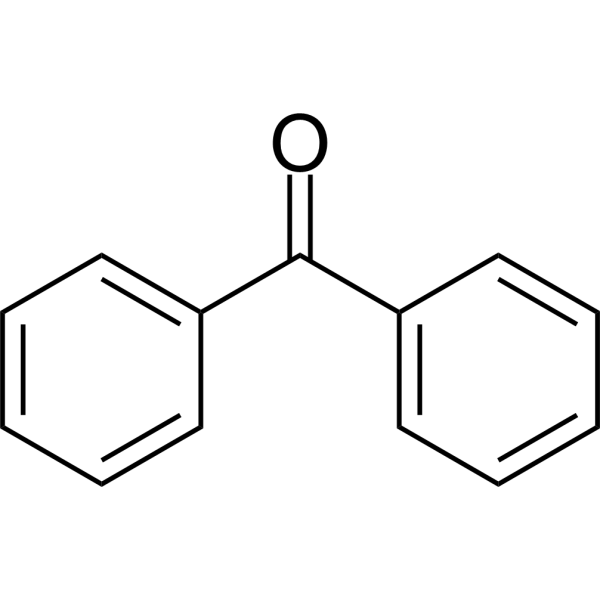
HY-Y0546
BenzophenonePhotosensitizer -

HY-W014937
4-HydroxybenzophenoneBenzophenone Metabolite -
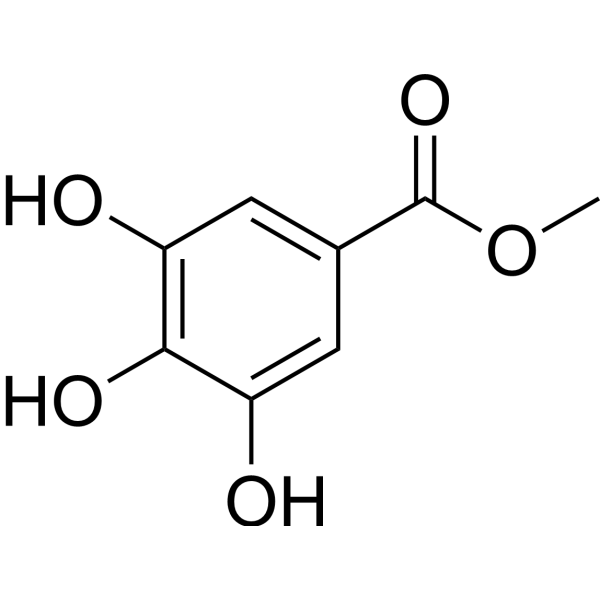
HY-N2010
Methyl gallateAntioxidant -

HY-W019643
Glycopyrronium impurity 3Drug Impurity -

HY-118571
Benzoin methyl etherPhotoinitiator -

HY-W142478
2,2-DiethoxyacetophenoneBiochemical Assay Reagents -
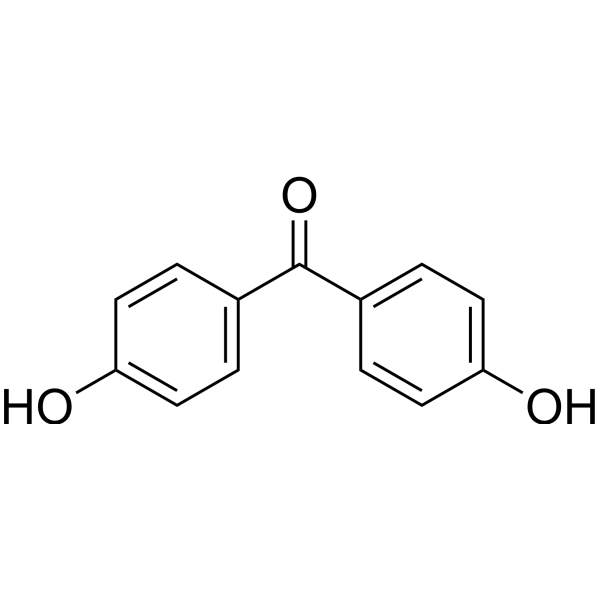
HY-W014226
4,4'-DihydroxybenzophenoneUltraviolet Absorber -

HY-Y0546R
Benzophenone (Standard)Photosensitizer -
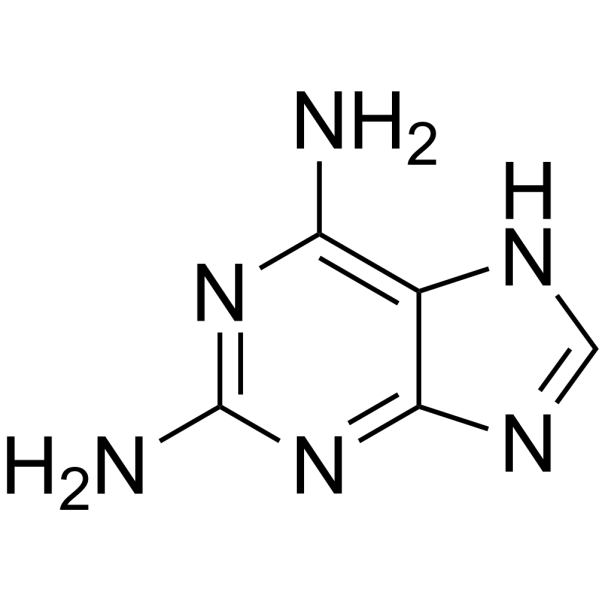
HY-W013631
7H-Purine-2,6-diamineBiochemical Reagent -

HY-78035
Citraconic anhydrideAntigen Retrieval Solution -

HY-W106405
1,4-Butanediol,diacrylateBiochemical Assay Reagent


Biological Activity
Description


Chemical Information
-
CAS No. 10373-78-1
-
Appearance Solid
-
Molecular Weight 166.22
-
Formula C10H14O2
-
Color Light yellow to yellow
-
SMILES
O=C1C(C2(C)C)(C)CCC2C1=O
-
Synonyms
2,3-Bornanedione
-
Shipping
Room temperature in continental US; may vary elsewhere.
-
Storage
Powder -20°C 3 years 4°C 2 years In solvent -80°C 6 months -20°C 1 month


Solvent & Solubility
In Vitro:
DMSO : 100 mg/mL (601.61 mM; Need ultrasonic; Hygroscopic DMSO has a significant impact on the solubility of product, please use newly opened DMSO)
Please refer to the solubility information to select the appropriate solvent. Once prepared, please aliquot and store the solution to prevent product inactivation from repeated freeze-thaw cycles.
Storage method and period of stock solution: -80°C, 6 months; -20°C, 1 month. When stored at -80°C, please use it within 6 months. When stored at -20°C, please use it within 1 month.
Please refer to the solubility information to select the appropriate solvent. Once prepared, please aliquot and store the solution to prevent product inactivation from repeated freeze-thaw cycles.
Storage method and period of stock solution: -80°C, 6 months; -20°C, 1 month. When stored at -80°C, please use it within 6 months. When stored at -20°C, please use it within 1 month.
Concentration (start) × Volume (start) = Concentration (final) × Volume (final)

Protocols
-
Cell Cytotoxicity Assay
Cytotoxicity assays are usually based on the assessment of cell membrane damage, which can also be indirectly detected by measuring cell viability. Detection methods include MTT assay, CKK-8 assay, LDH assay and ATP assay, etc.
-
Mammalian live/dead viability and cytotoxicity staining
Live/dead viability and cytotoxicity staining assays are based on the simultaneous detection of intracellular esterase activity in metabolically active (viable) cells and membrane integrity loss in non-viable cells. In commonly used dual-staining approaches, membrane-permeant fluorogenic substrates are converted by intracellular esterases into fluorescent products in live cells, while impermeant DNA-binding dyes selectively enter cells with compromised plasma membranes and label nucleic acids in dead or dying cells, enabling discrimination between viable and non-viable populations by fluorescence microscopy or flow cytometry.
-
Cell Viability Determination by MTT Colorimetric Assay
The following protocol uses the MTT colorimetric assay as a classic literature-established method for assessing cell viability/metabolic activity in cultured mammalian cells. MTT[3-(4,5-dimethylthiazol-2-yl)-2,5-diphenyltetrazolium bromide] is reduced by metabolically active cells to a colored formazan product; the amount of formazan is quantified spectrophotometrically and provides an indirect measure of metabolically active viable cells. Importantly, MTT reduction reflects cellular oxidoreductase/metabolic activity rather than an absolute direct count of living cells, so changes in cellular metabolism can alter the signal independently of cell number.


Purity & Documentation
-
Data Sheet (279 KB)
-
SDS (393 KB)
- English - EN (393 KB)
- Français - FR (393 KB)
- Deutsch - DE (393 KB)
- Norwegian - NO (393 KB)
- Español - ES (393 KB)
- Swedish - SV (393 KB)
- Italian - IT (393 KB)
- Korean - KR (393 KB)
- Portuguese - PT (393 KB)
-
Handling Instructions (2659 KB)
References


Complete Stock Solution Preparation Table
Please refer to the solubility information to select the appropriate solvent. Once prepared, please aliquot and store the solution to prevent product inactivation from repeated freeze-thaw cycles.
Storage method and period of stock solution: -80°C, 6 months; -20°C, 1 month. When stored at -80°C, please use it within 6 months. When stored at -20°C, please use it within 1 month.
| Optional Solvent | Concentration Solvent Mass | 1 mg | 5 mg | 10 mg | 25 mg |
|---|---|---|---|---|---|
| DMSO | 1 mM | 6.0161 mL | 30.0806 mL | 60.1612 mL | 150.4031 mL |
| 5 mM | 1.2032 mL | 6.0161 mL | 12.0322 mL | 30.0806 mL | |
| 10 mM | 0.6016 mL | 3.0081 mL | 6.0161 mL | 15.0403 mL | |
| 15 mM | 0.4011 mL | 2.0054 mL | 4.0107 mL | 10.0269 mL | |
| 20 mM | 0.3008 mL | 1.5040 mL | 3.0081 mL | 7.5202 mL | |
| 25 mM | 0.2406 mL | 1.2032 mL | 2.4064 mL | 6.0161 mL | |
| 30 mM | 0.2005 mL | 1.0027 mL | 2.0054 mL | 5.0134 mL | |
| 40 mM | 0.1504 mL | 0.7520 mL | 1.5040 mL | 3.7601 mL | |
| 50 mM | 0.1203 mL | 0.6016 mL | 1.2032 mL | 3.0081 mL | |
| 60 mM | 0.1003 mL | 0.5013 mL | 1.0027 mL | 2.5067 mL | |
| 80 mM | 0.0752 mL | 0.3760 mL | 0.7520 mL | 1.8800 mL | |
| 100 mM | 0.0602 mL | 0.3008 mL | 0.6016 mL | 1.5040 mL |


Camphorquinone Related Classifications
HY-W086630 Related Classifications
 Powered by Bioz