



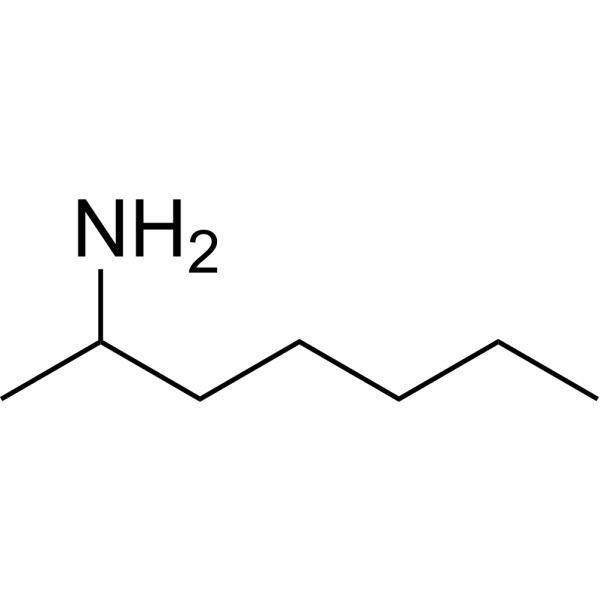
2-Aminoheptane
Based on 1 publication(s) in Google Scholar
2-Aminoheptane (Tuaminoheptane) is a norepinephrine transporter inhibitor. 2-Aminoheptane binds to norepinephrine transporter via ionic and hydrophobic interactions to block norepinephrine uptake. 2-Aminoheptane deactivates ω-TAmla enzyme, reduces recombinant whole cell stability, and acts as an amino group donor substrate for ω-TA and ω-TAmla enzymes. 2-Aminoheptane can be used in research on depression and Alzheimer's disease.
Nur für Forschungszwecke. Wir verkaufen nicht an Patienten.
- Reinheit : 99.69%
- CAS. Nr.: 123-82-0
- Formel: C7H17N
- Molecular Weight:115.22
-
Speicherung:Pure form -20°C, 3 years , 4°C, 2 years ; In solvent -80°C, 6 months , -20°C, 1 month

To place orders, for customer services and technical support, please contact: MedChemExpress USA
Tel: 609-228-6898 E-mail: [email protected] [email protected]


-
 Biologische Aktivität
-
Chemical Information
-
Lösungsmittel & Löslichkeit
- Reinheit & Dokumentation
- Verweise
-
 Help & FAQs


-
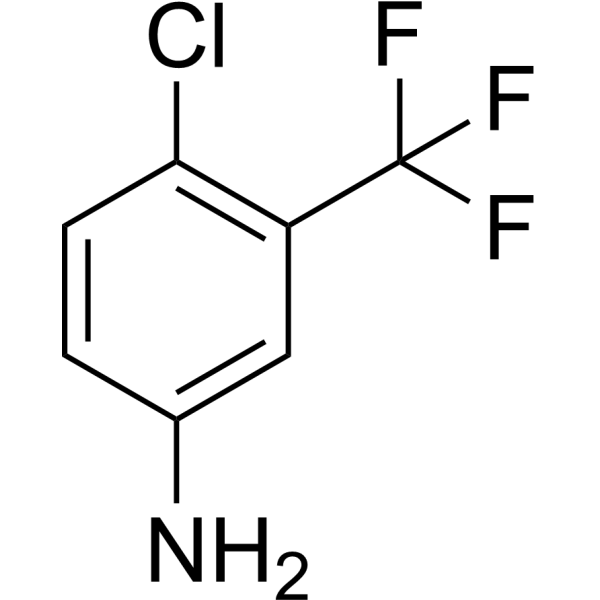
HY-77822
5-Amino-2-chlorobenzotrifluorideBiochemical Reagent -

HY-Z0132
N-Methyl-3-nitroanilineDrug Impurity -

HY-77822R
5-Amino-2-chlorobenzotrifluoride (Standard)Biochemical Reagent -

HY-Z0132R
N-Methyl-3-nitroaniline (Standard) -
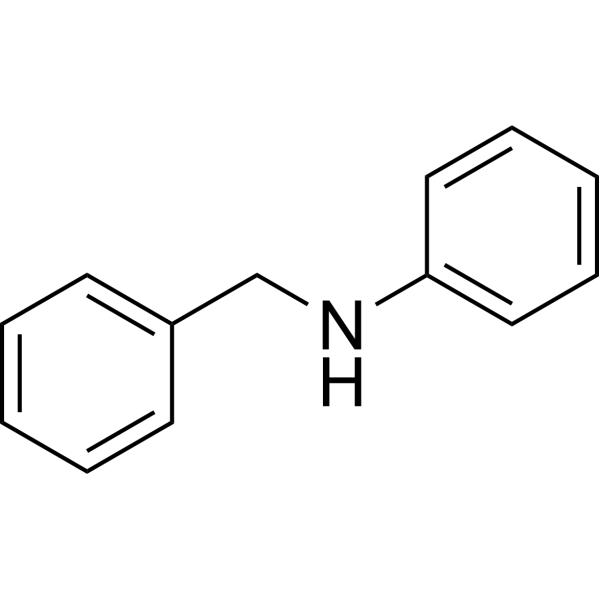
HY-W016321
N-BenzylanilineN-alkylated Derivative -
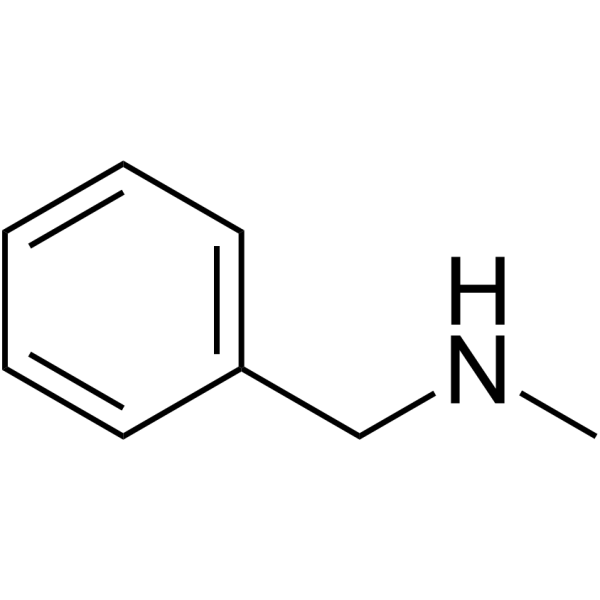
HY-W007426
N-Methylbenzylamine -

HY-W011998
Triphenylamine -

HY-W235067
N,N-DimethyldodecylamineDynamin I Inhibitor -

HY-W040305
2,6-Dichloro-4-nitroanilineHerbicide -

HY-W016234
Nimesulide impurity 4Drug Impurity -
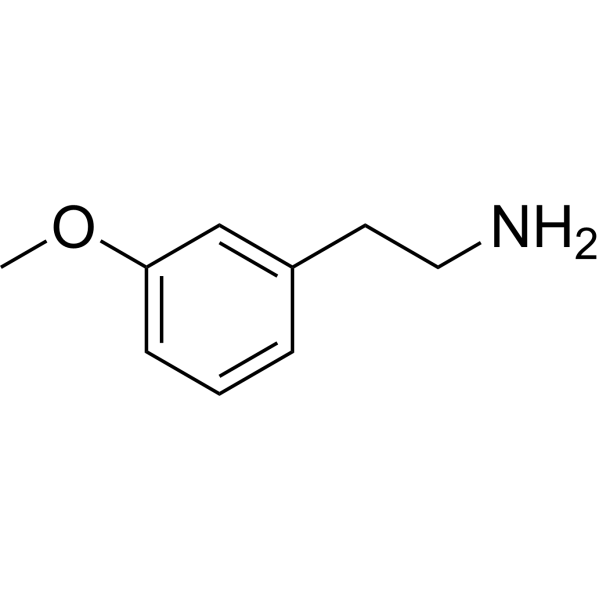
HY-41268
3-MethoxyphenylethylamineCYP2D6 Substrate
Publications Citing Use of MedChemExpress (MCE) 2-Aminoheptane
MoreAlle Adrenergic Receptor Isoform-spezifische Produkte anzeigen
More

Biologische Aktivität
Beschreibung
In Vitro
2-Aminoheptane inhibits [3H]norepinephrine uptake in HEK cells, with an IC50 of 3.7 μM[1].
2-Aminoheptane (0-250 mM; 1 h) shows that crude cell extracts of ω-TAmla-expressing E. coli BL21 are completely deactivated by 80 mM (without PLP) at 37°C for 1 h, while whole cells retain 44.4% activity at 150 mM 2-aminoheptane with 1 mM PLP[3].
2-Aminoheptane (2 mM) serves as the sole nitrogen source and successfully enriches E. coli BL21 expressing ω-TA mutants with reduced product inhibition, leading to the isolation of ω-TAmla[3].
2-Aminoheptane combined with NAC (HY-B0215) quickly relieves nasal congestion, significantly reduce resistance and increase inspiratory flow rate[4].
MedChemExpress (MCE) has not independently confirmed the accuracy of these methods. They are for reference only.


Chemical Information
-
CAS. Nr. 123-82-0
-
Appearance Liquid (Density: 0.766 g/cm3)
-
Molecular Weight 115.22
-
Formel C7H17N
-
Color Colorless to light yellow
-
SMILES
CC(N)CCCCC
-
Synonyms
Tuaminoheptane
-
Versand
Room temperature in continental US; may vary elsewhere.
-
Speicherung
Pure form -20°C 3 years 4°C 2 years In solvent -80°C 6 months -20°C 1 month


Publications (1)
-
Journal Impact Factor
-
Most Recent
-
Anal Bioanal Chem
Development and application of a dual isotopic labeling method for enhanced detection and quantification of stimulants in urine samples using high-resolution mass spectrometry. [Abstract]2024 Dec;416(29):7073-7084. PMID: 39455440


Lösungsmittel & Löslichkeit
In Vitro:
DMSO : ≥ 100 mg/mL (867.90 mM; Hygroscopic DMSO has a significant impact on the solubility of product, please use newly opened DMSO)
* "≥" means soluble, but saturation unknown.
Please refer to the solubility information to select the appropriate solvent. Once prepared, please aliquot and store the solution to prevent product inactivation from repeated freeze-thaw cycles.
Storage method and period of stock solution: -80°C, 6 months; -20°C, 1 month. When stored at -80°C, please use it within 6 months. When stored at -20°C, please use it within 1 month.
Please refer to the solubility information to select the appropriate solvent. Once prepared, please aliquot and store the solution to prevent product inactivation from repeated freeze-thaw cycles.
Storage method and period of stock solution: -80°C, 6 months; -20°C, 1 month. When stored at -80°C, please use it within 6 months. When stored at -20°C, please use it within 1 month.
Konzentration (Stammlösung) × Volumen (Stammlösung) = Konzentration (Ziellösung) × Volumen (Ziellösung)
In Vivo:
Select the appropriate dissolution method based on your experimental animal and administration route.
- For the following dissolution methods, please ensure to first prepare a clear stock solution using an In Vitro approach and then sequentially add co-solvents:
- To ensure reliable experimental results, the clarified stock solution can be appropriately stored based on storage conditions. As for the working solution for In Vivo experiments, it is recommended to prepare freshly and use it on the same day.
- The percentages shown for the solvents indicate their volumetric ratio in the final prepared solution. If precipitation or phase separation occurs during preparation, heat and/or sonication can be used to aid dissolution.
Add each solvent one by one: 10% DMSO 40% PEG300 5% Tween-80 45% Saline
Solubility: ≥ 2.5 mg/mL (21.70 mM); Clear solution
This protocol yields a clear solution of ≥ 2.5 mg/mL (saturation unknown).
Taking 1 mL working solution as an example, add 100 μL DMSO stock solution (25.0 mg/mL) to 400 μL PEG300, and mix evenly; then add 50 μL Tween-80 and mix evenly; then add 450 μL Saline to adjust the volume to 1 mL.
Preparation of Saline: Dissolve 0.9 g sodium chloride in ddH₂O and dilute to 100 mL to obtain a clear Saline solution.
Add each solvent one by one: 10% DMSO 90% (20% SBE-β-CD in Saline)
Solubility: ≥ 2.5 mg/mL (21.70 mM); Clear solution
This protocol yields a clear solution of ≥ 2.5 mg/mL (saturation unknown).
Taking 1 mL working solution as an example, add 100 μL DMSO stock solution (25.0 mg/mL) to 900 μL 20% SBE-β-CD in Saline, and mix evenly.
Preparation of 20% SBE-β-CD in Saline (4°C, storage for one week): 2 g SBE-β-CD powder is dissolved in 10 mL Saline, completely dissolve until clear.
In Vivo Dissolution Calculator
Please enter the basic information of animal experiments:
-
-
-
-
Recommended: Prepare an additional quantity of animals to account for potential losses during experiments.
Please enter your animal formula composition:
-
%DMSO +
Recommended: Keep the proportion of DMSO in working solution below 2% if your animal is weak.
-
%+
-
+%Tween-80 + +
-
%Saline +
The co-solvents required include: DMSO, . All of co-solvents are available by MedChemExpress (MCE). , Tween 80. All of co-solvents are available by MedChemExpress (MCE).
Working solution concentration: 0.22 mg/mL
Method for preparing stock solution: mg drug dissolved in μL DMSO. Stock solution concentration: mg/mL.
1. Take μL DMSO stock solution;
2. Add μL .
μL , mix evenly;
3. Then add μL Tween 80, mix evenly;
4. Then add μL
Please ensure that the stock solution in the first step is dissolved to a clear state, and add co-solvents in sequence. You can use ultrasonic heating (ultrasonic cleaner, recommended frequency 20-40 kHz), vortexing, etc. to assist dissolution.


Reinheit & Dokumentation
-
Data Sheet (271 KB)
-
SDS (607 KB)
- English - EN (607 KB)
- Français - FR (607 KB)
- Deutsch - DE (607 KB)
- Norwegian - NO (607 KB)
- Español - ES (607 KB)
- Swedish - SV (607 KB)
- Italian - IT (607 KB)
- Korean - KR (607 KB)
- Portuguese - PT (607 KB)
-
Handling Instructions (2659 KB)
Verweise
[1]. Schlessinger A, et al. Structure-based discovery of prescription drugs that interact with the norepinephrine transporter, NET. Proc Natl Acad Sci U S A. 2011;108(38):15810-15815. [Content Brief]
[2]. Zaremba I, et al. Differentiation of isomeric heptylamines by in-source collision-induced dissociation of [M + H]+ ions. Rapid Commun Mass Spectrom. 2019;33(9):848-856. [Content Brief]
[3]. Yun H, et al. Use of enrichment culture for directed evolution of the Vibrio fluvialis JS17 omega-transaminase, which is resistant to product inhibition by aliphatic ketones. Appl Environ Microbiol. 2005;71(8):4220-4224. [Content Brief]
[4]. Cogo A, et al. Efficacy of topical tuaminoheptane combined with N-acetyl-cysteine in reducing nasal resistance. A double-blind rhinomanometric study versus xylometazoline and placebo. Arzneimittelforschung. 1996;46(4):385-388. [Content Brief]


Complete Stock Solution Preparation Table
Please refer to the solubility information to select the appropriate solvent. Once prepared, please aliquot and store the solution to prevent product inactivation from repeated freeze-thaw cycles.
Storage method and period of stock solution: -80°C, 6 months; -20°C, 1 month. When stored at -80°C, please use it within 6 months. When stored at -20°C, please use it within 1 month.
| Optional Solvent | Concentration Solvent Mass | 1 mg | 5 mg | 10 mg | 25 mg |
|---|---|---|---|---|---|
| DMSO | 1 mM | 8.6790 mL | 43.3952 mL | 86.7905 mL | 216.9762 mL |
| 5 mM | 1.7358 mL | 8.6790 mL | 17.3581 mL | 43.3952 mL | |
| 10 mM | 0.8679 mL | 4.3395 mL | 8.6790 mL | 21.6976 mL | |
| 15 mM | 0.5786 mL | 2.8930 mL | 5.7860 mL | 14.4651 mL | |
| 20 mM | 0.4340 mL | 2.1698 mL | 4.3395 mL | 10.8488 mL | |
| 25 mM | 0.3472 mL | 1.7358 mL | 3.4716 mL | 8.6790 mL | |
| 30 mM | 0.2893 mL | 1.4465 mL | 2.8930 mL | 7.2325 mL | |
| 40 mM | 0.2170 mL | 1.0849 mL | 2.1698 mL | 5.4244 mL | |
| 50 mM | 0.1736 mL | 0.8679 mL | 1.7358 mL | 4.3395 mL | |
| 60 mM | 0.1447 mL | 0.7233 mL | 1.4465 mL | 3.6163 mL | |
| 80 mM | 0.1085 mL | 0.5424 mL | 1.0849 mL | 2.7122 mL | |
| 100 mM | 0.0868 mL | 0.4340 mL | 0.8679 mL | 2.1698 mL |


2-Aminoheptane Related Classifications
HY-B0952 Related Classifications
 Powered by Bioz