



Sultopride
Based on 1 publication(s) in Google Scholar
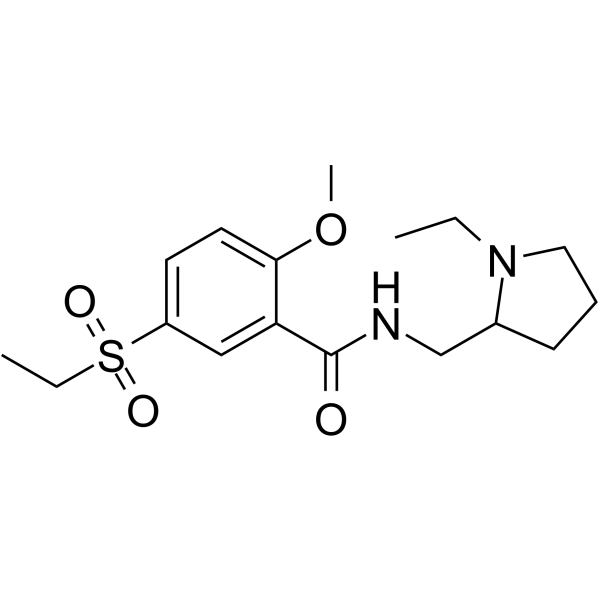
Sultopride (LIN-1418) is a selective antagonist of dopamine D2 receptor.
Nur für Forschungszwecke. Wir verkaufen nicht an Patienten.
- CAS. Nr.: 53583-79-2
- Formel: C17H26N2O4S
- Molecular Weight:354.46
-
Speicherung:
Please store the product under the recommended conditions in the Certificate of Analysis.

To place orders, for customer services and technical support, please contact: MedChemExpress USA
Tel: 609-228-6898 E-mail: [email protected] [email protected]


-
 Biologische Aktivität
-
Chemical Information
- Reinheit & Dokumentation
- Verweise
-
 Help & FAQs


Publications Citing Use of MedChemExpress (MCE) Sultopride
MoreAlle Dopamine Receptor Isoform-spezifische Produkte anzeigen
More

Biologische Aktivität
Beschreibung
IC50 & Target
Dopamine D2 receptor[1]
In Vivo
MedChemExpress (MCE) has not independently confirmed the accuracy of these methods. They are for reference only.


Chemical Information
-
CAS. Nr. 53583-79-2
-
Molecular Weight 354.46
-
Formel C17H26N2O4S
-
SMILES
O=C(NCC1N(CC)CCC1)C2=CC(S(=O)(CC)=O)=CC=C2OC
-
Synonyms
LIN-1418
-
Versand
Room temperature in continental US; may vary elsewhere.
-
Speicherung
Please store the product under the recommended conditions in the Certificate of Analysis.


Publications (1)
-
Journal Impact Factor
-
Most Recent
-
Acta Pharmacol Sin
Isosibiricin inhibits microglial activation by targeting the dopamine D1/D2 receptor-dependent NLRP3/caspase-1 inflammasome pathway. [Abstract]2020 Feb;41(2):173-180. PMID: 31506572


Reinheit & Dokumentation
Verweise

Calculators
Konzentration (Stammlösung) × Volumen (Stammlösung) = Konzentration (Ziellösung) × Volumen (Ziellösung)


Sultopride Related Classifications
HY-42849 Related Classifications
 Powered by Bioz