



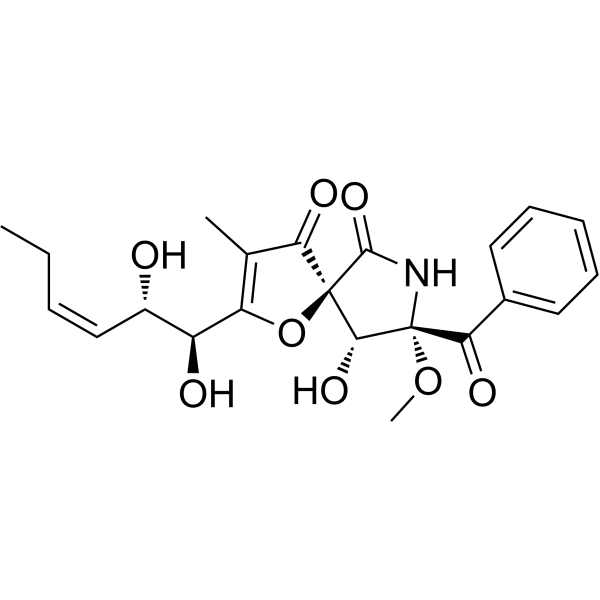
Pseurotin A

Based on 1 Customer Validation
Pseurotin A is a secondary metabolite of Aspergillus and other fungi. Pseurotin A is a competitive inhibitor of chitin synthase and a neuritogenic agent. Pseurotin A inhibits IgE production (IC50 = 3.6 μM). Pseurotin A inhibits the PCSK9-LDLr interaction. Pseurotin A shows dose-dependent reduction of PCSK9, along with increased LDLR levels in hormone-dependent breast cancer cell lines. Pseurotin A exhibits antitumor activity.
Nos produits utilisent uniquement pour la recherche. Nous ne vendons pas aux patients.
- Pureté : 98%
- CAS No.: 58523-30-1
- Formule: C22H25NO8
- Masse moléculaire:431.44
-
Stockage:
-20°C, protect from light
* In solvent : -80°C, 6 months; -20°C, 1 month (protect from light)

To place orders, for customer services and technical support, please contact: MedChemExpress USA
Tel: 609-228-6898 E-mail: [email protected] [email protected]


-
 Activité biologique
-
Chemical Information
- Protocole
- Pureté et documentation
- Références
-
 Help & FAQs


Voir tous les produits spécifiques à Isoform Endogenous Metabolite
More

Activité biologique
Description
IC50 & Target
|
Microbial Metabolite |
Cellular Effect
|
Cell Line

|
Type | Value | Description | References |
|---|---|---|---|---|
| K562 | IC50 |
>10 nM
Compound: 1
|
Cytotoxicity against human K562 cells
Cytotoxicity against human K562 cells
|
[PMID: 19179074] |
| K562 | IC50 |
41 μM
Compound: 5
|
Cytotoxicity against human K562 cells after 48 hrs by MTT assay
Cytotoxicity against human K562 cells after 48 hrs by MTT assay
|
[PMID: 19256529] |
| Lymphocyte | IC50 |
>10 μM
Compound: 1
|
Immunosuppressive activity in rat lymphocytes assessed as inhibition of mixed-lymphocyte reaction
Immunosuppressive activity in rat lymphocytes assessed as inhibition of mixed-lymphocyte reaction
|
[PMID: 19179074] |
| RAW264.7 | IC50 |
>100 μM
Compound: pseurotin A
|
Antiinflammatory activity in mouse RAW264.7 cells assessed as inhibition of LPS-stimulated nitric oxide production compound treated prior to LPS challenge by Griess assay
Antiinflammatory activity in mouse RAW264.7 cells assessed as inhibition of LPS-stimulated nitric oxide production compound treated prior to LPS challenge by Griess assay
|
[PMID: 27976895] |
| Vero | IC50 |
50 μM
Compound: 22
|
Antiviral activity against HSV1 F infected in african green monkey Vero cells assessed as reduction of virus-induced cytopathic effect by cellular replication assay
Antiviral activity against HSV1 F infected in african green monkey Vero cells assessed as reduction of virus-induced cytopathic effect by cellular replication assay
|
[PMID: 12828470] |
In Vitro
Pseurotin A inhibits the expression of PCSK9 in HepG2 cells, with an IC50 value of 1.2 μM[3].
Pseurotin A (25-100 μM; 72 hours) significantly suppresses the PCSK9 level in a dose dependent manner in BT-474 and T47D BC cell lines[3].
Pseurotin A (25-100 μM; 72 hours) significantly increases LDLR level in a dose dependent manner[3].
Pseurotin A (40-200 μM; 24-72 hours) shows anti-proliferative activity in the hormone-dependent BC cells[3].
MedChemExpress (MCE) has not independently confirmed the accuracy of these methods. They are for reference only.
-
Cell Line:BT-474 cells, T47D cells
-
Concentration:40-200 μM
-
Incubation Time:24-72 hours
-
Result:Showed weak but time and dose-dependent inhibition of the growth of BT-474 and T47D BC cells, with gradual decrease of the IC50 values over time (260.83-93.64 μM and 267.84-113.08 μM, respectively).
In Vivo
MedChemExpress (MCE) has not independently confirmed the accuracy of these methods. They are for reference only.
-
Animal Model:HFD-fed orthotopic athymic mice (bearing BT-474 tumor cells xenograft mode)[1]
-
Dosage:10 mg/kg
-
Administration:P.o.; 7X/week, 30 days
-
Result:Significantly suppressed the growth of BT474 tumors.


Chemical Information
-
CAS No. 58523-30-1
-
Appearance Solid
-
Masse moléculaire 431.44
-
Formule C22H25NO8
-
Color White to off-white
-
SMILES
O=C1C(C)=C([C@@H](O)[C@@H](O)/C=C\CC)O[C@]12C(N[C@@](OC)(C(C3=CC=CC=C3)=O)[C@@H]2O)=O
-
Structure Classification
-
Initial Source
Ascomycetes
-
Livraison
Room temperature in continental US; may vary elsewhere.
-
Stockage
-20°C, protect from light
* In solvent : -80°C, 6 months; -20°C, 1 month (protect from light)


Pureté et documentation
-
Fiche technique (288 KB)
-
SDS (251 KB)
- English - EN (251 KB)
- Français - FR (251 KB)
- Deutsch - DE (251 KB)
- Norwegian - NO (251 KB)
- Español - ES (251 KB)
- Swedish - SV (251 KB)
- Italian - IT (251 KB)
- Korean - KR (251 KB)
- Portuguese - PT (251 KB)
-
Instruction de manipulation (2659 KB)
Références
[1]. Ishikawa M, et al. Pseurotin A and its analogues as inhibitors of immunoglobulin E [correction of immunoglobuline E] production. Bioorg Med Chem Lett. 2009;19(5):1457-1460. [Content Brief]
[2]. Maiya S, Grundmann A, Li X, Li SM, Turner G. Identification of a hybrid PKS/NRPS required for pseurotin A biosynthesis in the human pathogen Aspergillus fumigatus. Chembiochem. 2007;8(14):1736-1743. [Content Brief]
[3]. Abdelwahed KS, et al. Pseurotin A as a novel suppressor of hormone dependent breast cancer progression and recurrence by inhibiting PCSK9 secretion and interaction with LDL receptor. Pharmacol Res. 2020;158:104847. [Content Brief]

Calculators
Concentration (start) × Volume (start) = Concentration (final) × Volume (final)


Pseurotin A Related Classifications
HY-125916 Related Classifications
 Powered by Bioz