



ChloraMine-T hydrate

Based on 1 Customer Validation
ChloraMine-T hydrate (Sodium chloro(4-methylbenzenesulfonyl)azanide (hydrate)) is a common reagent in various synthetic processes. It has been used as a reagent in aminohydroxylation and allylic amination reactions, a nitrogen source in aziridination reactions of alkenes and alkenes, and deprotection of sulfur groups in sulfur-containing compounds. It has been used as a reagent in the synthesis of factor Xa inhibitors. ChloraMine-T hydrate (Sodium chloro(4-methylbenzenesulfonyl)azanide (hydrate)) (0.2% w/v) is also an antimicrobial agent that kills Staphylococcus epidermidis, Staphylococcus aureus, Enterococcus faecalis, Escherichia coli, Proteus mirabilis, and Enterococcus cloacae.
For research use only. We do not sell to patients.
- Purity : 98.18%
- CAS No.: 149358-73-6
- Formula: C7H8ClNO2S·xH2O·Na
-
Storage:
-20°C, sealed storage, away from moisture
* In solvent : -80°C, 6 months; -20°C, 1 month (sealed storage, away from moisture)


To place orders, for customer services and technical support, please contact: MedChemExpress USA
Tel: 609-228-6898 E-mail: [email protected] [email protected]


-
 Biological Activity
-
Chemical Information
- Protocols
- Purity & Documentation
- References
-
 Help & FAQs


-
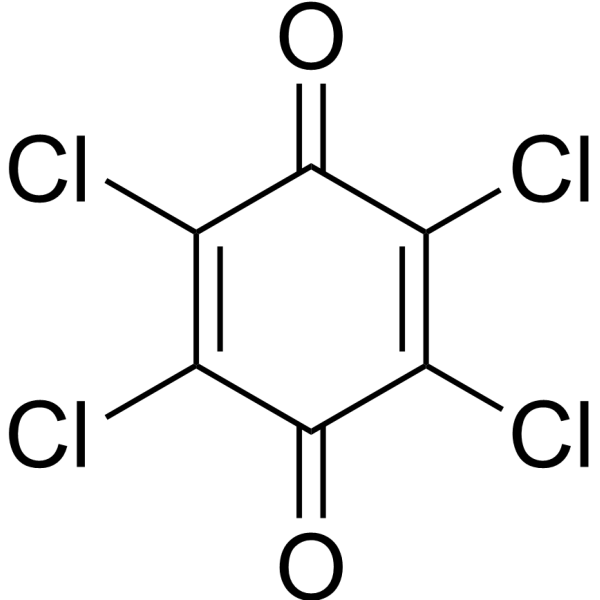
HY-Y0278
ChloranilROS Inducer -

HY-Y1101B
4-Methylmorpholine N-oxideOzonolysis Reagent -

HY-W145076
2-Azaadamantane-N-oxyl -
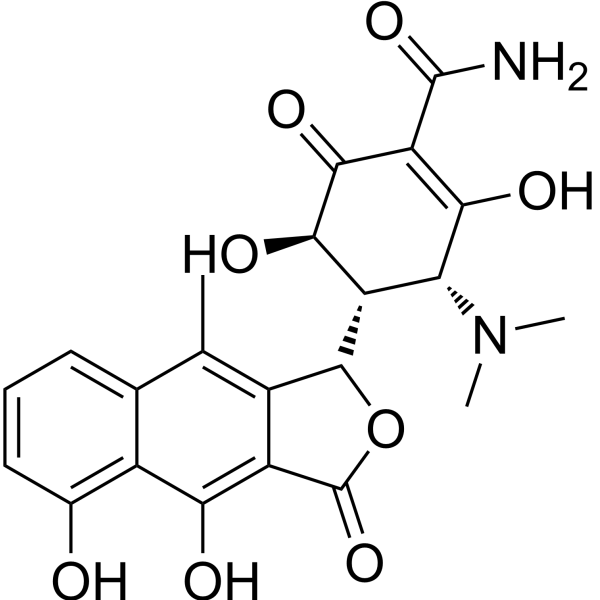
HY-135577
β-ApooxytetracyclineOxytetracycline Degradation Product -

HY-W012887
OxalyldihydrazideCrosslinking Agent -

HY-Y0532
N-Chlorosuccinimide生化试剂 -
![[Hydroxy(tosyloxy)iodo]benzene](https://file.medchemexpress.com/product_pic/hy-34619.gif)
HY-34619
[Hydroxy(tosyloxy)iodo]benzeneBiochemical Reagent -
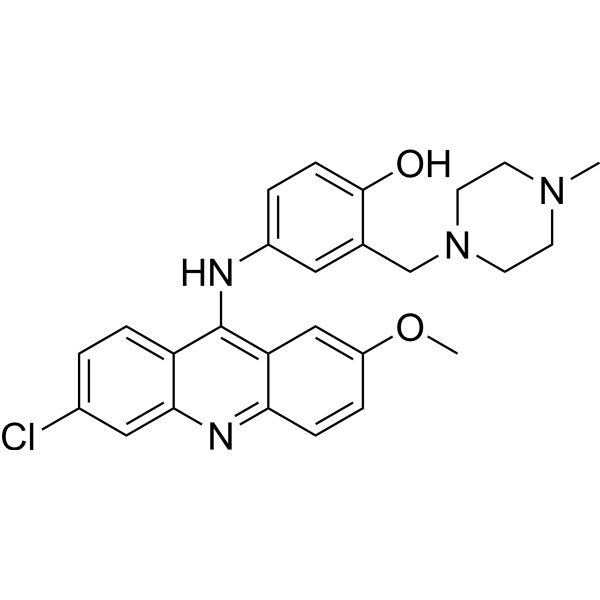
HY-125974
HM03HSPA5 Inhibitor -

HY-135577R
β-Apooxytetracycline (Standard)Oxytetracycline Degradation Product -

HY-Y0278R
Chloranil (Standard)ROS Inducer -
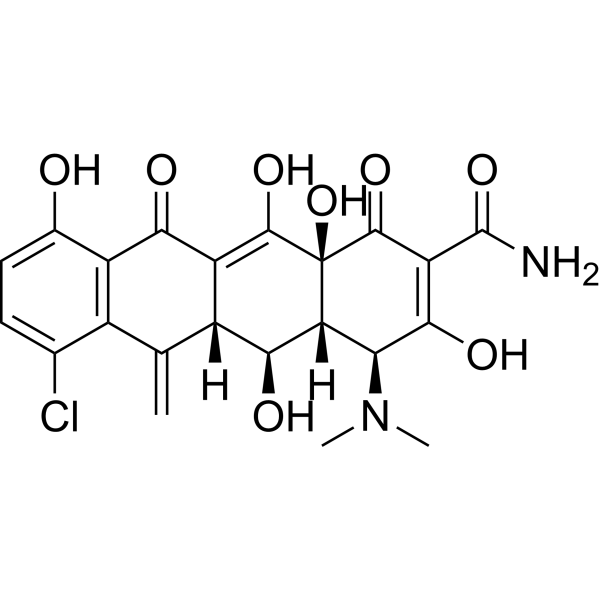
HY-B1366A
MeclocyclineTetracycline Derivative


Biological Activity
Description


Chemical Information
-
CAS No. 149358-73-6
-
Appearance Solid
-
Formula C7H8ClNO2S·xH2O·Na
-
Color White to off-white
-
SMILES
O=S(N([Na])Cl)(C1=CC=C(C)C=C1)=O.[xH2O]
-
Synonyms
Sodium chloro(4-methylbenzenesulfonyl)azanide hydrate
-
Shipping
Room temperature in continental US; may vary elsewhere.
-
Storage
-20°C, sealed storage, away from moisture
* In solvent : -80°C, 6 months; -20°C, 1 month (sealed storage, away from moisture)

Protocols
-
Research Protocol for Infectious Diseases
Infectious-disease experiments test how pathogens interact with host barriers, innate immune receptors, inflammatory signaling, pathogen replication, and tissue injury; pattern-recognition receptors such as TLRs, RIG-I-like receptors, NOD-like receptors, and inflammasomes detect microbial molecules and activate NF-κB, interferon, and cytokine responses. The central hypothesis is that infection severity reflects the balance between pathogen burden and host response: protective inflammation restricts pathogen growth, whereas excessive or mislocalized inflammation contributes to tissue damage and disease phenotype. Unresolved questions include which host pathways are protective versus pathogenic, why some infection models fail to translate to human disease, and which combined readouts best predict clinically relevant infection outcomes.


Purity & Documentation
-
Data Sheet (270 KB)
-
SDS (863 KB)
- English - EN (863 KB)
- Français - FR (863 KB)
- Deutsch - DE (863 KB)
- Norwegian - NO (863 KB)
- Español - ES (863 KB)
- Swedish - SV (863 KB)
- Italian - IT (863 KB)
- Korean - KR (863 KB)
- Portuguese - PT (863 KB)
-
Handling Instructions (2659 KB)
References

Calculators
Concentration (start) × Volume (start) = Concentration (final) × Volume (final)


ChloraMine-T hydrate Related Classifications
HY-W145053 Related Classifications
 Powered by Bioz