



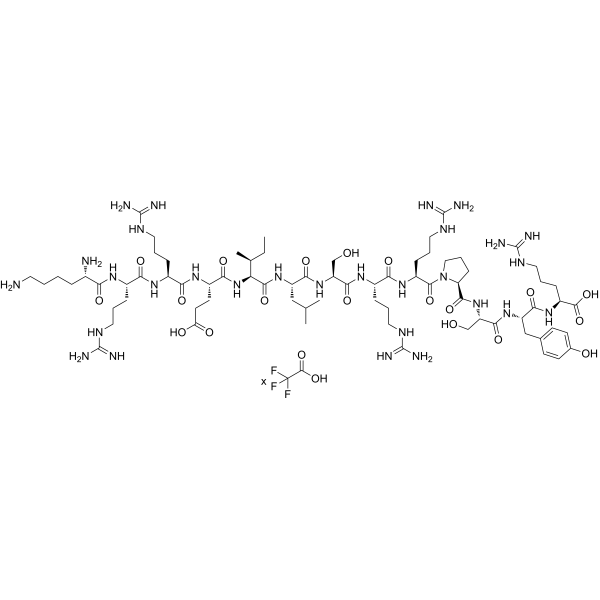
CREBtide TFA

Based on 1 Customer Validation
CREBtide TFA is a CREB (cAMP response element binding protein)-like peptide. CREBtide TFA a synthetic 13 amino acid peptide, has been reported as a PKA and PKC substrate.
For research use only. We do not sell to patients.
- Purity : 98.72%
- Formula: C73H129N29O19.xC2HF3O2
- Molecular Weight:1716.99 (free acid)
-
Storage:
Sealed storage, away from moisture.
Powder -80°C, 2 years , -20°C, 1 year* In solvent : -80°C, 6 months; -20°C, 1 month (sealed storage, away from moisture)

To place orders, for customer services and technical support, please contact: MedChemExpress USA
Tel: 609-228-6898 E-mail: [email protected] [email protected]


-
 Biological Activity
-
Chemical Information
-
Solvent & Solubility
- Purity & Documentation
- References
-
 Help & FAQs




Biological Activity
Description
In Vitro
delta-CREB is a spliced variant of cAMP response element binding protein (CREB). CREBtide (KRREILSRRPSYR), a synthetic peptide based on the phosphorylation sequence in delta-CREB. delta-CREB and CREBtide are tested as substrates of cAMP-dependent protein kinase (cAK). The apparent Km of CREBtide phosphorylation by cAK is 3.9 μM, which is 10-fold lower than that of Kemptide (Km=39 μM), the synthetic peptide substrate most often employed for cAK measurement. The Vmax values are 12.4 mumol/(min.mg) for CREBtide and 9.8 mumol/(min.mg) for Kemptide. The apparent Km of CREBtide phosphorylation by cGMP-dependent protein kinase (cGK) is 2.9 μM and the Vmax value is 3.2 mumol/(min.mg). Both delta-CREB and CREBtide are phosphorylated at a much slower rate by cGK as compared with cAK, implying that the high cAK/cGK specificity exhibits by delta-CREB is retained by the peptide[2].
MedChemExpress (MCE) has not independently confirmed the accuracy of these methods. They are for reference only.


Chemical Information
-
Appearance Solid
-
Molecular Weight 1716.99 (free acid)
-
Formula C73H129N29O19.xC2HF3O2
-
Color White to off-white
-
Sequence
Lys-Arg-Arg-Glu-Ile-Leu-Ser-Arg-Arg-Pro-Ser-Tyr-Arg
-
Sequence Shortening
KRREILSRRPSYR
-
Shipping
Room temperature in continental US; may vary elsewhere.
-
Storage
Sealed storage, away from moisture
Powder -80°C 2 years -20°C 1 year * In solvent : -80°C, 6 months; -20°C, 1 month (sealed storage, away from moisture)


Solvent & Solubility
In Vitro
H2O
Peptide Solubility and Storage Guidelines:
1. Calculate the length of the peptide.
2. Calculate the overall charge of the entire peptide according to the following table:
| Contents | Assign value | |
|---|---|---|
| Acidic amino acid | Asp (D), Glu (E), and the C-terminal -COOH. | -1 |
| Basic amino acid | Arg (R), Lys (K), His (H), and the N-terminal -NH2 | +1 |
| Neutral amino acid | Gly (G), Ala (A), Leu (L), Ile (I), Val (V), Cys (C), Met (M), Thr (T), Ser (S), Phe (F), Tyr (Y), Trp (W), Pro (P), Asn (N), Gln (Q) | 0 |
3. Recommended solution:
| Overall charge of peptide | Details |
|---|---|
| Negative (<0) |
1. Try to dissolve the peptide in water first. 2. If water fails, add NH4OH (<50 μL). 3. If the peptide still does not dissolve, add DMSO (50-100 μL) to solubilize the peptide. |
| Positive (>0) |
1. Try to dissolve the peptide in water first. 2. If water fails, try dissolving the peptide in a 10%-30% acetic acid solution. 3. If the peptide still does not dissolve, try dissolving the peptide in a small amount of DMSO. |
| Zero (=0) |
1. Try to dissolve the peptide in organic solvent (acetonitrile, methanol, etc.) first. 2. For very hydrophobic peptides, try dissolving the peptide in a small amount of DMSO, and then dilute the solution with water to the desired concentration. |


Purity & Documentation
-
Data Sheet (271 KB)
-
SDS (252 KB)
- English - EN (252 KB)
- Français - FR (252 KB)
- Deutsch - DE (252 KB)
- Norwegian - NO (252 KB)
- Español - ES (252 KB)
- Swedish - SV (252 KB)
- Italian - IT (252 KB)
- Korean - KR (252 KB)
- Portuguese - PT (252 KB)
-
Handling Instructions (2659 KB)
References
[1]. Wu J, et al. A microPLC-based approach for determining kinase-substrate specificity. Assay Drug Dev Technol. 2007 Aug;5(4):559-66. [Content Brief]
[2]. Colbran JL, et al. cAMP-dependent protein kinase, but not the cGMP-dependent enzyme, rapidly phosphorylates delta-CREB, and a synthetic delta-CREB peptide. Biochem Cell Biol. 1992 Oct-Nov;70(10-11):1277-82. [Content Brief]
[3]. Harum KH, et al. Cognitive impairment in Coffin-Lowry syndrome correlates with reduced RSK2 activation. Neurology. 2001 Jan 23;56(2):207-14. [Content Brief]
[4]. Peng J, et al. Protein kinase C-α signals P115RhoGEF phosphorylation and RhoA activation in TNF-α-induced mouse brain microvascular endothelial cell barrier dysfunction. J Neuroinflammation. 2011 Apr 8;8:28. [Content Brief]

Calculators
Concentration (start) × Volume (start) = Concentration (final) × Volume (final)


CREBtide TFA Related Classifications
HY-P1595A Related Classifications
 Powered by Bioz