



Phospho-ERK1/2 (Tyr204/Tyr187) Antibody
(Synonyms: MAPK1/MAPK3)Based on 1 publication(s) in Google Scholar
Phospho-ERK1/2 (Tyr204/Tyr187) Antibody is a Rabbit-derived and non-conjugated IgG polyclonal antibody, targeting to Phospho-ERK1/2 (Tyr204/Tyr187).
-
Host:
Rabbit
-
Isotype:
IgG
-
Application:
WB, IHC-P, ICC/IF
-
Reactivity :
Human, Mouse, Rat
-
Formulation:
Supplied in 1*PBS (pH 7.3), 50% glycerol and 0.5% BSA. Preservative: 0.02% sodium azide or PBS containing 150 mM NaCl, 50% glycerol and 0.02% sodium azide, pH 7.4..
-
Conjugation:
Non-conjugated


To place orders, for customer services and technical support, please contact: MedChemExpress USA
Tel: 609-228-6898 E-mail: [email protected] [email protected]



-

HY-P80393
ERK1/2 Antibody (YA453) -
HY-P80830
Phospho-JNK1/2/3 (Thr183) Antibody -
HY-P80137
GAPDH Antibody (YA418) -
HY-P80842
Phospho-p38 alpha/MAPK14 (Thr180/Tyr182) Antibody -
HY-P80846
Phospho-PI3 Kinase p85/p55 (Tyr467/Tyr199) Antibody -
HY-P80276
Phospho-AKT1(Ser473) Antibody (YA227) -
HY-P86143
Phospho-MEK1/2(Ser217/221) Antibody (YA5835)
Publications Citing Use of MedChemExpress (MCE) Phospho-ERK1/2 (Tyr204/Tyr187) Antibody
More

Applications
| Application |
WB

WB: Western Blot
|
IHC-P
IHC-P: Immunohistochemistry-Paraffin
|
ICC/IF
ICC/IF: Immunocytochemistry/
Immunofluorescence |
|---|---|---|---|
| Dilution Ratio | 1:500-1:1000 | 1:50-1:100 | 1:50-1:200 |


Product Details
Phospho-ERK1/2 (Tyr204/Tyr187) Antibody is a Rabbit-derived and non-conjugated IgG polyclonal antibody, targeting to Phospho-ERK1/2 (Tyr204/Tyr187).
-
Host Rabbit

-
Clonality Polyclonal

-
Species ReactivityHuman, Mouse, Rat
-
Observed Molecular WeightObserved band size: 42/44 kDa
Note: Due to possible protein modifications or aggregation, the molecular weight should be confirmed by actual measurement, and the predicted value is for reference only.

-
Calculated Molecular Weight Predicted band size: 42/44 kDa

Entrez Gene: 5594 Human ; 5595 Human ; 26413 Mouse ; 26417 Mouse ;
SwissProt: P27361 Human ; P28482 Human ; P63085 Mouse ; Q63844 Mouse ;
OMIM: 601795 Human
Synthetic phosphopeptide corresponding to residues surrounding Tyr204/Tyr187 of Human p44/42 MAP Kinase.The exact sequence is proprietary to MCE.
Endogenous
affinity purified
Non-conjugated
Phosphorylated
IgG


Product Properties
-
Appearance
Solution
-
Formulation
Supplied in 1*PBS (pH 7.3), 50% glycerol and 0.5% BSA. Preservative: 0.02% sodium azide or PBS containing 150 mM NaCl, 50% glycerol and 0.02% sodium azide, pH 7.4..
-
Concentration
Batch-dependent, Please check the COA for the concentration of each lot. Check Lot Concentration
-
Storage & Stability
Stored at -20°C for 1 year. Avoid repeated freeze / thaw cycles.
-
Shipping
Shipping with blue ice.


Publications (1)
-
Journal Impact Factor
-
Most Recent
-
Biol Direct
L-741626 inhibits hepatocellular carcinoma progression by targeting Ref-1 to suppress MAPK/ERK signalling pathway activity. [Abstract]2025 Apr 16;20(1):54. PMID: 40241114


Verification Images
-
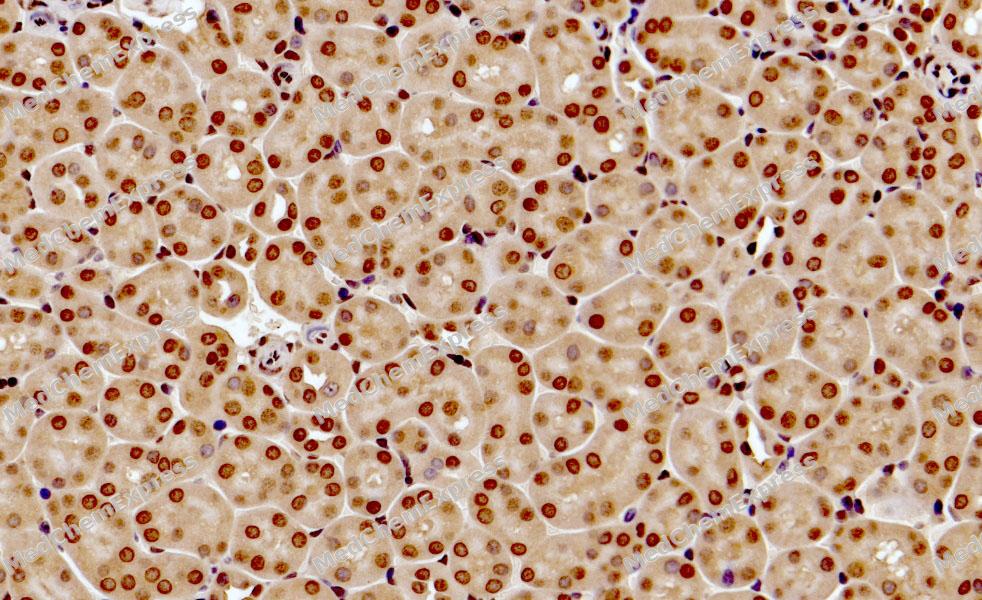 Immunohistochemical analysis of paraffin-embedded mouse kidney tissue using Phospho-ERK1/2 (Tyr204/Tyr187) Antibody. The section was pre-treated using heat mediated antigen retrieval with sodium citrate buffer (pH 6.0) for 8 minutes. The tissues were blocked in QuickBlock for 20 minutes at room temperature, washed with ddH2O and PBS, and then probed with the primary antibody at 1/100 dilution in 4℃ overnight. The detection was performed using an HRP conjugated compact polymer system. DAB was used as the chromogen. Tissues were counterstained with hematoxylin and mounted with DPX.
 -
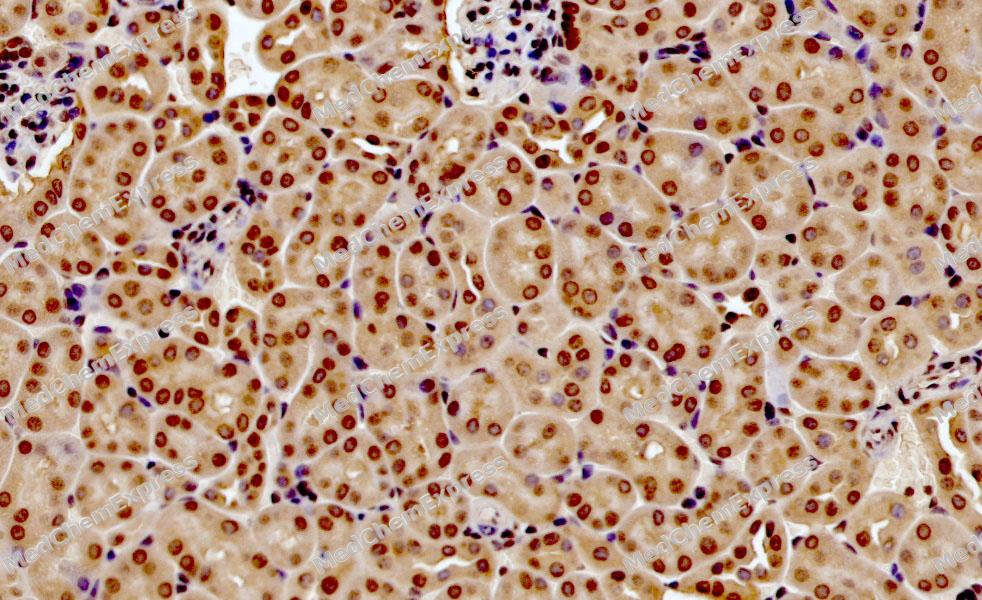 Immunohistochemical analysis of paraffin-embedded mouse kidney tissue using Phospho-ERK1/2 (Tyr204/Tyr187) Antibody. The section was pre-treated using heat mediated antigen retrieval with sodium citrate buffer (pH 6.0) for 8 minutes. The tissues were blocked in QuickBlock for 20 minutes at room temperature, washed with ddH2O and PBS, and then probed with the primary antibody at 1/100 dilution in 4℃ overnight. The detection was performed using an HRP conjugated compact polymer system. DAB was used as the chromogen. Tissues were counterstained with hematoxylin and mounted with DPX.


Background
-
Function
ERK1/2 is a P27361: Serine/threonine kinase which acts as an essential component of the MAP kinase signal transduction pathway. MAPK1/ERK2 and MAPK3/ERK1 are the 2 MAPKs which play an important role in the MAPK/ERK cascade. They participate also in a signaling cascade initiated by activated KIT and KITLG/SCF. Depending on the cellular context, the MAPK/ERK cascade mediates diverse biological functions such as cell growth, adhesion, survival and differentiation through the regulation of transcription, translation, cytoskeletal rearrangements. The MAPK/ERK cascade also plays a role in initiation and regulation of meiosis, mitosis, and postmitotic functions in differentiated cells by phosphorylating a number of transcription factors.
P28482: Serine/threonine kinase which acts as an essential component of the MAP kinase signal transduction pathway. MAPK1/ERK2 and MAPK3/ERK1 are the 2 MAPKs which play an important role in the MAPK/ERK cascade. They participate also in a signaling cascade initiated by activated KIT and KITLG/SCF. Depending on the cellular context, the MAPK/ERK cascade mediates diverse biological functions such as cell growth, adhesion, survival and differentiation through the regulation of transcription, translation, cytoskeletal rearrangements. The MAPK/ERK cascade also plays a role in initiation and regulation of meiosis, mitosis, and postmitotic functions in differentiated cells by phosphorylating a number of transcription factors.
[1]. -
Subcellular Localization
P27361: Cytoplasm; Nucleus; Membrane, caveola; Cell junction, focal adhesion
P28482: Cytoplasm, cytoskeleton, spindle; Nucleus; Cytoplasm, cytoskeleton, microtubule organizing center, centrosome; Cytoplasm; Membrane, caveola; Cell junction, focal adhesion -
Subunit
P27361: Binds both upstream activators and downstream substrates in multimolecular complexes. Found in a complex with at least BRAF, HRAS, MAP2K1/MEK1, MAPK3 and RGS14 (By similarity).
P28482: Binds both upstream activators and downstream substrates in multimolecular complexes. This interaction inhibits its tyrosine-kinase activity. -
Synonyms
MAPK1/MAPK3
-
Research Field
Cell Biology
Documentation
-
Data Sheet (261 KB)
-
SDS (251 KB)
- English - EN (251 KB)
- Français - FR (251 KB)
- Deutsch - DE (251 KB)
- Norwegian - NO (251 KB)
- Español - ES (251 KB)
- Swedish - SV (251 KB)
- Italian - IT (251 KB)
- Korean - KR (251 KB)
- Portuguese - PT (251 KB)
-
User Guide for Antibodies (1077 KB)
References

 Powered by Bioz
