



Phospho-JNK1/2/3 (Thr183) Antibody
(Synonyms: JNK 46; JNK 55; MAPK10; MAPK9; MAPK8; SAPK1b; SAPK1; SAPK; PRKM10; PRKM9; PRKM8)Based on 2 publication(s) in Google Scholar
Phospho-JNK1/2/3 (Thr183) Antibody is a Rabbit-derived and non-conjugated IgG polyclonal antibody, targeting to Phospho-JNK1/2/3 (Thr183).
-
Host:
Rabbit
-
Isotype:
IgG
-
Application:
WB, IHC-P, ICC/IF, IP, FC
-
Reactivity :
Human, Mouse, Rat
-
Formulation:
Supplied in Rabbit IgG in 10mM phosphate buffered saline , pH 7.4, 150mM sodium chloride, 0.05% BSA, 0.02% sodium azide and 50% glycerol.
-
Conjugation:
Non-conjugated


To place orders, for customer services and technical support, please contact: MedChemExpress USA
Tel: 609-228-6898 E-mail: [email protected] [email protected]



-

HY-P80728
JNK1/2/3 Antibody (YA329) -
HY-P80842
Phospho-p38 alpha/MAPK14 (Thr180/Tyr182) Antibody -
HY-P80197
JNK1+JNK2+JNK3 Antibody (YA328) -
HY-P80815
Phospho-ERK1/2 (Tyr204/Tyr187) Antibody -
HY-P80393
ERK1/2 Antibody (YA453) -
HY-P80777
p38 alpha/MAPK14 Antibody (YA252) -
HY-P80776A
Phospho-p38 alpha/MAPK14 (Thr180+Tyr182) Antibody -
HY-P80814
Phospho-ERK1/2 (Thr202/Tyr204)/(Thr185/Tyr187) Antibody
Publications Citing Use of MedChemExpress (MCE) Phospho-JNK1/2/3 (Thr183) Antibody
More

Applications
| Application |
WB

WB: Western Blot
|
IHC-P
IHC-P: Immunohistochemistry-Paraffin
|
ICC/IF
ICC/IF: Immunocytochemistry/
Immunofluorescence |
IP
IP: Immunoprecipitation
|
FC
FC: Flow Cytometry
|
|---|---|---|---|---|---|
| Dilution Ratio | 1:500-1:1000 | 1:50-1:100 | 1:50-1:200 | 1:20 | 1:50-1:100 |


Product Details
Phospho-JNK1/2/3 (Thr183) Antibody is a Rabbit-derived and non-conjugated IgG polyclonal antibody, targeting to Phospho-JNK1/2/3 (Thr183).
-
Host Rabbit

-
Clonality Polyclonal

-
Species ReactivityHuman, Mouse, Rat
-
Observed Molecular WeightObserved band size: 46/54 kDa
Note: Due to possible protein modifications or aggregation, the molecular weight should be confirmed by actual measurement, and the predicted value is for reference only.

-
Calculated Molecular Weight Predicted band size: 48 kDa

Entrez Gene: 5599 Human ; 26419 Mouse ; 116554 Rat
SwissProt: P45983 Human ; Q91Y86 Mouse ; P49185 Rat
OMIM: 601158 Human
Synthetic phosphopeptide corresponding to residues surrounding Thr183 of Human Phospho-JNK1/2/3.The exact sequence is proprietary to MCE.
Endogenous
affinity purified
Non-conjugated
Phosphorylated
IgG


Product Properties
-
Appearance
Solution
-
Formulation
Supplied in Rabbit IgG in 10mM phosphate buffered saline , pH 7.4, 150mM sodium chloride, 0.05% BSA, 0.02% sodium azide and 50% glycerol.
-
Concentration
Batch-dependent, Please check the COA for the concentration of each lot. Check Lot Concentration
-
Storage & Stability
Stored at -20°C for 1 year. Avoid repeated freeze / thaw cycles.
-
Shipping
Shipping with blue ice.


Publications (2)
-
Journal Impact Factor
-
Most Recent
-
Fitoterapia
Gastrodia elata Blume extract alleviates sepsis-induced lung injury by suppressing IL-23/IL-17 A axis. [Abstract]2025 Jul:184:106624. PMID: 40398516


Verification Images
-
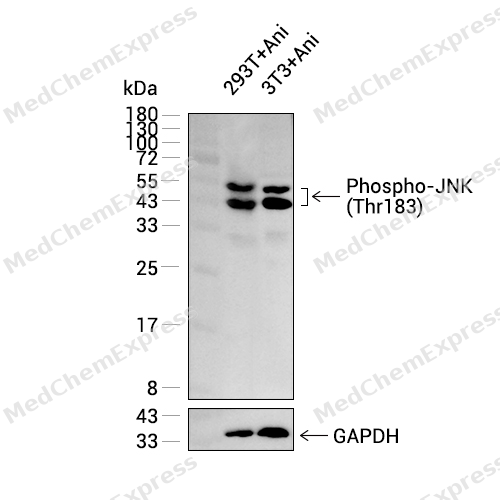 Western blot analysis was performed on extracts from 293T cell (lane 1, 20 μg) and 3T3 cell (lane 2, 20 μg) treated with 10 μg/mL Anisomycin for 30 minutes using Phospho-JNK (Thr183) Rabbit mAb.Proteins were transferred to a PVDF membrane and blocked with 5% non - fat milk in TBST at 4°C overnight.The primary antibody (1:1000 dilution) and the loading control antibody (GAPDH, HY-P2804, 1:5000 dilution) were incubated in 5% non-fat milk in TBST for 1 hour at 37°C.Goat Anti - Rabbit IgG - HRP Secondary Antibody (1:20000 dilution) was then applied for 40 minutes at 37°C.


Background
-
Function
JNK1/2/3 is a P45983: Serine/threonine-protein kinase involved in various processes such as cell proliferation, differentiation, migration, transformation and programmed cell death. Extracellular stimuli such as pro-inflammatory cytokines or physical stress stimulate the stress-activated protein kinase/c-Jun N-terminal kinase (SAP/JNK) signaling pathway. In this cascade, two dual specificity kinases MAP2K4/MKK4 and MAP2K7/MKK7 phosphorylate and activate MAPK8/JNK1. In turn, MAPK8/JNK1 phosphorylates a number of transcription factors, primarily components of AP-1 such as JUN, JDP2 and ATF2 and thus regulates AP-1 transcriptional activity. Phosphorylates the replication licensing factor CDT1, inhibiting the interaction between CDT1 and the histone H4 acetylase HBO1 to replication origins. Loss of this interaction abrogates the acetylation required for replication initiation.
P45984: Serine/threonine-protein kinase involved in various processes such as cell proliferation, differentiation, migration, transformation and programmed cell death. Extracellular stimuli such as pro-inflammatory cytokines or physical stress stimulate the stress-activated protein kinase/c-Jun N-terminal kinase (SAP/JNK) signaling pathway. In this cascade, two dual specificity kinases MAP2K4/MKK4 and MAP2K7/MKK7 phosphorylate and activate MAPK9/JNK2. In turn, MAPK9/JNK2 phosphorylates a number of transcription factors, primarily components of AP-1 such as JUN and ATF2 and thus regulates AP-1 transcriptional activity.
P53779: Serine/threonine-protein kinase involved in various processes such as neuronal proliferation, differentiation, migration and programmed cell death. Extracellular stimuli such as pro-inflammatory cytokines or physical stress stimulate the stress-activated protein kinase/c-Jun N-terminal kinase (SAP/JNK) signaling pathway. In this cascade, two dual specificity kinases MAP2K4/MKK4 and MAP2K7/MKK7 phosphorylate and activate MAPK10/JNK3. In turn, MAPK10/JNK3 phosphorylates a number of transcription factors, primarily components of AP-1 such as JUN and ATF2 and thus regulates AP-1 transcriptional activity. Plays regulatory roles in the signaling pathways during neuronal apoptosis. Phosphorylates the neuronal microtubule regulator STMN2. Acts in the regulation of the amyloid-beta precursor protein/APP signaling during neuronal differentiation by phosphorylating APP. Also participates in neurite growth in spiral ganglion neurons. Phosphorylates the CLOCK-BMAL1 heterodimer and plays a role in the photic regulation of the circadian clock.
[1][2][3][4][5][6][7][8][9][10][11]. -
Subcellular Localization
P45983: Cytoplasm; Nucleus; Synapse
P45984: Cytoplasm; Nucleus
P53779: Cytoplasm; Membrane; Lipid-anchor; Nucleus; Mitochondrion -
Expression
Tissue_specificity: P53779: Specific to a subset of neurons in the nervous system. Present in the hippocampus and areas, cerebellum, striatum, brain stem, and weakly in the spinal cord. Very weak expression in testis and kidney -
Subunit
P45983: Forms a complex with MAPK8IP1 and ARHGEF28 (By similarity). Found in a complex with SH3RF1, RAC1, MAP3K11/MLK3, MAP2K7/MKK7 and MAPK8IP1/JIP1.
P45984: Interacts with NFATC4 (PubMed:17875713). Interacts with ATF7; the interaction does not phosphorylate ATF7 but acts as a docking site for ATF7-associated partners such as JUN (PubMed:10376527). Interacts with BCL10 (PubMed:17189706).
P53779: Interacts with MAPKBP1 (By similarity). Interacts with MAPK8IP1/JIP-1 and MAPK8IP3/JIP-3/JSAP1 (By similarity). Interacts with SPAG9/MAPK8IP4/JIP4 (PubMed:15693750). Interacts with HDAC9 (PubMed:16611996). -
Synonyms
JNK 46; JNK 55; MAPK10; MAPK9; MAPK8; SAPK1b; SAPK1; SAPK; PRKM10; PRKM9; PRKM8
-
Research Field
Signal Transduction
Documentation
-
Data Sheet (264 KB)
-
SDS (251 KB)
- English - EN (251 KB)
- Français - FR (251 KB)
- Deutsch - DE (251 KB)
- Norwegian - NO (251 KB)
- Español - ES (251 KB)
- Swedish - SV (251 KB)
- Italian - IT (251 KB)
- Korean - KR (251 KB)
- Portuguese - PT (251 KB)
-
User Guide for Antibodies (1077 KB)
References
[1]. Song N, et al. NLRP3 Phosphorylation Is an Essential Priming Event for Inflammasome Activation. Mol Cell. 2017 Oct 5;68(1):185-197.e6. [Content Brief]
[2]. Murata T, et al. Phosphorylation of two eukaryotic transcription factors, Jun dimerization protein 2 and activation transcription factor 2, in Escherichia coli by Jun N-terminal kinase 1. Anal Biochem. 2008 May 1;376(1):115-21. [Content Brief]
[3]. Miotto B, et al. JNK1 phosphorylation of Cdt1 inhibits recruitment of HBO1 histone acetylase and blocks replication licensing in response to stress. Mol Cell. 2011 Oct 7;44(1):62-71. [Content Brief]
[4]. De Graeve F, et al. Role of the ATFa/JNK2 complex in Jun activation. Oncogene. 1999 Jun 10;18(23):3491-500. [Content Brief]
[5]. Mayer C, et al. The nucleolus as a stress sensor: JNK2 inactivates the transcription factor TIF-IA and down-regulates rRNA synthesis. Genes Dev. 2005 Apr 15;19(8):933-41. [Content Brief]
[6]. Oleinik NV, et al. Cooperation between JNK1 and JNK2 in activation of p53 apoptotic pathway. Oncogene. 2007 Nov 8;26(51):7222-30. [Content Brief]
[7]. Hu D, et al. GSK3beta is involved in JNK2-mediated beta-catenin inhibition. PLoS One. 2009 Aug 13;4(8):e6640. [Content Brief]
[8]. Samak G, et al. c-Jun NH2-terminal kinase-2 mediates osmotic stress-induced tight junction disruption in the intestinal epithelium. Am J Physiol Gastrointest Liver Physiol. 2010 Sep;299(3):G572-84. [Content Brief]
[9]. Tomlinson V, et al. JNK phosphorylates Yes-associated protein (YAP) to regulate apoptosis. Cell Death Dis. 2010;1(2):e29. [Content Brief]
[10]. Yoshitane H, et al. JNK regulates the photic response of the mammalian circadian clock. EMBO Rep. 2012 May 1;13(5):455-61. [Content Brief]
[11]. Yu F, et al. Post-translational modification of RNA m6A demethylase ALKBH5 regulates ROS-induced DNA damage response. Nucleic Acids Res. 2021 Jun 4;49(10):5779-5797. [Content Brief]

 Powered by Bioz
