



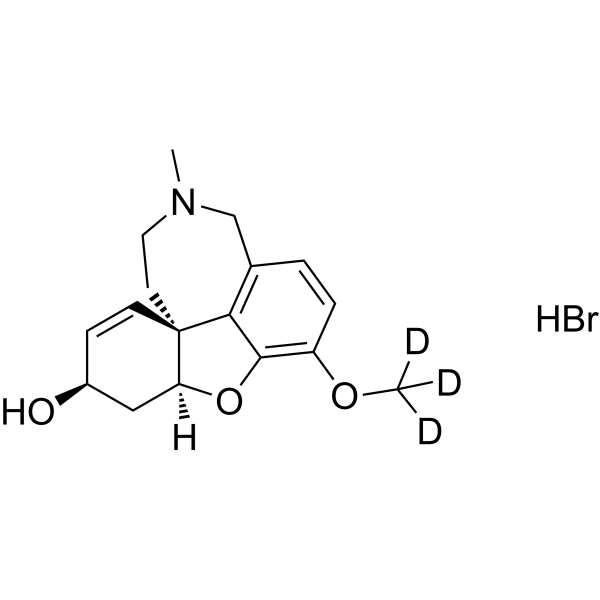
Galanthamine-d3 hydrobromide
Galanthamine-d3 (hydrobromide) is deuterium labeled Galanthamine (hydrobromide). Galanthamine hydrobromide (Galantamine hydrobromide) is a selective, reversible, competitive, alkaloid AChE inhibitor, with an IC50 of 0.35 μM. Galanthamine hydrobromide is a potent allosteric potentiating ligand (APL) of human α3β4, α4β2, α6β4 nicotinic receptors ( nAChRs). Galanthamine hydrobromide is developed for the research of Alzheimer's disease (AD).
For research use only. We do not sell to patients.
- Formula: C17H19D3BrNO3
- Molecular Weight:371.28
-
Storage:
Please store the product under the recommended conditions in the Certificate of Analysis.

To place orders, for customer services and technical support, please contact: MedChemExpress USA
Tel: 609-228-6898 E-mail: [email protected] [email protected]


-
 Biological Activity
-
Chemical Information
- Protocols
- Purity & Documentation
- References
-
 Help & FAQs




Biological Activity
Description
In Vitro
Stable heavy isotopes of hydrogen, carbon, and other elements have been incorporated into drug molecules, largely as tracers for quantitation during the drug development process. Deuteration has gained attention because of its potential to affect the pharmacokinetic and metabolic profiles of drugs[1].
MedChemExpress (MCE) has not independently confirmed the accuracy of these methods. They are for reference only.
Application
1. This compound can be used as a tracer
2. This compound can be used as an internal standard for quantitative analysis by NMR, GC-MS, or LC-MS.


Chemical Information
-
Unlabeled CAS 1953-04-4
-
Molecular Weight 371.28
-
Formula C17H19D3BrNO3
-
SMILES
O[C@@H](C=C1)C[C@@](O2)([H])[C@@]31C(C2=C4OC([2H])([2H])[2H])=C(C=C4)CN(C)CC3.Br
-
Synonyms
Galantamine-d3 hydrobromide
-
Shipping
Room temperature in continental US; may vary elsewhere.
-
Storage
Please store the product under the recommended conditions in the Certificate of Analysis.


Purity & Documentation
References
[1]. Russak EM, et al. Impact of Deuterium Substitution on the Pharmacokinetics of Pharmaceuticals. Ann Pharmacother. 2019;53(2):211-216. [Content Brief]
[2]. L J Scott, et al. Galantamine: a review of its use in Alzheimer's disease. Drugs. 2000 Nov;60(5):1095-122. [Content Brief]
[3]. Marek Samochocki, et al. Galantamine is an allosterically potentiating ligand of neuronal nicotinic but not of muscarinic acetylcholine receptors. Pharmacol Exp Ther. 2003 Jun;305(3):1024-36. [Content Brief]
[4]. Acharya Balkrishna, et al. Anti-Acetylcholinesterase Activities of Mono-Herbal Extracts and Exhibited Synergistic Effects of the Phytoconstituents: A Biochemical and Computational Study. Molecules. 2019 Nov; 24(22): 4175. [Content Brief]
[5]. Balpreet Matharu, et al. Galantamine inhibits beta-amyloid aggregation and cytotoxicity. J Neurol Sci. 2009 May 15;280(1-2):49-58. [Content Brief]
[6]. Debby Van Dam, et al. Symptomatic effect of donepezil, rivastigmine, galantamine and memantine on cognitive deficits in the APP23 model. Psychopharmacology (Berl). 2005 Jun;180(1):177-90. [Content Brief]
[7]. Johan Monbaliu, et al. Pharmacokinetics of galantamine, a cholinesterase inhibitor, in several animal species. Arzneimittelforschung. 2003;53(7):486-95. [Content Brief]

Calculators
Concentration (start) × Volume (start) = Concentration (final) × Volume (final)


Galanthamine-d3 hydrobromide Related Classifications
HY-A0009S Related Classifications
 Powered by Bioz