



Napropamide

Based on 1 Customer Validation
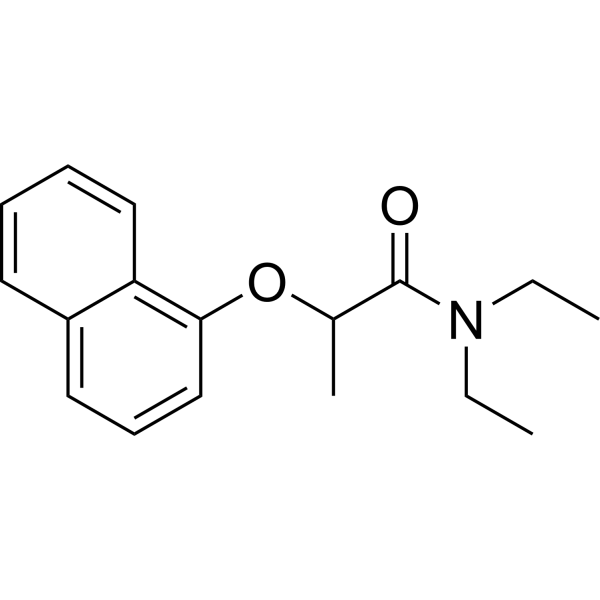
Napropamide (Napropamid) is an amide herbicide that can be used to control weeds in fruits, vegetables, tobacco, and ornamental plants. Napropamide mainly exerts its effect by inhibiting DNA synthesis and cell division. Napropamide has moderate to high persistence in the field, with a half-life of 24-131 days, and is prone to photodegradation.
Para uso exclusivo en investigación. No vendemos a pacientes.
- Pureza : 99.63%
- No. CAS: 15299-99-7
- Fòrmula: C17H21NO2
- Peso molecular:271.35
-
Almacenamiento:Powder -20°C, 3 years , 4°C, 2 years ; In solvent -80°C, 2 years , -20°C, 1 year

To place orders, for customer services and technical support, please contact: MedChemExpress USA
Tel: 609-228-6898 E-mail: [email protected] [email protected]


-
 Actividad biológica
-
Chemical Information
-
Solvente y solubilidad
- Protocolo
- Pureza y Documentación
- Referencias
-
 Help & FAQs


Ver todos los productos específicos de isoformas DNA/RNA Synthesis
More

Actividad biológica
Descripciòn
In Vivo
MedChemExpress (MCE) has not independently confirmed the accuracy of these methods. They are for reference only.


Chemical Information
-
No. CAS 15299-99-7
-
Appearance Solid
-
Peso molecular 271.35
-
Fòrmula C17H21NO2
-
Color Light brown to brown
-
SMILES
CC(OC1=C2C=CC=CC2=CC=C1)C(N(CC)CC)=O
-
Synonyms
Napropamid
-
Envío
Room temperature in continental US; may vary elsewhere.
-
Almacenamiento
Powder -20°C 3 years 4°C 2 years In solvent -80°C 2 years -20°C 1 year


Solvente y solubilidad
In Vitro:
DMSO : ≥ 42 mg/mL (154.78 mM; Hygroscopic DMSO has a significant impact on the solubility of product, please use newly opened DMSO)
* "≥" means soluble, but saturation unknown.
Please refer to the solubility information to select the appropriate solvent. Once prepared, please aliquot and store the solution to prevent product inactivation from repeated freeze-thaw cycles.
Storage method and period of stock solution: -80°C, 2 years; -20°C, 1 year. When stored at -80°C, please use it within 2 years. When stored at -20°C, please use it within 1 year.
Please refer to the solubility information to select the appropriate solvent. Once prepared, please aliquot and store the solution to prevent product inactivation from repeated freeze-thaw cycles.
Storage method and period of stock solution: -80°C, 2 years; -20°C, 1 year. When stored at -80°C, please use it within 2 years. When stored at -20°C, please use it within 1 year.
Concentration (start) × Volume (start) = Concentration (final) × Volume (final)


Pureza y Documentación
-
Ficha de datos (271 KB)
-
SDS (537 KB)
- English - EN (537 KB)
- Français - FR (537 KB)
- Deutsch - DE (537 KB)
- Norwegian - NO (537 KB)
- Español - ES (537 KB)
- Swedish - SV (537 KB)
- Italian - IT (537 KB)
- Korean - KR (537 KB)
- Portuguese - PT (537 KB)
-
Instrucciones de manejo (2659 KB)
Referencias


Complete Stock Solution Preparation Table
Please refer to the solubility information to select the appropriate solvent. Once prepared, please aliquot and store the solution to prevent product inactivation from repeated freeze-thaw cycles.
Storage method and period of stock solution: -80°C, 2 years; -20°C, 1 year. When stored at -80°C, please use it within 2 years. When stored at -20°C, please use it within 1 year.
| Optional Solvent | Concentration Solvent Mass | 1 mg | 5 mg | 10 mg | 25 mg |
|---|---|---|---|---|---|
| DMSO | 1 mM | 3.6853 mL | 18.4264 mL | 36.8528 mL | 92.1319 mL |
| 5 mM | 0.7371 mL | 3.6853 mL | 7.3706 mL | 18.4264 mL | |
| 10 mM | 0.3685 mL | 1.8426 mL | 3.6853 mL | 9.2132 mL | |
| 15 mM | 0.2457 mL | 1.2284 mL | 2.4569 mL | 6.1421 mL | |
| 20 mM | 0.1843 mL | 0.9213 mL | 1.8426 mL | 4.6066 mL | |
| 25 mM | 0.1474 mL | 0.7371 mL | 1.4741 mL | 3.6853 mL | |
| 30 mM | 0.1228 mL | 0.6142 mL | 1.2284 mL | 3.0711 mL | |
| 40 mM | 0.0921 mL | 0.4607 mL | 0.9213 mL | 2.3033 mL | |
| 50 mM | 0.0737 mL | 0.3685 mL | 0.7371 mL | 1.8426 mL | |
| 60 mM | 0.0614 mL | 0.3071 mL | 0.6142 mL | 1.5355 mL | |
| 80 mM | 0.0461 mL | 0.2303 mL | 0.4607 mL | 1.1516 mL | |
| 100 mM | 0.0369 mL | 0.1843 mL | 0.3685 mL | 0.9213 mL |


Napropamide Related Classifications
HY-B1972 Related Classifications
 Powered by Bioz