



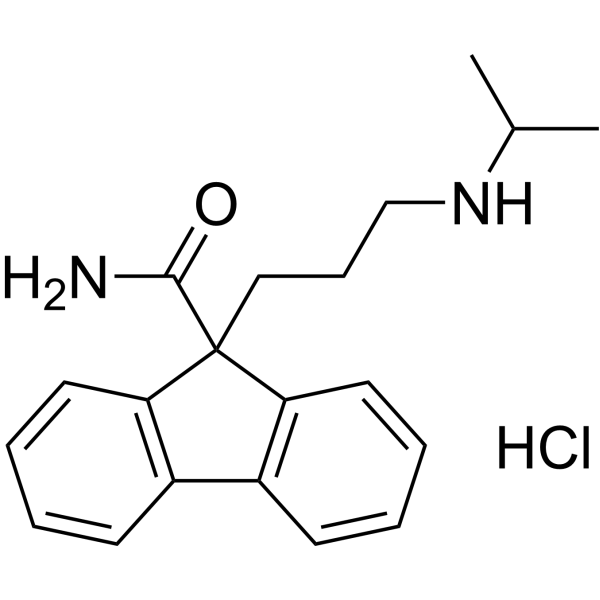
Indecainide hydrochloride
Indecainide hydrochloride is a potent and orally active class I local anesthetic antiarrhythmic agent. Indecainide hydrochloride has Na+-channel-blocking activity.
Para uso exclusivo en investigación. No vendemos a pacientes.
- No. CAS: 73681-12-6
- Fòrmula: C20H25ClN2O
- Peso molecular:344.88
-
Almacenamiento:
Please store the product under the recommended conditions in the Certificate of Analysis.

To place orders, for customer services and technical support, please contact: MedChemExpress USA
Tel: 609-228-6898 E-mail: [email protected] [email protected]


-
 Actividad biológica
-
Chemical Information
- Pureza y Documentación
- Referencias
-
 Help & FAQs




Actividad biológica
Descripciòn
In Vivo
Indecainide hydrochloride (0, 1.5, 3, or 4.5 mg/kg; IV, daily for 1 month) causes 2 of 4 dogs die at 4.5 mg/kg; exhibits no overt signs of toxicity and no hematologic, serum chemistry or histologic changes at 1.5 or 3 mg/kg[2].
MedChemExpress (MCE) has not independently confirmed the accuracy of these methods. They are for reference only.


Chemical Information
-
No. CAS 73681-12-6
-
Peso molecular 344.88
-
Fòrmula C20H25ClN2O
-
SMILES
O=C(C1(CCCNC(C)C)C2=C(C3=C1C=CC=C3)C=CC=C2)N.Cl
-
Synonyms
Ricainide hydrochloride; LY 135837
-
Envío
Room temperature in continental US; may vary elsewhere.
-
Almacenamiento
Please store the product under the recommended conditions in the Certificate of Analysis.


Pureza y Documentación
Referencias
[1]. Steinberg MI, et al. Electrophysiological studies of indecainide hydrochloride, a new antiarrhythmic agent, in canine cardiac tissues. J Cardiovasc Pharmacol. 1984 Jul-Aug;6(4):614-21. [Content Brief]
[2]. Sandusky GE Jr, et al. Toxicology of indecainide hydrochloride after intravenous administration to rats and dogs. Toxicol Lett. 1985 Aug;26(2-3):107-10. [Content Brief]
[3]. D R Holland, et al. Indecainide: effects on arrhythmias, electrophysiology, and cardiovascular dynamics. J Cardiovasc Pharmacol. 1989 Sep;14(3):454-61. [Content Brief]

Calculators
Concentration (start) × Volume (start) = Concentration (final) × Volume (final)


Indecainide hydrochloride Related Classifications
HY-16259 Related Classifications
 Powered by Bioz