



Schisanhenol

Based on 1 Customer Validation
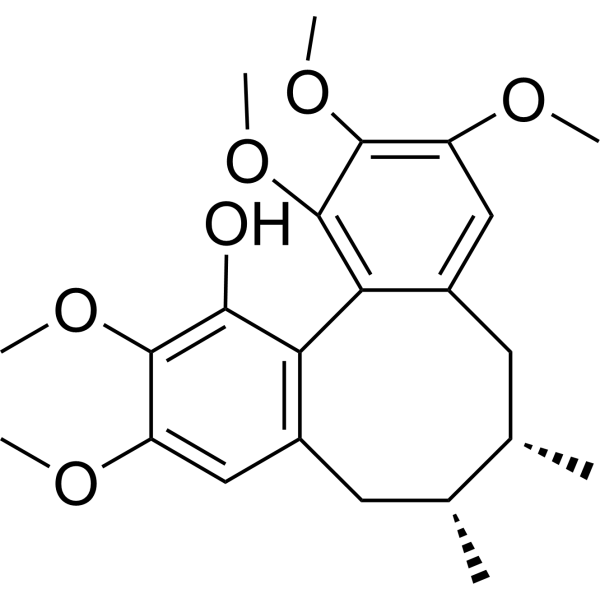
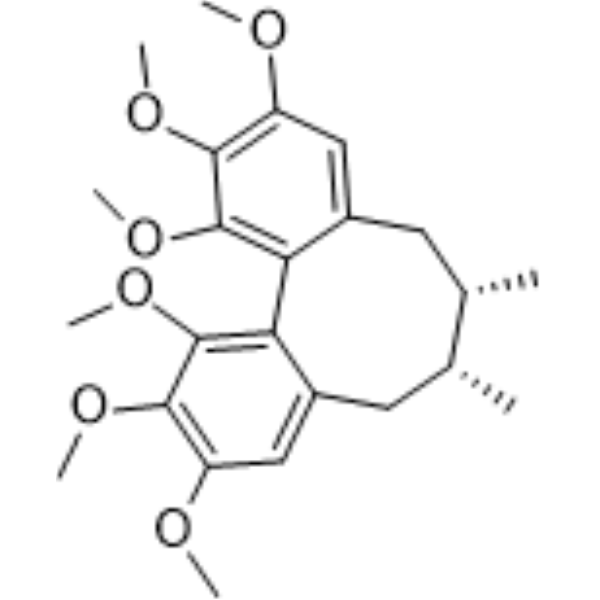
Schisanhenol (Schizanhenol), a lignan, is an orally active antioxidant. Schisanhenol reduces AChE activity, increases SIRT1 and PGC-1α expression, and decreases phosphorylated Tau (Ser 396) levels. Schisanhenol increases SOD and glutathione peroxidase activity, decreases malondialdehyde (MDA) content, and inhibits UGT2B7 activitY. Schisanhenol attenuates ox-LDL-induced apoptosis, intracellular reactive oxygen species generation, and cytotoxicity in endothelial cells. Schisanhenol inhibits LDL oxidation, brain mitochondrial and membrane peroxidative damage, and brain mitochondrial swelling and disintegration. Schisanhenol can be used for the research of Alzheimer’s disease, atherosclerosis, brain ischemia, and age-related brain deterioration.
商品は「研究用試薬」です。人や動物の医療用・臨床診断用・食品用の製品ではありません。
研究用途以外に使用した場合、当社は一切の責任を負いかねます。
- 純度: 99.99%
- CAS 番号: 69363-14-0
- 分子式: C23H30O6
- 分子量:402.48
-
保管条件:Powder -20°C, 3 years , 4°C, 2 years ; In solvent -80°C, 2 years , -20°C, 1 year

To place orders, for customer services and technical support, please contact: MedChemExpress USA
Tel: 609-228-6898 E-mail: [email protected] [email protected]


-
 生物活性
生物活性
-
化学情報
-
溶剤 & 溶解度
- 純度とドキュメンテーション
- 参考文献
-
 Help & FAQs





生物活性
|
AChE |
SIRT1 |
|
Cell Line

|
Type | Value | Description | References |
|---|---|---|---|---|
| H9 | EC50 |
5.7 μM
Compound: 6
|
Antiviral activity against HIV1 3B in H9 cells after 4 days by p24-antigen ELISA
Antiviral activity against HIV1 3B in H9 cells after 4 days by p24-antigen ELISA
|
[PMID: 17190445] |
| H9 | IC50 |
42 μM
Compound: 6
|
Cytotoxicity against human H9 cells after 4 days
Cytotoxicity against human H9 cells after 4 days
|
[PMID: 17190445] |
Schisanhenol attenuates ox-LDL-induced apoptosis and reactive oxygen species generation in cultured bovine aorta endothelial cells[1].
Schisanhenol scavenges oxygen radicals in cultured human neutrophils[1].
Schisanhenol protects cultured mouse spleen lymphocytes, isolated rat cerebral mitochondria and synaptosomes from oxygen free radical-induced injury[1].
Schisanhenol (10-50 μM; 1 h pre-incubation, then 24 h co-incubation with ox-LDL) protects bovine aorta endothelial cells against ox-LDL-induced cytotoxicity in a dose-dependent manner, with 50 μM producing the strongest effect by preserving cell morphology, increasing cell viability, and reducing LDH leakage[3].
Schisanhenol (10-50 μM; 24 h co-incubation with ox-LDL) inhibits ox-LDL-induced apoptosis in bovine aorta endothelial cells in a dose-dependent manner, with 10 μM producing a stronger reduction in sub-G1 apoptotic cells[3].
Schisanhenol (10-50 μM; 30 min pre-incubation with DCFH-DA, then 15 min stimulation with ox-LDL) inhibits ox-LDL-induced intracellular reactive oxygen species generation in bovine aorta endothelial cells, with 10 μM returning ROS levels to normal control values[3].
Schisanhenol (1-100 μM; 30 min) inhibits Fe2+-cysteine-induced lipid peroxidation and ATPase activity loss in 8-month-old rat brain membrane fractions in vitro in a dose-dependent manner[4].
MedChemExpress (MCE) has not independently confirmed the accuracy of these methods. They are for reference only.
-
Cell Line:Bovine aorta endothelial cells (BAECs)
-
Concentration:5-50 μM
-
Incubation Time:1 h pre-incubation, then 24 h co-incubation with ox-LDL
-
Result:Increased cell survival.
Reduced LDH leakage.
Preserved normal BAEC morphology.
Did not significantly increase cell viability or reduce LDH leakage at 5 μM.
-
Cell Line:Bovine aorta endothelial cells (BAECs)
-
Concentration:10 μM, 50 μM
-
Incubation Time:24 h co-incubation with ox-LDL
-
Result:Reduced ox-LDL-induced chromatin condensation at 10 and 50 μM.
Diminished the intensity of typical internucleosomal DNA laddering at 10 and 50 μM.
Decreased the percentage of apoptotic cells in the sub-G1 phase to 33.9% at 50 μM.
Decreased the percentage of apoptotic cells in the sub-G1 phase to 23.8% at 10 μM.
Schisanhenol (150 mg/kg; p.o.) significantly increases brain cytosol glutathione-peroxidase activity in mice subjected to brain ischemia-reperfusion, with a measured activity of 0.898 nmol/mg/5 min[4].
MedChemExpress (MCE) has not independently confirmed the accuracy of these methods. They are for reference only.
-
Animal Model:Kunming mice (male, 20-30 g) injected with Scopolamine[1]
-
Dosage:10 mg/kg; 30 mg/kg; 100 mg/kg
-
Administration:i.p.; daily; 7 days
-
Result:Significantly reduced escape latency in the Morris water maze.
Significantly increased time spent in the target quadrant during the probe test.
Significantly reduced acetylcholinesterase (AChE) and malondialdehyde (MDA) activity in hippocampal tissue.
Significantly increased superoxide dismutase (SOD) and glutathione peroxidase (GSH-px) activity in hippocampal tissue.
Significantly increased SIRT1 and PGC-1α protein levels in hippocampal tissue.
Significantly reduced phosphorylated Tau (Ser396) protein levels in hippocampal tissue.


化学情報
-
CAS 番号 69363-14-0
-
性状 Solid
-
分子量 402.48
-
分子式 C23H30O6
-
Color White to off-white
-
SMILES
COC(C(OC)=C(OC)C=C1C[C@H](C)[C@H](C)C2)=C1C3=C2C=C(OC)C(OC)=C3O
-
別名
Schizanhenol; Gomisin-K3
-
Structure Classification
-
Initial Source
-
輸送条件
Room temperature in continental US; may vary elsewhere.
-
保管条件
Powder -20°C 3 years 4°C 2 years In solvent -80°C 2 years -20°C 1 year


溶剤 & 溶解度
DMSO : 250 mg/mL (621.15 mM; Need ultrasonic; Hygroscopic DMSO has a significant impact on the solubility of product, please use newly opened DMSO)
Please refer to the solubility information to select the appropriate solvent. Once prepared, please aliquot and store the solution to prevent product inactivation from repeated freeze-thaw cycles.
Storage method and period of stock solution: -80°C, 2 years; -20°C, 1 year. When stored at -80°C, please use it within 2 years. When stored at -20°C, please use it within 1 year.
Please refer to the solubility information to select the appropriate solvent. Once prepared, please aliquot and store the solution to prevent product inactivation from repeated freeze-thaw cycles.
Storage method and period of stock solution: -80°C, 2 years; -20°C, 1 year. When stored at -80°C, please use it within 2 years. When stored at -20°C, please use it within 1 year.
濃度 (開始) × 体積 (開始) = 濃度 (終了) × 体積 (終了)
Select the appropriate dissolution method based on your experimental animal and administration route.
- For the following dissolution methods, please ensure to first prepare a clear stock solution using an In Vitro approach and then sequentially add co-solvents:
- To ensure reliable experimental results, the clarified stock solution can be appropriately stored based on storage conditions. As for the working solution for In Vivo experiments, it is recommended to prepare freshly and use it on the same day.
- The percentages shown for the solvents indicate their volumetric ratio in the final prepared solution. If precipitation or phase separation occurs during preparation, heat and/or sonication can be used to aid dissolution.
Add each solvent one by one: 10% DMSO 40% PEG300 5% Tween-80 45% Saline
Solubility: ≥ 6.25 mg/mL (15.53 mM); Clear solution
This protocol yields a clear solution of ≥ 6.25 mg/mL (saturation unknown).
Taking 1 mL working solution as an example, add 100 μL DMSO stock solution (62.5 mg/mL) to 400 μL PEG300, and mix evenly; then add 50 μL Tween-80 and mix evenly; then add 450 μL Saline to adjust the volume to 1 mL.
Preparation of Saline: Dissolve 0.9 g sodium chloride in ddH₂O and dilute to 100 mL to obtain a clear Saline solution.
Please enter the basic information of animal experiments:
-
-
-
-
Recommended: Prepare an additional quantity of animals to account for potential losses during experiments.
Please enter your animal formula composition:
-
%DMSO +
Recommended: Keep the proportion of DMSO in working solution below 2% if your animal is weak.
-
%+
-
+%Tween-80 + +
-
%Saline +
The co-solvents required include: DMSO, . All of co-solvents are available by MedChemExpress (MCE). , Tween 80. All of co-solvents are available by MedChemExpress (MCE).
Working solution concentration: 0.22 mg/mL
Method for preparing stock solution: mg drug dissolved in μL DMSO. Stock solution concentration: mg/mL.
1. Take μL DMSO stock solution;
2. Add μL .
μL , mix evenly;
3. Then add μL Tween 80, mix evenly;
4. Then add μL
Please ensure that the stock solution in the first step is dissolved to a clear state, and add co-solvents in sequence. You can use ultrasonic heating (ultrasonic cleaner, recommended frequency 20-40 kHz), vortexing, etc. to assist dissolution.


純度とドキュメンテーション
-
データシート (287 KB)
-
SDS (254 KB)
- English - EN (254 KB)
- Français - FR (254 KB)
- Deutsch - DE (254 KB)
- Norwegian - NO (254 KB)
- Español - ES (254 KB)
- Swedish - SV (254 KB)
- Italian - IT (254 KB)
- Korean - KR (254 KB)
- Portuguese - PT (254 KB)
-
取扱説明書 (2659 KB)
参考文献
[1]. Han Y, et al. Schisanhenol improves learning and memory in scopolamine-treated mice by reducing acetylcholinesterase activity and attenuating oxidative damage through SIRT1-PGC-1α-Tau signaling pathway. Int J Neurosci. 2019;129(2):110-118. [Content Brief]
[2]. Song JH, et al. Inhibition of UDP-Glucuronosyltransferases (UGTs) Activity by constituents of Schisandra chinensis. Phytother Res. 2015;29(10):1658-1664. [Content Brief]
[3]. Yu LH, et al. Schisanhenol attenuated ox-LDL-induced apoptosis and reactive oxygen species generation in bovine aorta endothelial cells in vitro. J Asian Nat Prod Res. 2008;10(7-8):799-806. [Content Brief]
[4]. Xue JY, et al. Antioxidant activity of two dibenzocyclooctene lignans on the aged and ischemic brain in rats. Free Radic Biol Med. 1992;12(2):127-135. [Content Brief]


Complete Stock Solution Preparation Table
Please refer to the solubility information to select the appropriate solvent. Once prepared, please aliquot and store the solution to prevent product inactivation from repeated freeze-thaw cycles.
Storage method and period of stock solution: -80°C, 2 years; -20°C, 1 year. When stored at -80°C, please use it within 2 years. When stored at -20°C, please use it within 1 year.
| Optional Solvent | Concentration Solvent Mass | 1 mg | 5 mg | 10 mg | 25 mg |
|---|---|---|---|---|---|
| DMSO | 1 mM | 2.4846 mL | 12.4230 mL | 24.8460 mL | 62.1149 mL |
| 5 mM | 0.4969 mL | 2.4846 mL | 4.9692 mL | 12.4230 mL | |
| 10 mM | 0.2485 mL | 1.2423 mL | 2.4846 mL | 6.2115 mL | |
| 15 mM | 0.1656 mL | 0.8282 mL | 1.6564 mL | 4.1410 mL | |
| 20 mM | 0.1242 mL | 0.6211 mL | 1.2423 mL | 3.1057 mL | |
| 25 mM | 0.0994 mL | 0.4969 mL | 0.9938 mL | 2.4846 mL | |
| 30 mM | 0.0828 mL | 0.4141 mL | 0.8282 mL | 2.0705 mL | |
| 40 mM | 0.0621 mL | 0.3106 mL | 0.6211 mL | 1.5529 mL | |
| 50 mM | 0.0497 mL | 0.2485 mL | 0.4969 mL | 1.2423 mL | |
| 60 mM | 0.0414 mL | 0.2070 mL | 0.4141 mL | 1.0352 mL | |
| 80 mM | 0.0311 mL | 0.1553 mL | 0.3106 mL | 0.7764 mL | |
| 100 mM | 0.0248 mL | 0.1242 mL | 0.2485 mL | 0.6211 mL |


Schisanhenol 関連分類
HY-N0859 関連分類
 Powered by Bioz
- Schisanhenol
- 69363-14-0
- Schizanhenol
- Gomisin-K3
- UGT
- Cholinesterase (ChE)
- Tau Protein
- SOD
- Sirtuin
- UDP-glucuronosyltransferase 2B7
- superoxide dismutase
- endothelial cells
- phosphorylated Tau (Ser 396)
- SIRT1
- acetylcholinesterase
- PGC-1α
- bovine aorta endothelial cells
- Alzheimer’s disease
- glutathione peroxidase
- Inhibitor
- inhibitor
- inhibit